


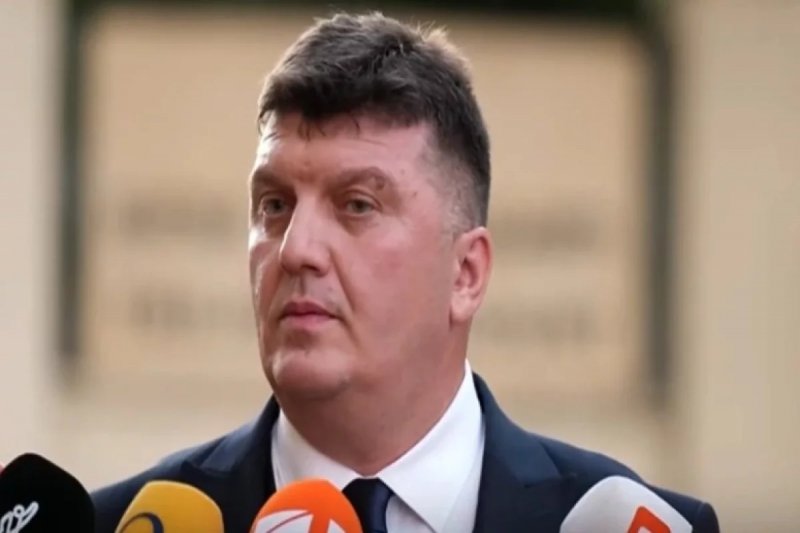
Tbilisi, Georgia – Dito Chubinidze, a journalist with the independent newspaper Asaval-Dasavali, has been detained in the Georgian capital on charges of treason and sabotage, the country’s Prosecutor General’s Office announced at an emergency briefing on Monday. The announcement marks a dramatic escalation in the government’s crackdown on media outlets it accuses of undermining national security, with Chubinidze becoming the first journalist in recent memory to face the country’s most serious criminal charges. According to the Prosecutor General’s Office, relayed by APA’s local bureau, Chubinidze is accused of engaging in a systematic campaign of disinformation since February 2026. The office alleges that he deliberately fabricated and disseminated false claims through various media outlets and social media platforms, asserting that Georgian Prime Minister Irakli Kobakhidze had secretly agreed to cede a portion of the David Gareji monastery complex to neighboring Azerbaijan. The prosecutor’s office said it will apply to the court within the legally prescribed timeframe to request pre-trial detention for Chubinidze, indicating that authorities consider him a flight risk or a continued threat to state security if released.
The specific allegations against Chubinidze center on a series of reports and social media posts that allegedly claimed the prime minister conspired to hand over parts of the ancient David Gareji monastery complex, known in Azerbaijani as Keshikchidagh, to Baku. The Prosecutor General’s Office stated that these claims were based on fabricated evidence and bore no resemblance to official government positions. In their briefing, prosecutors asserted that Chubinidze’s reporting was not an act of journalism but a coordinated operation aimed at destabilizing Georgia’s internal situation and damaging its relations with Azerbaijan. The charges of treason, which carry a prison sentence of up to 20 years, and sabotage, which can result in even stricter penalties, suggest that authorities view the alleged disinformation as a direct attack on Georgia’s territorial integrity and sovereignty. The disclosure of the charges comes after weeks of mounting tension between the government and critical journalists, and Chubinidze’s detention has immediately raised concerns about press freedom in the South Caucasus nation.
At the heart of the case is the long-standing border dispute between Georgia and Azerbaijan over the 13th-century David Gareji monastery complex. The site, a UNESCO tentative World Heritage listing, spans a rugged, mountainous region along the international border, and includes centuries-old cave monasteries and frescoes of deep cultural significance to Georgians. For decades, the two countries have negotiated the demarcation of the border, with the complex often acting as a sticking point due to its strategic and spiritual importance. In recent years, reports have circulated that a bilateral commission had been working on a compromise that might involve a land swap or shared access, but no official agreement has been publicly ratified. Chubinidze’s alleged fabrication appears to have exploited these ongoing rumors, suggesting that the prime minister had conceded Georgian territory without parliamentary approval or public consultation. Such a claim, if believed, could spark massive public protests and undermine the government’s legitimacy at a time when it already faces significant domestic opposition over its foreign policy orientation.
Asaval-Dasavali, where Chubinidze serves as a reporter, is known for its tough investigative journalism and critical stance toward the current ruling party, Georgian Dream. The newspaper has frequently covered government corruption, alleged electoral fraud, and human rights abuses, and its journalists have previously faced harassment and legal challenges. Chubinidze himself is a veteran correspondent known for his coverage of rural communities along the Georgian-Azerbaijani border, making him an especially credible voice to many readers. The Prosecutor General’s Office did not provide specific examples of his alleged fabricated claims, nor did it name any particular social media posts or articles that crossed the line from opinion into sabotage. This lack of specificity has led many media watchdogs to suspect that the charges are politically motivated, intended to silence a critical voice ahead of upcoming parliamentary elections. Press freedom organizations, including the Georgian Charter of Journalistic Ethics and the International Press Institute, have demanded the immediate release of Chubinidze, arguing that the allegations are based on protected speech and that treason laws are being weaponized against legitimate reporting.
Under Georgian law, treason is defined as providing aid to a foreign state, organization, or representative to the detriment of Georgia’s sovereignty, territorial integrity, or security. Sabotage is similarly broad, encompassing actions aimed at weakening the state’s economic or military power. Applying these statutes to a journalist’s reporting activity is highly unusual and raises serious questions about the interpretation of these laws in practice. The Prosecutor General’s Office has indicated that its investigation found evidence that Chubinidze’s false reports were coordinated with foreign actors, although no such evidence has been disclosed. The court is now expected to rule on the pre-trial detention request within 72 hours, as prescribed by Georgian procedural rules. If the court grants the motion, Chubinidze could remain in custody for several months while the investigation continues, during which time the newspaper’s ability to report on the case will be severely limited. Legal experts note that even if Chubinidze were eventually acquitted, the time spent in detention, combined with the chilling effect on other journalists, would serve the government’s goal of suppressing dissenting voices.
International reactions have been swift and condemnatory. The European Union’s foreign affairs service issued a statement expressing deep concern over the detention, calling it a clear violation of media freedom principles that are central to Georgia’s EU candidate status. The U.S. State Department similarly urged Georgian authorities to uphold democratic standards and release the journalist, while reaffirming the importance of a free press in any society. Meanwhile, Azerbaijani officials maintained a public silence on the case, likely to avoid being drawn into a domestic Georgian political dispute. However, the incident is likely to complicate the fragile negotiations over the David Gareji border, as any public discourse on the issue is now heavily politicized and potentially dangerous for journalists. For Georgia, the arrest of Chubinidze may represent a turning point in its relationship with Western institutions, with many observers noting that the government is moving closer to Russian-style authoritarianism. As the court prepares to hear the detention request, human rights groups are already planning protests in Tbilisi, and international media are watching closely to see whether the legal system will remain independent or become another instrument of executive power.