


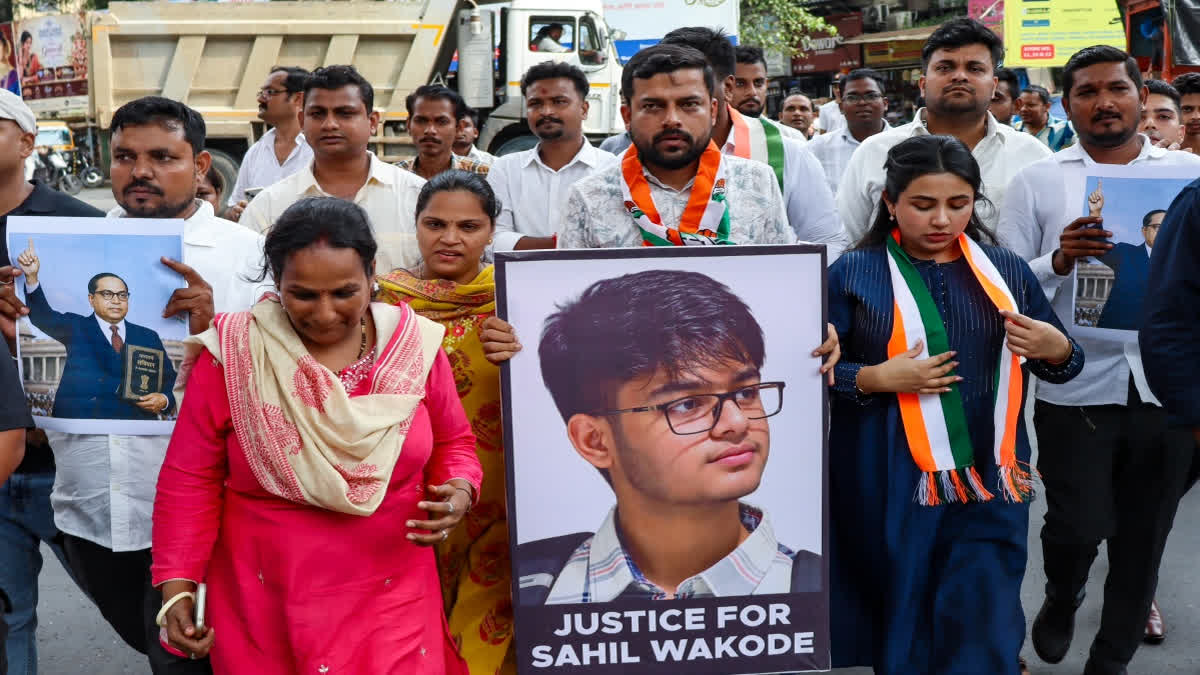
MUMBAI: Student protests erupted on the campus of the Indian Institute of Technology (IIT) Bombay on Tuesday evening after the death of 20-year-old Sahil Wakode, a second-year B.Tech student, who was found hanging in his hostel room on September 18. The agitating students demanded justice and accountability, alleging that institutional failures and caste discrimination had contributed to the tragedy. Mumbai Police, meanwhile, made a public appeal asking citizens and media to avoid speculation and misinformation in the sensitive case. The police Crime Branch is now carrying out a detailed investigation into the circumstances surrounding Wakode’s death, with a senior officer of the rank of Assistant Commissioner of Police leading the probe under the close supervision of a Deputy Commissioner of Police. The appeal came in the wake of divergent narratives circulating online and in sections of the media about the events that preceded the death, and authorities made it clear that no premature conclusions should be drawn until all evidence and statements have been examined. The handling of the case, officers stressed, is being conducted with impartiality and integrity, and all possible angles—including academic pressure, mental health, the reported incident in the examination hall, and allegations of caste-based harassment—were being explored.
The tragedy may have a direct academic context. Police said Wakode was found dead on the evening of September 18, just hours after he had been caught allegedly using a mobile phone with ChatGPT during a mid-semester examination. According to officials, the student had been found with his phone in the examination hall, a violation that would have triggered disciplinary proceedings. The exact sequence of events that followed the alleged misuse of technology in the exam—and whether any faculty member or examination official made remarks or took action that crossed a line—is now a core focus of the investigation. In the days after the student’s death, IIT Bombay’s administration has faced sharp criticism from students and political activists. The institute has taken some administrative action: Professor Suryanarayana Doolla, who was serving as Dean of Administrative Affairs, has been removed from the post, although the institution denied reports that he had resigned. A case has been registered against Doolla on charges of abetment and caste discrimination. The police have not yet confirmed the details of the charges, but the move signals the seriousness with which the authorities are treating the allegations by Wakode’s family. Students have been demanding more far-reaching steps, including the arrest of both Professor Doolla and IIT Bombay Director Professor Shirish Kedare, arguing that the administration had failed to create a safe environment for students from marginalized communities.
The parents of the deceased student have been at the forefront of these demands. They have claimed that Wakode shared with them instances of caste-based slurs he had faced, and they believe that these insults, compounded by the examination incident, created an unbearable atmosphere. Their demand for the immediate arrest of the Director and the former Dean has resonated with several student bodies and social organizations that have held solidarity rallies under the banner “Justice for Sahil.” Demonstrations in front of the institute’s main gate have continued, with protesters displaying placards and shouting slogans against alleged systemic discrimination in higher education. The students’ grievance is not limited to this single death but reflects longstanding concerns about the treatment of Scheduled Castes, Scheduled Tribes and Other Backward Classes in premium technical institutions. IIT Bombay, which has historically been considered a citadel of meritocracy and excellence, has become the site of an intense reckoning over caste equality and mental health support. The administration, for its part, has issued a statement saying that the institution is cooperating with the investigation and is committed to maintaining discipline, but it has stopped short of accepting any allegations of caste discrimination or institutional negligence. Activists have pointed out that the alleged caste-based slurs, if proven, would constitute an offence under the Scheduled Castes and Scheduled Tribes (Prevention of Atrocities) Act, making the question of institutional intent and responsibility all the more important. The case has also drawn attention to the fact that first-generation students and students from less privileged backgrounds often face an additional burden in elite campuses, where they are expected to navigate both academic demands and a social environment that may not always be inclusive.
The death has also prompted urgent remedial measures regarding infrastructure and campus safety. In an unexpected development, IIT Bombay announced that it will replace all ceiling fans with wall-mounted fans in hostels, reportedly as a precautionary measure following the death. While the immediate relevance of this step to Wakode’s suicide is not clear, and the investigation has not yet determined whether a ceiling fan was involved, the announcement has drawn both curiosity and criticism. Some students have questioned why the administration is focused on physical infrastructure rather than on addressing mental health, academic stress, discrimination and the administrative culture that they argue pushed their colleague to such extremes. Others see it as a gesture, albeit an insufficient one, to demonstrate responsiveness. The incident has brought the issue of suicides in educational institutions back into sharp focus, particularly in engineering and medical colleges, where the pressure on students is immense. Counselor services, peer support networks and anti-discrimination cells exist on paper, but often remain under-resourced and under-publicized. Activists argue that the administration cannot simply retrofit buildings while ignoring the social and psychological vulnerabilities that students, especially those from historically disadvantaged communities, bring to campus life. They have called for a complete audit of hostels, mental health facilities, and the authorities’ approach to punishment and discipline, saying that a student’s first brush with rules should not lead to humiliation or despair but to guidance and reform. The demand for transparent inquiry and change is not merely about one institution; it is about the very safety and ethical atmosphere of higher education in India.
This tragedy has to be understood within a broader national context. Cases of student suicides in higher education institutions have risen in recent years, and many are linked by activists to discrimination, humiliation and an unforgiving academic environment. In India, the Scheduled Castes and Scheduled Tribes (Prevention of Atrocities) Act provides legal protections against caste-based harassment, and the registration of a case against Professor Doolla under the Act—along with abetment—indicates that the parents’ complaint is being treated with legal seriousness. Yet, justice in such cases is difficult to obtain. Families often have to fight not only the actual acts of harassment but also the institutional machinery that tends to circle the wagons, protect reputations and dismiss allegations. The demand for the arrest of the IIT Bombay Director is particularly significant, as it underscores the degree of anger and mistrust that has built up among students. Political activists have joined the protests, seeing the issue as another example of systemic violence against marginalised communities in elite educational spaces. The police appeal against misinformation is an attempt to keep the public discourse factual, but it also exposes a credibility gap between the students and the state machinery. Until the investigation concludes, the protests are likely to continue, with students demanding transparency and accountability at every stage. There is also a growing chorus of alumni and academics outside IIT Bombay who have expressed solidarity with the protesting students, calling upon the administration to engage in a genuine dialogue rather than relying only on formal statements and administrative reshuffles. They have urged the police to examine not just the immediate circumstances of the death but also any patterns of behaviour, emails, messages or testimonies that may indicate a hostile atmosphere for Dalit and other marginalised students.
As the Crime Branch and the Human Rights Cell work through witness statements, digital evidence and the student’s personal communications, the institution faces a moment of reckoning. The removal of Professor Doolla as Dean of Administrative Affairs is perhaps the first of many steps, but the IIT administration needs to demonstrate that its response is not cosmetic. A thorough, independent and timely investigation is essential to bring closure to Wakode’s grieving family and to address the anxieties of the student community. Mumbai Police’s assurance of a “diligent and impartial” investigation is welcome, but the call for restraint must be balanced with the legitimate demand for justice and the right to protest. The tragic loss of a promising young student, a boy from a humble background who had earned a place in one of India’s most prestigious institutions, should not become a footnote in an endless cycle of official process and counter-allegations. Instead, it should serve as a catalyst for systemic reform—in examination policies, mental-health support, anti-caste discrimination mechanisms and grievance redressal—so that no other student feels so isolated, humiliated or desperate. The administration, the faculty, the students and the wider society must confront the uncomfortable truths that this case has surfaced. The institution must answer difficult questions: Were the student’s complaints heard? Did the examination incident trigger public embarrassment? Was there any caste-based taunting before, during or after the incident? And most importantly, what will change to ensure that such a death is never repeated? Only then will Sahil Wakode’s death not have been in vain. The next few weeks, as the police investigation unfolds and the campus protests continue, will determine whether India’s leading technical institution can turn sorrow into meaningful action.