








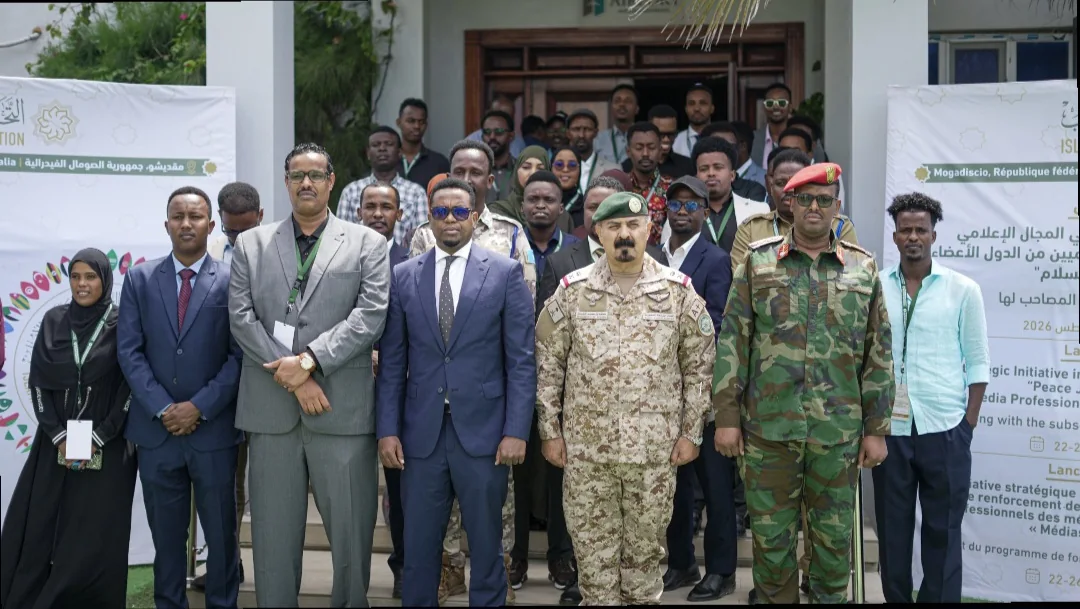
MOGADISHU, Somalia — Somalia has begun training journalists and social media content producers under a programme supported by the Islamic Military Counter-Terrorism Coalition (IMCTC), a Saudi Arabia-backed multinational body, in an effort to strengthen the media’s role in countering extremist propaganda and disinformation. The Peace Journalists programme was launched in the capital Mogadishu as part of broader cooperation between Somalia and the coalition, which groups many Islamic states in a coordinated struggle against terrorism. Officials described the training as one of several initiatives being rolled out through Somali government institutions, reflecting a comprehensive approach that combines security operations with media, ideological, financial, and political measures. The first training cohort brought together 40 journalists, academics, media professionals, and social media influencers from government and private media organisations across Somalia. The launch came amid intensified Somali military operations against Al-Shabaab and authorities’ efforts to stop the group from using propaganda, recruitment messages, and online platforms to influence public opinion. The programme reflects a shifting emphasis in counterterrorism policy: while security offensives remain essential, official attention is increasingly focused on how to deny extremist groups their most persuasive tools. The coalition’s involvement also signals coordinated regional support, with the Riyadh-based body lending expertise to member states facing the online aspects of extremism. For Somali media workers, the training is a chance to learn how to check the reliability of digital content and avoid spreading material intended to serve extremist agendas. The initiative includes both state and private media, indicating a desire to strengthen the entire media ecosystem. Somalia has experienced more than a decade of violence and instability, and the information battlefield is now as important as the territorial one. Organisers said the first phase is expected to serve as a foundation for a wider network of trained journalists and content creators, who will be able to guide their newsrooms in the responsible use of digital tools. In a country where rumours and manipulated images can move quickly across messaging apps, the ability to separate fact from falsehood has become an essential part of public safety.
Inside the training workshops, participants are being equipped with practical techniques to determine whether information circulating online is genuine before using it in their work. The curriculum includes digital verification, open-source intelligence, image and video analysis, network analysis, and identification of manipulated or deliberately misleading information. Journalists are taught how to trace the origin of photographs, inspect metadata, reverse-search images, geolocate video footage, and detect signs of digital alteration. They are also learning to identify coordinated online behaviour, including the use of fake accounts, automated bots, and propaganda cells that amplify extremist messages. The programme places strong emphasis on open-source intelligence, a discipline that has become increasingly important in modern journalism as reporting moves into the digital sphere. By using openly available data to verify claims and establish facts, media practitioners can avoid inadvertently spreading false narratives. The training also covers legal and ethical dimensions of reporting on terrorism, including privacy, the safety of sources, and the risk of causing panic. Participants are encouraged to develop a systematic approach to fact-checking rather than relying on intuition or the credibility of a single platform. The course includes sessions on the psychology of misinformation, exploring why certain stories go viral and how emotions can be exploited to bypass rational judgment. It also addresses technical aspects of media production, helping participants create content that meets professional standards while remaining resilient to attack. The participation of academics and social media influencers is particularly notable, because the information battle in Somalia increasingly takes place on Facebook, X, TikTok and other platforms where millions of Somalis receive news. Extremists use these spaces to test narratives, recruit supporters and intimidate opponents. The training therefore aims to create a network of informed voices who can respond to those narratives with factual reporting and compelling counter-messaging. The sessions are designed to be interactive, with participants bringing real examples from their own work to analyse in class. Organisers said practical sessions are supplemented by case studies, including coverage of terrorist incidents in Somalia, showing how false information can spread during crises and how journalists can maintain accuracy under extreme pressure. By the end of the first phase, participants are expected to have developed not only technical skills but also a sharper understanding of how information can be weaponised in conflict.
Beyond the mechanics of verification, the programme seeks to deepen participants’ understanding of how extremist organisations use online platforms to spread their messages and reach wider audiences. Trainees are being shown how Al-Shabaab and other groups produce official media releases, exploit social media algorithms, target vulnerable communities, and shape their content to appeal to different groups. The curriculum explains the structure of extremist media operations, including how content is produced, edited, distributed and amplified across networks of supporters. Participants are trained to produce content that challenges extremist narratives without inadvertently amplifying them. This is a central difficulty of reporting on terrorism: drawing public attention to a threat can provide free publicity for the group, while ignoring it can allow dangerous ideas to grow unchecked. The programme teaches a set of principles for responsible coverage, including careful language choices, avoiding graphic imagery, refusing to grant legitimacy to terrorists, and not repeating slogans or claims as if they were established facts. It encourages participants to focus on the experiences of victims and the efforts of security forces rather than on the identity of the attackers. It also explores the value of positive storytelling: stories of resilience, community resistance and reconciliation can offer an alternative to extremist narratives. Counter-narratives are designed with Somali religious, cultural and social sensitivities in mind. Extremist groups often attempt to justify violence using religious references and historical grievances; credible responses must be rooted in the same cultural framework to be effective. The course features sessions on message design, audience segmentation and ethical boundaries. Participants are reminded that counter-messaging must be grounded in truth and human rights, or it will damage the credibility of the media and the state. The programme also recognises the personal risks faced by Somali journalists, who are frequently targeted by armed groups, so it includes guidance on digital security, protecting accounts, securing communications and avoiding online harassment. By creating a community of practice among journalists and influencers, the programme aims to provide peer support and reduce isolation. As social media becomes more central to daily life in Somalia, the ability of citizens to verify content and question narratives has become a critical civic skill, and the programme supports that capacity. Trainers stressed that the effort is not about imposing a government line but about building a professional media culture that values accuracy and responsibility, enabling journalists to see themselves as public guardians of verified information.
During the launch ceremony in Mogadishu, Somalia’s Defence Minister Ahmed Moallim Fiqi said the fight against terrorism requires more than military operations, stressing the need to involve other sectors of society in confronting extremist groups. In remarks reported by Somali authorities, the minister said the government is adopting a broad approach that combines security operations with media, ideological and economic measures as it continues its campaign against terrorism. His comments reflected a significant shift in official thinking, recognising that sustainable victory depends on winning over communities as much as controlling territory. IMCTC Secretary General Mohammed bin Saeed Al-Moghedi said journalists can play an important role in the fight against terrorism by helping the public distinguish between reliable information and content designed to create confusion or advance extremist causes. He said the training is intended to strengthen the ability of journalists and other media workers to verify information, identify disinformation and recognise accounts linked to extremist propaganda. The coalition, established in 2015 to coordinate counterterrorism among Islamic nations, has increasingly focused on countering online extremism. Officials note that the media programme is one element of a larger package of projects being implemented jointly by the coalition and Somalia. The fact that defence, information and security institutions are all involved is a sign that the programme is regarded as a strategic priority, not a training exercise. The statements echo a growing regional consensus that terrorist groups recruit and radicalise primarily through the internet and that shutting down their online operations is as important as cutting supply lines. At the same time, officials stressed that journalists are not being asked to become tools of state propaganda. Instead, they are being equipped to report accurately, independently and ethically in an environment full of manipulated information. This distinction matters in a country where public trust in institutions remains fragile. For journalists, the message was clear: they have a vital role to play in the fight against extremism, but that role must be based on professional standards. The programme is meant to support that role by providing training, networks and practical guidance. During the ceremony, several participants said they hoped the skills acquired in the programme would help them not only strengthen their own reporting but also protect their newsrooms and communities, adding that the launch represented recognition that the media front line in Somalia can no longer be ignored or left to chance. The programme is expected to continue with follow-up sessions and mentoring, ensuring that the initial cohort becomes the core of a larger network.
The media programme is part of a wider package of projects being implemented jointly by IMCTC and Somalia, with more than ten government institutions expected to participate. According to information released by Somali authorities, projects will address terrorism financing, military affairs and ideological efforts in addition to media training. The participating bodies include agencies and ministries responsible for defence, internal security, information, finance, religious affairs, national security, immigration and communications. This broad institutional involvement indicates that the partnership is designed to cover many dimensions of counterterrorism. Fighting terrorism financing requires coordination between financial intelligence units and banks; military efforts require training and equipment for security forces; ideological efforts involve religious affairs and education agencies to promote moderate interpretations of Islam and counter the twisted narratives used by extremists. Immigration and communications officials, in turn, have a role to play in preventing foreign fighters from entering the country and detecting extremist content online. The cooperation follows earlier discussions between Somalia and the coalition on projects to be implemented in the country, with the latest activities expanding the partnership into the media sector. This suggests a gradual process of building a comprehensive relationship, in which security collaboration is now being complemented by capacity-building in softer areas. Inclusion of the finance ministry is particularly important because Somali authorities have sought to improve their ability to track and disrupt money flows to armed groups. The communications and information ministries are expected to work with the coalition on developing policies and mechanisms to counter propaganda, while national security agencies may provide threat assessments and operational guidance. The coalition’s support reflects its view that terrorism cannot be defeated through military means alone. It also highlights the growing role of Saudi Arabia and its allies in backing counterterrorism in the Horn of Africa. For Somalia, the partnership complements existing relationships with the African Union, the United Nations and other bilateral partners. The key, officials note, is local ownership: externally supported programmes must be implemented by Somali institutions if they are to have a lasting impact. The government’s decision to coordinate the various ministries involved is intended to keep the projects aligned with a national counterterrorism strategy. As the partnership expands, further training and technical assistance are expected in areas such as cybersecurity, media regulation and the development of strategic communication capacities.
The initiative comes at a critical moment for Somalia, as its armed forces continue military operations against Al-Shabaab while authorities also step up efforts to prevent the group from using propaganda, recruitment messages and online platforms to influence the public. Al-Shabaab remains one of the most lethal and resilient extremist organisations in Africa despite losing significant territory in recent years. Its media operation has become increasingly professional, with videos, communiqués and a social media strategy aimed at projecting strength and attracting recruits. Somali journalists are often on the front lines of this battle for information, reporting on attacks and then watching as disinformation and rumours spread across social media. The new training programme aims to change that dynamic by equipping media workers with the tools to cut through the noise and provide the public with verified, contextual reporting. If successful, it could help reduce the impact of psychologically damaging propaganda and lower the group’s ability to shape perceptions of its strength. It could also strengthen public trust in the media, which is essential for a functioning society. There are, however, significant challenges. Digital verification depends on reliable internet access, functioning institutions and a secure working environment. Somali media workers operate under constant threats, and even with better skills, they cannot eliminate the risks of reporting on a ruthless group. The broader security environment remains fragile, and the success of any media initiative will depend on the overall trajectory of the conflict. The coalition’s support does not replace the need for domestic investment in media safety and infrastructure, but it can help build a cadre of professionals prepared for the digital age. The Peace Journalists programme is a small but noteworthy step in the process of rebuilding Somalia’s media capacity after decades of instability. It also serves as a reminder that counterterrorism cannot be confined to airstrikes and raids; it must include a sustained effort to protect the information space. As the programme continues, participants are expected to train others, creating a multiplier effect beyond the first group of 40. The ultimate test will be whether the public feels safer, better informed and less vulnerable to online extremism. For now, the launch represents a recognition in both Mogadishu and at IMCTC that journalists are not merely witnesses to the fight against terrorism but participants in it.


