


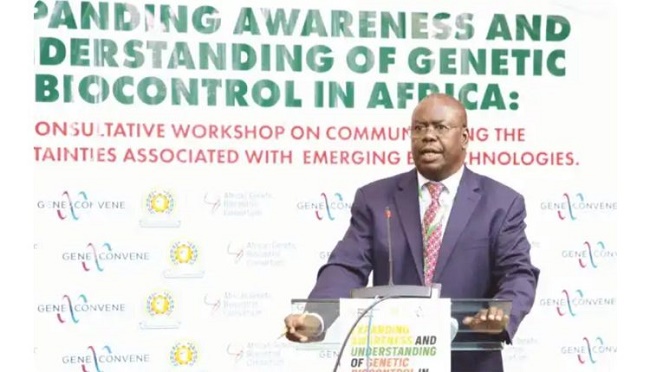
As Africa stands at a pivotal juncture in its scientific development, the rapid advancement of biotechnology in health, agriculture, and industry is being shadowed by a persistent surge in misinformation and disinformation. To safeguard the continent’s innovation landscape, a coalition led by the BioTRUST Institute and the African Genetic Biocontrol Consortium (AGBC), in partnership with the Elizabeth R. Griffin Programme at Johns Hopkins University, has launched a critical initiative. This collaborative effort seeks to dismantle the barriers of false narratives that often impede the adoption of life-saving scientific breakthroughs, ensuring that the promise of progress is not stifled by a lack of public understanding.
At the heart of this initiative is a six-part webinar series titled “Truth Under the Microscope: Tackling Disinformation and Misinformation in Emerging Technologies and Life Sciences.” Running weekly from August 6 to September 10, 2026, the series is designed as a direct response to the uneven public perception of sophisticated innovations like gene drives, synthetic biology, and gene editing. By addressing the current gaps in scientific literacy and regulatory discourse, the organizers aim to foster an environment where complex, evidence-based technologies can be understood and debated with clarity rather than fear.
Dr. Willy Tonui, Founder and Advisor of the AGBC, emphasizes that the series is a multifaceted call to action for a diverse cross-section of society. By convening scientists, policymakers, media professionals, and civil society actors, the program aims to unpack how misinformation distorts scientific evidence and undermines public trust in essential health systems. Dr. Tonui notes that the initiative is not merely about identifying falsehoods, but about providing tangible strategies for professionals to navigate a landscape where scientific uncertainty is frequently weaponized to derail responsible innovation.
The curriculum of the webinar series is comprehensive, designed to equip participants with the tools to distinguish between legitimate scientific inquiry and malicious disinformation. Key sessions will tackle the influence of artificial intelligence and synthetic media, the complexities of communicating genomic research, and the vital role of biosecurity. From “Trust by Design” to “Evidence to Influence,” each session focuses on practical application—teaching journalists how to report on nuanced science responsibly and showing policymakers how to translate complex data into evidence-based public policy.
A primary objective of this program is to bridge the historical divide between the scientific community and the public. By fostering stronger collaboration between researchers, journalists, and regulators, the organizers aim to build a resilient information ecosystem. This is particularly vital for Africa’s development, where the success of emerging technologies relies heavily on public acceptance. The series seeks to move beyond traditional communication methods, instead focusing on developing new, effective models for fact-checking and clarifying scientific uncertainty without inadvertently amplifying false claims.
Ultimately, the organizers believe that by empowering a new generation of science communicators and enhancing the capacity of existing stakeholders, this initiative will catalyze a more informed public discourse. As the series concludes on September 10 with a focus on “Rising Voices,” the overarching goal remains clear: to build the public trust necessary to sustain Africa’s innovation agenda. Through this concerted effort, the continent hopes to transform its communication landscape, ensuring that scientific progress is met with informed enthusiasm rather than the destructive interference of disinformation.