


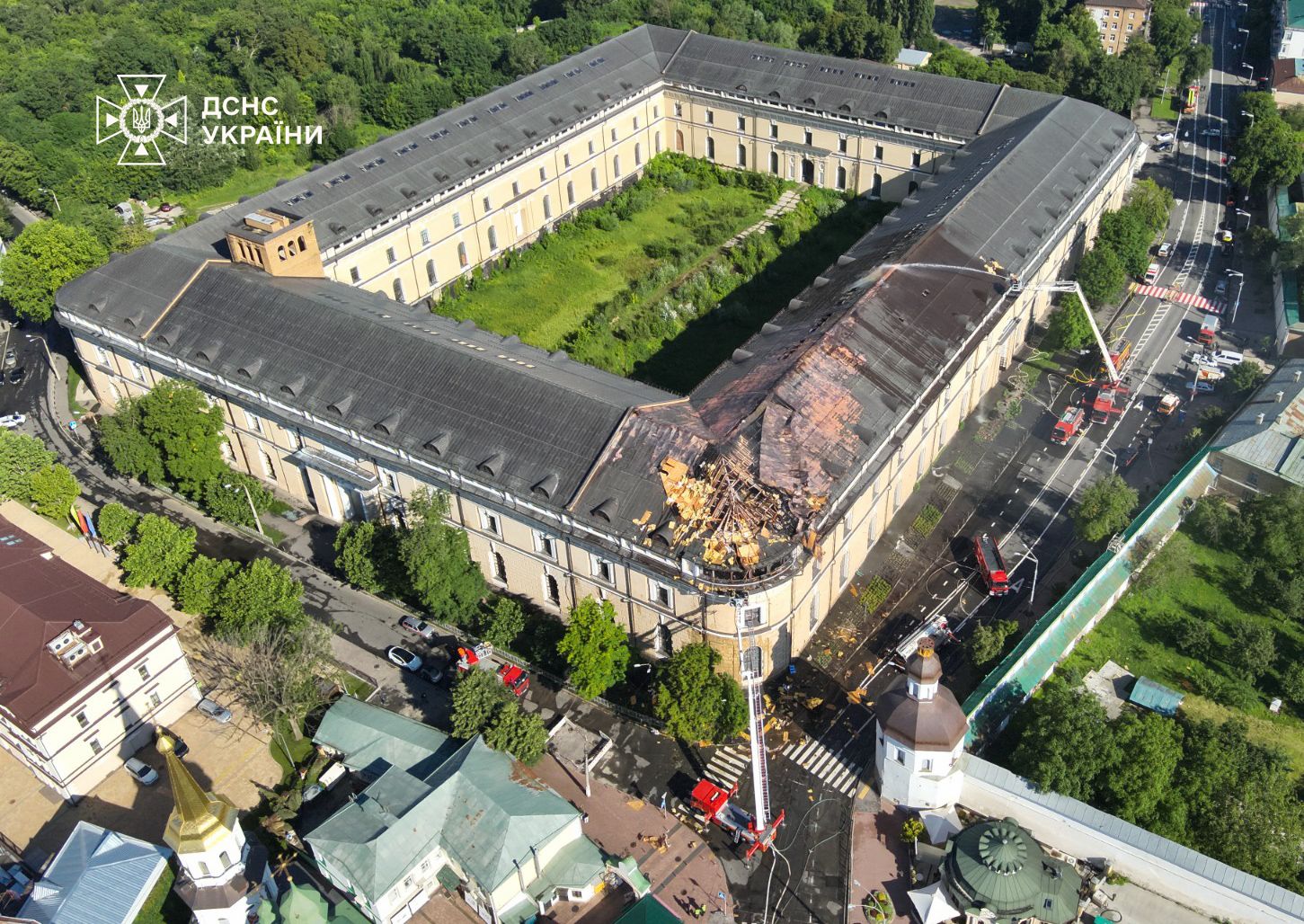
The Ukrainian Center for Countering Disinformation (CPD) has issued a stern warning regarding a new, large-scale Russian disinformation campaign designed to justify recent mass strikes on civilian and cultural landmarks in Kyiv. As Russian forces continue to target the capital, state-aligned media and propaganda networks have deployed a calculated strategy to reframe these acts of terror. By characterizing historic sites and civilian infrastructure as “military targets” or outright blaming Ukrainian forces for self-inflicted damage, Moscow is attempting to obfuscate its role in documented war crimes.
At the heart of this narrative manipulation is a well-established pattern that the CPD has been tracking since the 2022 invasion. Russian propagandists are currently pushing five specific, evidence-free claims to deflect accountability. This includes framing the fire at the UNESCO-protected Kyiv-Pechersk Lavra as a “Ukrainian provocation,” dismissing strikes on administrative buildings like the Higher Anti-Corruption Court as part of internal conspiracies, and labeling cultural institutions such as the Dovzhenko Film Studio as “propaganda nests.” By claiming that civilian buildings are secretly housing weapons production, Russia seeks to provide a blanket justification for treating the entirety of Kyiv as a legitimate military frontline.
This tactical pivot relies heavily on the “deflection of blame” method, where Russian sources consistently attribute civilian casualties to malfunctioning Ukrainian air defense systems. The CPD underscores that these narratives are fundamentally dishonest, noting that no amount of spin can mask the reality of the destruction. According to the Ukrainian authorities, the responsibility for every injury, death, and damaged heritage site lies squarely with Moscow. The Center asserts that these psychological operations are a clear attempt to shield the aggressor from international legal consequences for violating documented conventions regarding the protection of cultural property.
To contextualize the current campaign, the CPD highlights that this behavior is a predictable iteration of Russia’s past information warfare. In March 2022, following the brutal airstrike on the Mariupol Drama Theater—which claimed an estimated 600 lives—Russian officials claimed the site was a false-flag operation conducted by Ukrainian soldiers. Subsequent independent investigations by organizations like Amnesty International and the Associated Press definitively ruled out these claims, categorizing the strike as a deliberate war crime committed by Russian fighter jets dropping 500-kg bombs on a clearly marked civilian shelter.
The pattern repeated in July 2023, when a missile strike struck the historic Transfiguration Cathedral in Odesa, a monument situated within a UNESCO-protected area. On that occasion, the Russian Defense Ministry utilized the familiar defense of claiming that the damage was caused by a stray Ukrainian anti-aircraft missile. UNESCO and local religious authorities immediately countered these claims, citing evidence of a direct hit that destroyed multiple altars. Much like the Mariupol theater attack, the Odesa incident was swiftly condemned by the international community as an escalation of violence against global cultural heritage.
Ultimately, the Ukrainian government posits that the rhetoric surrounding the latest strikes on Kyiv is merely a continuation of a systematic policy of erasure and denial. By rotating stale disinformation tactics—whether it is claiming “self-arson” at the Kyiv-Pechersk Lavra or inventing secret military workshops in civilian apartments—Russia hopes to confuse global audiences and undermine the severity of its military actions. The CPD, however, remains resolute in its mission, maintaining that the evidence of Russia’s intent is clear and that no amount of manipulation can obscure the fundamental illegality of targeting the cultural and civilian heart of Ukraine.