


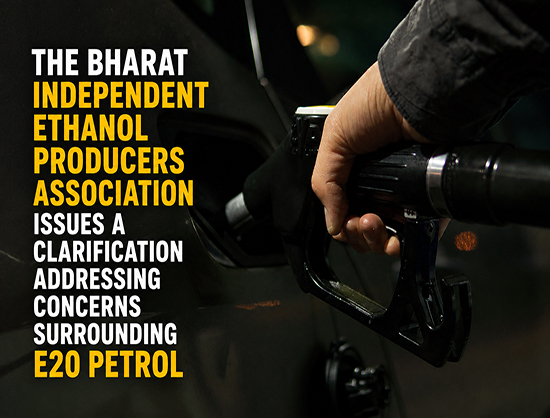
BIEPA Defends E20 Ethanol Blending, Urges Reliance on Scientific Data Over Online Misinformation
New Delhi, July 14, 2026 – The Bharat Independent Ethanol Producers Association (BIEPA) has issued a formal statement addressing the growing wave of skepticism surrounding the nationwide rollout of E20 fuel—petrol blended with 20% ethanol. As conflicting narratives proliferate across social media, the association stresses that these unverified claims have stirred unnecessary consumer anxiety. BIEPA maintains that the E20 initiative is a cornerstone of India’s clean energy transition, providing verifiable environmental, economic, and energy-security advantages that are systematically being undermined by misinformation.
The association is urging consumers to look past anecdotal online reports and prioritize information sourced directly from the Government of India, registered vehicle manufacturers, and authorized oil marketing companies. By aligning with official data, the public can better understand the rigorous scientific framework that supports the transition to ethanol-blended petrol. According to BIEPA, the shift is not merely a policy decision but a milestone backed by extensive collaborative efforts between automotive engineers, energy experts, and scientific institutions to ensure the safety and compatibility of the national fuel supply.
The economic impact of the Ethanol Blended Petrol (EBP) program has been significant, according to the Ministry of Petroleum and Natural Gas. Since the 2014–15 fiscal year, the program has saved India over INR 1.90 lakh crore in foreign exchange by curbing the need for crude oil imports. Beyond macroeconomic gains, the initiative has invigorated the agricultural sector. By creating a lucrative market for surplus produce and by-products—such as maize, sugarcane, broken rice, and molasses—the government has successfully transformed farm waste into an energy asset, thereby bolstering rural livelihoods and strengthening the nation’s energy autonomy.
Pushpinder Singh, President of BIEPA, emphasized that the integrity of the fuel is a result of years of testing and infrastructure planning. “India’s ethanol programme is built on years of scientific research and close collaboration between sectors,” Singh stated. He dismissed the fears circulating in digital spaces as counterproductive, noting that such misinformation hurts both the consumer’s confidence and the millions of farmers who rely on the ethanol market for their income. He stressed that when used as specified, E20 is a safe, stable, and nationally vital resource.
BIEPA took the opportunity to systematically debunk the most prevalent concerns regarding E20. Addressing fears of engine damage, the association noted that no credible study has linked approved E20 fuel to hardware failure, adding that the Automotive Research Association of India (ARAI) continues to monitor performance closely. Regarding fuel economy, BIEPA acknowledged a marginal difference in energy efficiency—typically ranging between 2% and 6%—but labeled claims of dramatic mileage loss as gross exaggerations. Furthermore, the association clarified that modern ethanol production emphasizes sustainability, utilizing water recycling and zero-liquid-discharge systems to ensure environmental impact remains low.
To put the domestic situation into a broader context, BIEPA highlighted that India is simply joining a global transition toward biofuels. Nations such as Brazil, the United States, Japan, and Indonesia have utilized ethanol and biodiesel blends for decades to reduce their carbon footprints and fossil fuel dependency. India’s successful implementation of E20 aligns it with these global energy standards. The association reiterated that when consumers purchase BIS-compliant E20 from authorized outlets, their vehicle warranties and insurance policies remain fully intact, reinforcing that the program is both safe for vehicles and critical for India’s long-term environmental and economic health.