


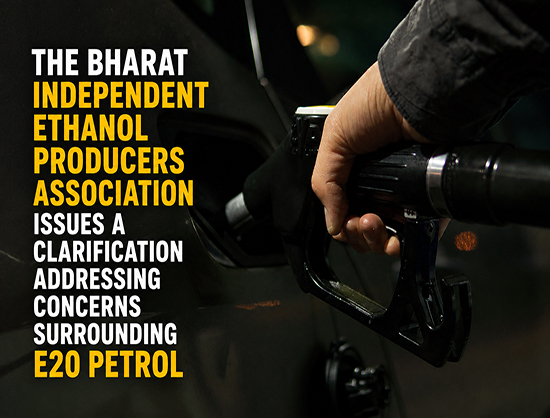
Bharat Independent Ethanol Producers Association Issues Definitive Guidance on E20 Fuel Safety Amid Growing Misinformation
New Delhi, July 14, 2026 – The Bharat Independent Ethanol Producers Association (BIEPA) has issued a formal statement to address the surge of conflicting and unverified claims regarding the blending of ethanol with petrol, commonly known as E20. As India continues its aggressive rollout of the Ethanol Blended Petrol (EBP) Programme, BIEPA expressed concern that baseless rumors circulating on social media are creating unnecessary anxiety among motorists. The association emphasized that the transition to E20 is a milestone in India’s clean energy strategy, underpinned by rigorous scientific validation and years of coordinated testing by the government, automotive manufacturers, and oil marketing companies.
The economic and strategic impact of the EBP programme has been significant, according to data from the Ministry of Petroleum and Natural Gas. Since the 2014–15 fiscal year, the initiative has successfully reduced India’s crude oil import dependency, resulting in a foreign exchange savings of over INR 1.90 lakh crore. Beyond fiscal gains, the programme serves as a vital economic lifeline for India’s agricultural sector. By utilizing surplus crops such as maize, broken rice, molasses, and sugarcane, the initiative has created a productive market for farmers, simultaneously bolstering rural livelihoods and reinforcing the nation’s overall energy security.
Pushpinder Singh, President of BIEPA, has urged the public to disregard internet-driven misinformation, which he argues threatens a national project of critical importance. “India’s ethanol programme is built on years of scientific research and close collaboration between stakeholders,” Singh noted. He stressed that consumers should rely exclusively on verified guidance from government bodies, authorized oil marketing companies, and reputable vehicle manufacturers. According to BIEPA, the widespread pushback against E20 is largely unfounded, particularly regarding technical performance, and failing to support the programme risks undermining long-term benefits to both the domestic economy and the welfare of millions of Indian farmers.
Addressing specific technical grievances, BIEPA provided a detailed breakdown to dispel common myths. Regarding concerns over engine integrity, the association stated that there is no credible scientific evidence linking government-approved E20 fuel to widespread engine damage. Furthermore, while E20 may offer a slightly lower energy density than pure petrol, its higher octane rating promotes more efficient combustion. BIEPA clarified that the perceived loss in fuel economy, often cited in exaggerated online posts, is limited to a negligible 2–6 percent under standard driving conditions, debunking reports of severe fuel consumption issues.
BIEPA also tackled environmental and sustainability concerns regarding raw material consumption. Modern ethanol facilities are now mandated to implement zero liquid discharge, condensate recovery, and water recycling systems to minimize their environmental footprint. The association highlighted that India’s production strategy is increasingly shifting toward agricultural by-products and surpluses rather than crops specifically grown for fuel, ensuring a sustainable cycle that supports the environment while maximizing resource efficiency. Additionally, the association categorically confirmed that utilizing BIS-compliant E20 fuel at authorized outlets does not jeopardize vehicle insurance policies or void manufacturer warranties.
In its closing statement, BIEPA contextualized India’s progress by noting that the country is simply joining a global movement toward sustainable transport. With countries like Brazil (E30), the United States (E15-E18), Japan, and Indonesia already successfully integrating high levels of biofuels, India’s transition aligns with established international standards. The association reiterated that when used as intended, ethanol-blended petrol provides a globally accepted, safe, and effective pathway to reducing carbon emissions and dependence on finite fossil fuel reserves, ultimately securing a more stable energy future for India.