


Paragraph 1
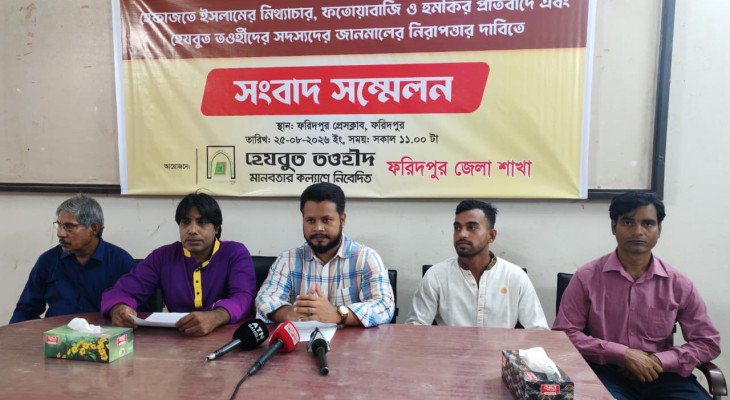
In a significant display of organizational unity and defensive mobilization, the Faridpur District Unit of Hezbut Tawheed convened a high-profile press conference on Tuesday morning at the historic late Shamsuddin Mollah Auditorium, located within the bustling confines of the Faridpur Press Club. The event was orchestrated with meticulous precision, serving as a formal and public declaration of the organization’s deep-seated grievances against the powerful Hefazat-e-Islam faction. The primary objective was to articulate a robust protest against what they describe as a coordinated campaign of falsehoods, perilous religious edicts (fatwas), and intimidating threats that have escalated at an alarming rate in recent weeks. The choice of a press club auditorium as the venue was strategically significant, underscoring the group’s desire to leverage the fourth estate—the media—to communicate directly with the public, the state apparatus, and the global audience, bypassing what they perceive as a biased or negligent intermediary. The atmosphere inside the hall was tense yet orderly, characterized by a palpable current of apprehension among the district leaders, grassroots members, and the substantial contingent of journalists from both print and electronic media who squeezed into their seats to hear the official stance of an organization under siege. This press conference was not merely a ritualistic tumor of organizational politics; it was a calculated appeal for state protection and a desperate cry for survival against what they allege is an existential threat posed by a rival Islamist bloc. By bringing their concerns to the center of journalistic activity in Faridpur, the leadership of Hezbut Tawheed signaled that they are no longer willing to suffer in silence, and that the stakes are so high that they must seek public adjudication of their safety concerns.
Paragraph 2
The crux of the allegations levelled by Hezbut Tawheed revolves around a specific, incendiary incident that occurred during a massive, well-attended rally organized by Hefazat-e-Islam at the Noakhali District School ground on August 1st of the current year. According to the written statement meticulously read out by the Faridpur district president, Md. Rezaul Karim, this large and politically charged gathering served as an unseemly stage for disseminating ‘provocative and false propaganda’ specifically targeting Hezbut Tawheed and its leadership. The speakers at the Noakhali rally allegedly issued undemocratic, inflammatory, and highly aggressive remarks that explicitly targeted the spiritual leader (Imam) and senior members of Hezbut Tawheed, effectively threatening their lives and social standing. The term ‘fatwa’ holds a profoundly loaded and dangerous consequence in the Bangladeshi socio-legal context; while not legally binding under the country’s secular Constitution, a fatwa issued by a rival cleric possesses the terrifying power to incite mob psychology, leading to communal violence, violent social ostracism, or even extrajudicial physical harm against the designated targets. Hezbut Tawheed officials specifically highlighted that these threats are not simply abstract theological disagreements but are concrete, actionable plans aimed at destabilizing their entire organizational network across the country. They unequivocally claimed that the propaganda attempts to maliciously frame Hezbut Tawheed as heretical, deviant, or anti-Islamic—a dangerous and false label that provides a convenient pretext for vigilante violence and societal rejection. The specific details of the alleged false propaganda include baseless accusations regarding their unique theological practices, unsubstantiated claims of foreign funding and nefarious external allegiances, and fabricated tales of social misconduct, all carefully designed to erode their public legitimacy, incite hatred among the masses, and justify physical aggression against their unsuspecting followers, who are now living in a state of perpetual and crippling fear for their safety. This deliberate dissemination of misinformation represents a dangerous escalation from doctrinal debate into the criminal realm of incitement to violence.
Paragraph 3
This confrontation must be understood within the complex, fragmented, and often turbulent tapestry of Islamist politics and theological rivalry in Bangladesh. Hezbut Tawheed, known for its staunch advocacy of strict monotheism (Tawheed) and its vocal opposition to religious innovations (Bid’ah), often finds itself in fierce ideological opposition to more traditionally entrenched or politically powerful groups like Hefazat-e-Islam, which commands significant grassroots influence through its extensive network of Qawmi madrasas and its deep ties to conservative rural constituencies. The conflict is not merely personal or incidental; it represents a profound and ongoing struggle for the ideological soul of Bangladeshi Islam and the prized political space that religious authority provides in a country where faith and politics are inextricably intertwined. Hefazat-e-Islam has historically positioned itself as the unyielding defender of mainstream, conservative orthodoxy and has engaged heavily in national politics, often operating with a perceived sense of impunity, historical dominance, and a potent moral superiority complex. In stark contrast, Hezbut Tawheed is viewed by many political analysts as a relatively newer, more reformist, or puritanical offshoot that lacks the same logistical muscle, historical pedigree, or political leverage to negotiate with the state on equal terms. When such a dominant force issues formal threats and theological condemnations against a smaller rival, it disproportionately escalates the physical and psychological security risk for the smaller group. Hezbut Tawheed’s central committee and district leaders argue that the relentless dogmatic attacks have crossed the threshold from healthy, scholarly religious debate into criminal intimidation and psychological warfare. They assert that the fatwas and threats are a direct violation of the fundamental constitutional right to freedom of religion, thought, and assembly, and that the deafening silence of law enforcement agencies in the face of these blatant threats tacitly encourages further aggression and emboldens the perpetrators. By holding this press conference, Hezbut Tawheed is strategically attempting to shift the narrative from a purely theological dispute to a critical matter of public order, fundamental human rights, and the state’s commitment to legal impartiality.
Paragraph 4
A recurring, emphatic, and non-negotiable demand from the speakers was the explicit, immediate provision of security for the lives and properties of Hezbut Tawheed members across Faridpur district and beyond. The written statement formally called upon the Deputy Commissioner and the Superintendent of Police of Faridpur to guarantee the physical safety of their leadership, grassroots activists, and the sanctity of their religious institutions. They argued, with visible desperation, that the inflammatory rhetoric unleashed at the Noakhali rally has created a powder-keg situation, whereby any minor incident, trivial misunderstanding, or localized dispute could trigger a violent pogrom against their communities, similar to communal clashes witnessed elsewhere in South Asia. Hezbut Tawheed leaders highlighted that their members are ordinary, peace-loving citizens—teachers, farmers, small traders, and rural imams—who lack the means or the political backing to defend themselves against organized mobs incited by religious leaders. They demanded that the government take swift, stern, and visible action against those who issued the threatening fatwas, insisting that such absolutist declarations of a death sentence, social boycott, or economic ruin have no place in a sovereign secular legal framework. Furthermore, they formally requested a comprehensive and transparent investigation into the transcript and audio-visual recordings of the Noakhali rally speeches to determine whether they constitute criminal hate speech under the Bangladesh Penal Code and the Digital Security Act. The organization also sought a binding assurance that its mosques, offices, and community centers would be placed under specific police surveillance to prevent potential arson, vandalism, or orchestrated attacks. They implored the state not to view this as an internal squabble among religious groups, but rather as a crucial test of the state’s monopoly on legitimate violence and its unwavering commitment to ensuring a lawful, equitable, and secure environment for all citizens, irrespective of their specific religious interpretation or sectarian affiliation. The leaders gave a clear ultimatum: without verifiable protective measures, they will be forced to escalate their protests to the High Court.
Paragraph 5
The press conference featured a poignant display of organizational hierarchy, solidarity, and strategic coordination. Md. Rezaul Karim, as the district president, anchored the event by meticulously reading out the full text of the written statement, ensuring that no nuance, detail, or emotional plea was lost in translation to the assembled media. He was accompanied at the head table by Mokhlesur Rahman Suman, the central committee’s student welfare secretary, whose presence signified that the distress felt in Faridpur is a national concern for the organization, effectively linking grassroots grievances to the highest decision-making bodies in the capital, Dhaka. Additionally, Md. Jihad Molla, the secretary general of the Faridpur unit, played a key behind-the-scenes role in coordinating the event, managing the logistics, and fielding direct questions from the journalists. The presence of these specific functionaries demonstrated a coordinated, multi-tiered response mechanism. Suman’s involvement strongly suggested that the central leadership is contemplating nationwide solidarity actions, mass resignations from certain boards, or collaborative legal strategies to counter the pervasive threats. For the local chapter, the active participation of the general secretary indicated that daily operations and mobilization protocols are being meticulously maintained despite the immense duress. Journalists pressed the leaders for specifics regarding any formal complaints filed with the police and asked whether a case had been registered against the Noakhali speakers. While the leaders confirmed that they had already submitted a preliminary written memorandum to the district administration and were preparing a comprehensive petition for the High Court, they expressed palpable skepticism about the police’s willingness to act against the powerful Hefazat-e-Islam bloc, which they accused of enjoying tacit political patronage. The collective demeanor of the leadership was one of defiant resilience, signaling that while they genuinely fear for their safety, they refuse to be silenced by intimidation tactics and are prepared to pursue every legal and democratic avenue available to them.
Paragraph 6
In conclusion, the Faridpur press conference serves as a stark, unwelcome warning about the rapidly deteriorating intra-Islamic relations in Bangladesh, a crisis that threatens to spill over into violent civil conflict if left unchecked by the central authorities. Hezbut Tawheed’s public airing of these grievances is a testament to their trust in the democratic process and the monumental power of the media to hold actors accountable and force scrutiny upon otherwise opaque power dynamics. However, it also lays bare the profound vulnerability of smaller religious factions in a country where larger, more muscular groups can wield enormous political influence to intimidate rivals. The allegations of false propaganda, hate speech, and the issuing of threatening fatwas are extremely serious, as they carry the inherent potential to incite public fury, rioting, and extrajudicial action with devastating consequences. The organization’s clear, legitimate demand for state protection is a call that the authorities cannot afford to ignore without risking the erosion of the rule of law. If the state fails to conduct a transparent investigation into the specific threats emanating from the Noakhali rally and does not offer proactive, protective security arrangements for Hezbut Tawheed members, it risks emboldening other extremist groups to employ similar intimidation tactics to resolve doctrinal disputes through violence rather than dialogue. The coming weeks will be absolutely crucial. Hezbut Tawheed has vowed to continue their peaceful protests and will likely escalate to domestic and international human rights bodies if their security is not guaranteed. Meanwhile, the onus remains squarely on the law enforcement agencies to maintain strict neutrality, deftly distinguish between protected religious speech and criminal threat, and act decisively to preserve public order and the constitutional rights of all citizens. The media, for its part, has been tasked with reporting these developments with extreme balance, ensuring that verifiable fact is separated from fanatical polemic. Ultimately, this conflict underscores the urgent and pressing need for an intra-faith dialogue platform facilitated by the state, where legitimate doctrinal differences can be argued peacefully without resorting to the dangerous weapons of fatwas, hate speech, and violence, ensuring that Bangladesh’s long-standing tradition of moderate, tolerant Islam is not irreparably torn apart by the monstrous forces of extremist extremism and sectarian polarization.