


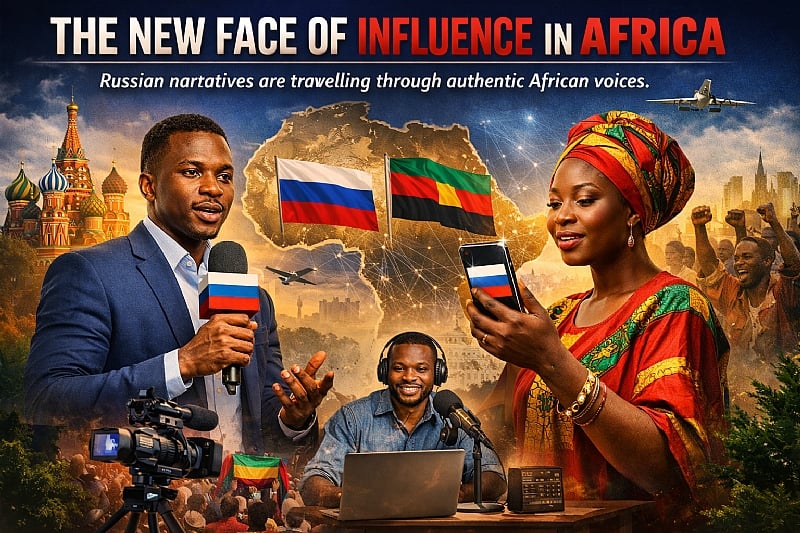
The landscape of digital disinformation has undergone a profound transformation, moving away from the crude, automated tactics of troll farms and anonymous bots toward a more sophisticated model: the utilization of “authentic” voices. Today’s most potent influence operations no longer rely on masked accounts, but on real individuals with credible public profiles and deep-seated local convictions. The case of Fortune Madondo, a Zimbabwean teacher whose prolific output critiques Western involvement in Africa while praising Sahelian military juntas, exemplifies this shift. Whether Madondo is acting on personal ideology or external coordination is ultimately secondary; his significance lies in his utility as a credible, local messenger whose narratives seamlessly align with Russian geopolitical strategies on the continent.
The core of this new influence strategy relies on the strategic exploitation of Pan-Africanism, a movement deeply rooted in the historical reality of anti-colonial struggle. By framing themselves as the antithesis of Western imperialism, foreign powers—most notably Russia—have successfully tapped into genuine African grievances. The danger arises when this critique becomes one-sided, treating Western military and economic influence as neo-colonial while remaining largely silent on the expanding Russian military and mining footprint across the continent. This selective scrutiny creates a “false symmetry” that inadvertently promotes a specific agenda, transforming a doctrine of genuine independence into an instrument for serving the interests of a new external power.
Ghana has emerged as a crucial theater in this evolving influence landscape, largely due to its stature as one of Africa’s premier democracies and a hub for anglophone media. Influence campaigns here act as a force multiplier; narratives planted in Ghanaian media hold a level of prestige that allows them to travel with credibility across West Africa. Recent initiatives, such as SputnikPro seminars, cooperation agreements with journalism schools, and the establishment of cultural centers, demonstrate a long-term investment in local institutional relationships. These activities, while entirely legal, provide the infrastructure necessary to inject foreign-aligned narratives into the veins of trusted, credible outlets.
The effectiveness of this approach rests on the silent transfer of credibility from legitimate local reporting to syndicated foreign propaganda. When a publication known for high-quality, local journalism begins incorporating verbatim Russian state material alongside its own editorial content, the reader naturally assumes that the foreign commentary carries the same weight and fact-checking standards as the local news. The normalization of these views is further cemented through repetition; when identical narratives appear across multiple independent outlets, they create the illusion of a spontaneous continental consensus, masking the fact that the same viewpoint is simply being recycled and amplified.
The challenge posed by the Madondo case is that it blurs the line between genuine local intellectual conviction and externally incentivized messaging. In an ecosystem where influence is conveyed through authentic voices and ideas that already resonate with the public, traditional methods of identifying “foreign agents” are increasingly obsolete and misdirected. The goal of these operations is not necessarily to force a specific lie upon the public, but to curate an environment where a foreign power’s strategic interests are constantly reinforced by the organic voices of the community. Consequently, the search for hidden operatives is a distraction that ignores the structural nature of modern influence.
Ultimately, the defense against these more durable and invisible forms of influence does not lie in witch-hunts or the suppression of speech, but in the rigorous, slow work of media development. Combating this requires a heightened emphasis on critical thinking, radical editorial transparency, and robust media literacy programs that encourage audiences to look past the identity of the speaker. The most important question for the modern reader is no longer just who is speaking, but whose strategy is being served when a narrative is repeated with such precise consistency across the continent. In this new era, the only antidote to engineered consensus is a more skeptical, well-informed public.