


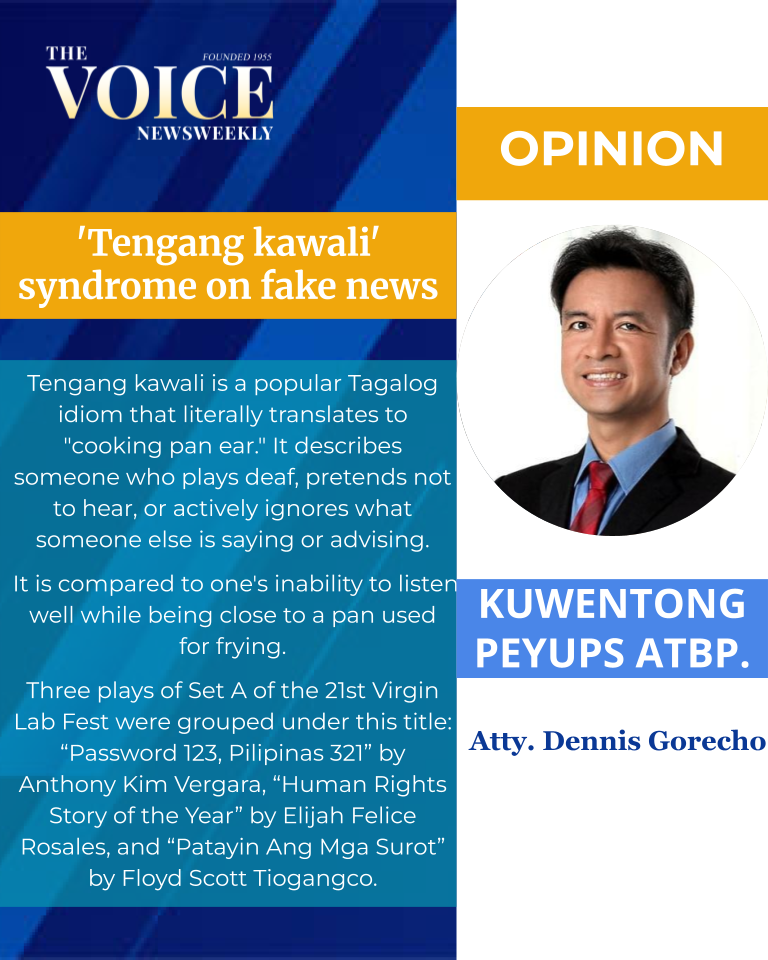
‘𝐓𝐞𝐧𝐠𝐚𝐧𝐠 𝐤𝐚𝐰𝐚𝐥𝐢’ 𝐒𝐲𝐧𝐝𝐫𝐨𝐦𝐞: The Dangerous Peril of Misinformation in the Digital Era
The digital landscape has become a fertile ground for “Tengang Kawali” syndrome—a colloquial metaphor describing individuals who remain willfully detached, indifferent, or “looking the other way” when faced with the escalating crisis of fake news. Much like a frying pan sitting precariously on the edge of a stove, society is teetering on the brink of a systemic collapse caused by disinformation. While digital platforms promise connectivity, they have ironically fostered an environment where truth is increasingly sidelined by sensationalism, emotional manipulation, and algorithmic echo chambers that reward outrage over accuracy.
At the heart of this phenomenon is the psychology of apathy. The “Tengang Kawali” attitude suggests a dangerous complacency among the public; many internet users have become desensitized to the sheer volume of falsehoods circulating online. Instead of actively verifying information, a significant portion of the population chooses to scroll past, adopt a “wait and see” approach, or simply ignore the gravity of misinformation until it directly impacts their personal lives. This passive observation is not merely a lack of interest—it is a societal malfunction that allows purveyors of fake news to operate with minimal resistance, effectively normalizing dishonesty as a standard feature of digital discourse.
The economic and political mechanics fueling this syndrome are sophisticated and predatory. Misinformation is no longer the work of mere hobbyists; it is a multi-million-peso industry driven by engagement metrics. When users fail to call out, flag, or debase fake narratives, they inadvertently validate the business model of disinformation peddlers. By ignoring the problem, the public inadvertently keeps the “pan” on the heat, allowing rumors and propaganda to simmer until they boil over into real-world violence, political instability, or the erosion of public trust in essential institutions like the media, science, and the judiciary.
Furthermore, the rise of the “Tengang Kawali” syndrome reveals a deep-seated exhaustion among the electorate and the citizenry. In the face of overwhelming information, many retreat into cognitive dissonance, preferring to believe comforting lies over complex, unsettling truths. When truth becomes a matter of “personal perspective” rather than objective evidence, the foundation of democratic debate begins to crumble. This erosion is facilitated by algorithms that tailor content to existing biases, shielding users from dissenting opinions and creating a false sense of security that everything being viewed is legitimate, thereby reinforcing the cycle of ignorance.
Addressing this syndrome requires a paradigm shift from passive consumption to active digital literacy. It is no longer enough to be a “neutral observer” in the digital age. Media organizations, educators, and technology policymakers must emphasize that neutrality in the face of disinformation is complicity. Strengthening fact-checking initiatives and imposing accountability on social media giants are necessary steps, but they cannot replace the individual responsibility of the user. Society must stop treating fake news as a minor nuisance or an entertaining curiosity and start recognizing it as a systemic health crisis that requires urgent, collective intervention.
Ultimately, the goal is to stabilize the “pan” before it tips over. The “Tengang Kawali” syndrome thrives on silence and the absence of critical engagement. If the public continues to look the other way, the repercussions for future generations will be irreparable. Restoring the value of truth requires a concerted effort to cultivate discernment, demand transparency from platforms, and foster a culture where calling out falsehoods is viewed not as a political stance, but as a civic duty. The era of indifference must end; the survival of our shared reality depends on the vigilance of every citizen who refuses to turn a blind eye to the digital fire.