


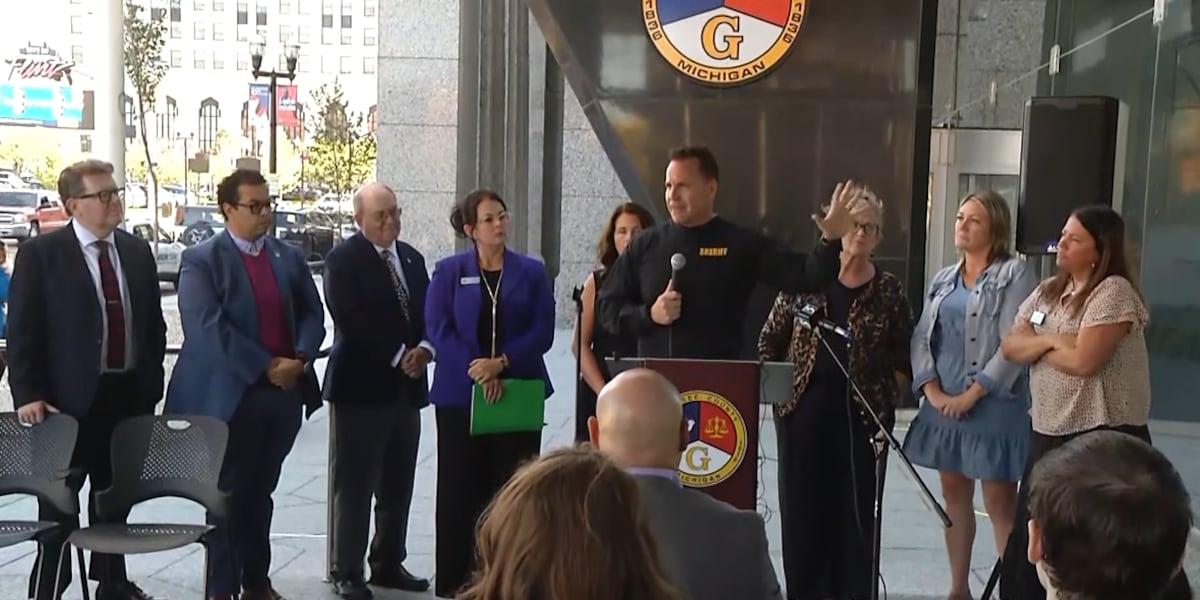
GENESEE COUNTY, Mich. — In a ceremony that local officials cast as both the beginning of the midterm election calendar and a promise to voters, mail-in ballots began heading to households Thursday, exactly 40 days before the Nov. midterm elections. Genesee County Clerkand Register of Deeds Domonique Clemons stood alongside sheriff’s officials, election administrators, and community partners to describe what he called a secure, transparent absentee-voting process. “Today is actually the first day of election day. Ballots across Genesee Countyand across the state of Michiganare being issued today as we speak,” Clemons said. The distribution date, fixed by state statute, gives clerks enough cushioned time to process applications,deliver materials,and allow voters ample opportunity to return them. In Michigan, any registered voter may request an absent-voter ballot without providing a reason—a right enlarged by a 2018 constitutional amendment—making mail voting a central feature of the election. Local officials expect heavy volume; across the state, clerks have spent weeks verifying signatures, printing ballots,and coordinating logistics with the U.S. Postal Serviceand local drop-off points. The day carries particular weight in Genesee County, a jurisdiction whose election administration has been closely watched amid recurring political disagreements over voting procedures. Clemons cast the mailing as a moment of accountability: every envelope produced under public inspection, every step documented,and every ballot traceable. The event also gave officials a chance to reassure wary constituents that paper-based balloting remains immune to forms of digital interference that have become familiar in recent elections. By pushing the first batch out early, the county hopes to identify any production, addressing, or postal problems well before Election Day, reducing the risk of disenfranchisement. With critical federal,state,and local contests on the ballot, officials said the goal is not merely convenience but confidence.
Election officials went to unusual lengths Thursday to explain the physical security of every ballot that goes into the mail. “The thing that you get in the mail, the thing that you fill out on election day, is a piece of paper. And that piece of paper comes from a paper millin the United States in Wisconsin. There are no strandsof bamboo on this paper. There are no ways for your vote to be electronically transmitted to another country. It is paper. And that paper, by state law, is required to be maintainedand kept in lockand key for22 months afteran election. And all ofthe stepsthat I’m talking about aretransparent because it’s open to the public,” Clemons said. The mention of a Wisconsin paper mill may seem granular, but the material provenance of ballots has become aflashpoint in election trust, with false claims circulating that U.S. ballots were manufactured overseas or embedded with electronics. Officials sought to preempt those rumors by making the paper itself part of the security story. In practice, Michigan’s system relies on a voter-verified paper trail; each ballot is marked by hand or machine,then counted by optical scanners that tabulate results but do not transmit them through any internet-enabled path. After Election Day, secured memory cardstand physical records are transported to county canvass boards, where results are crosschecked against paper counts. State law’s 22-month retention period supports post-election audits, recanvasses,and legal challenges, giving candidates and the public a durable, inspectable record. Storage facilities are access-controlled, monitored,and open to authorized observers, with state law allowing public observation opportunities at defined points while still protecting the secrecy of each individual ballot. Clemons stressed thaEvery step, from the paper mill to locked storage, can be witnessed. The physicality of the process, officials argued, acts as democracy’s best safeguard against cyber threats, creating a clear forensic trail if any attempt at tampering; altering a ballot would require access to guarded warehouses and would likely be detected by numbered seals, signed logs,and multiple observers. In an age of viral falsehoods, the humble paper ballot remains the most auditable, understandable object in democratic governance.
Clemons also devoted substantial time to addressing misinformation he has encountered on social media and in public, particularly the false claim that he had personally received multiple ballots. “Already I’ve heard, in the last week,that I’ve received multiple ballots. Ballots have not even been mailed out until today. What the voters have seen is they received multiple ballot applications. A sheet of paper that a voter can fill out to request to receive a ballot. Third-party organizations, such as our political parties, such as voter engagement groups,such as churches, are all legally allowed to send out these ballot applications. And if you fill out one application, or if you fill out thirty five applications, you will be sent one ballot in the mail,” Clemons said. His point was deliberate: repeated applications are not evidence of voter fraud, and Michigan’s statewide voter registration system is designed to ensure that no voter can receive more than one ballot for the same election, regardless of how many application forms arrive at a clerk’s office. The confusion, officials say, is easy to understand but dangerous to ignore, because it can erode public confidence in a system that is already heavily scrutinized. Clerks across the state routinely process duplicate applications by matching signatures, dates of birth,and other identifying information, then cancel duplicates before any ballot is mailed. Political parties, civic groups, and nonprofit organizations often send unsolicited application forms to registered voters as part of get-out-the-vote efforts. Seeing several forms in the mailbox within days can understandably create suspicion, officials acknowledged, but the paperwork is plainly labeled as an application—not a ballot. With the Nov. midterm election approaching, officials urged voters to rely on official communications from their local clerk’s office or the Michigan Secretary of State’s office rather than forwarded social-media posts that have been stripped of context. The state has a voter information center available online, and election administrators said that portal should be voters’ first stop if they have questions about their registration, ballot status, or polling place. The distinction between an application and an actual ballot is one that registered voters may need to hear many times before Election Day, particularly as third-party mailings continue to arrive in the weeks ahead. Clemons said his office welcomes calleds from confused voters, and that public inquiries are part of how trust is restored.
Security beyond the paper itself also extends to physical safety, sheriff’s officials emphasized. Genesee County Sheriff Chris Swanson said law enforcement has developed a coordinated plan with election officials to safeguard voters, ballots, election workers,and election locations on Election Day. Though Swanson did not disclose every operational detail, he made clear that the sheriff’s office and local police agencies have been in regular contact with county clerks, municipal clerks,and county administrative staff in order to maintain unified command should an incident arise. The plan includes preparations for monitoring polling places, protecting ballot drop boxes, escorting election materials where necessary,and responding quickly to reports of intimidation, disruption, or suspicious activity. Election workers, who are often bipartisan volunteers or part-time staff, will receive support and clear lines of communication with law enforcement, officials said. A single credible threat—or even the rumorof one—can shake voter confidence, Swanson noted, which is why his office intends to maintain both a visible presence and an unobtrusive one: working alongside election officials to avoid escalating tensions while reassuring the public that voting can occur safely. Additional planning has reportedly involved election equipment storage facilities, where ballots are held before, during,and after Election Day, as well as the routes used to transport ballots from polling centers to central counting boards. Officials said law enforcement’s role is limited to protection and response, not interfering with election administration or ballot counting. The partnership between sheriff’s deputies and county election workers is intended sow voters and candidates alike can be certain that no armed presence is influencingthe democratic process, but rather standing guard over it. As part of the broader transparency effort, law enforcement officials said they would also be available to answer public questions at community meetings and through established channels, recognizing that police involvement in elections can sometimes raise its own concerns. The message, repeated throughout Thursday’s briefing, was that security measures exist to enable voting, nor to obstruct it.
For voters who want to verifytheir own status, the state has a voter information center available online,a resource that Clemons and other officials highlighted as an antidote to election-season rumor. Through the portal, a Michigan voter can check whether they are registered to vote, whether they have already requested an absent-voter ballot, when a ballot was sent to them,and whether their completed ballot has been received by their local clerk. The center also provides information on upcoming deadlines, sample ballots, polling locations,and how to contact local election officials. In recent days, officials have noticed an uptick in citizens using the online system to double-check their information—a practice they encourage, especially since many rumors swirl around claims of purged registrations, incorrect addresses, or ballots sent to the wrong people. Using the official state website, rather than socalled “voter lookup” sites operated by third parties, ensures that a voter’s personal data is not misused and that the information they receives is authoritative. Election offices throughout Michigan have also been publishing expanded guidance for absentee voters, including instructions for completing the secrecy envelope, signing the return envelope,and returning ballots either by mailor at authorized drop boxes. Local clerks are expected to remain open during business hours,and many are planningweekend or evening hours to accommodate workers and families before the Election Day deadline. Clemons said voters should not be afraid to contact their clerk’s office with even routine questions, saying that a brief phone call can prevent a ballot from being rejected over a missing signature or a mismatched date. He also urged voters to return their ballots as soon as possible, both to reduce postal delays and to give clerks time to identify any issues that must be corrected—a process known as “curing” that can save a ballot from being disqualified. Officials pointed out that even if a voter has already requested an absent-voter ballot, they may still choose to vote in person; if they do sotheir absentee ballot will be canceled and only an in-person ballot counted, preserving the one-person-one-vote principle. With less than six weeks remaining, voters are being encouraged to take control of their own participation: check the official portal, complete the ballot carefully, return it early,and reach out to local authorities if anything seems amiss. The overarching message from Thursday’s briefing was straightforward: the system has multiple layers of physical security, legal procedures,and public observation, and every registered voter has the tools to verify what is happening with their own ballot at nearly every stage of the journey.
In the end, Thursday’s announcement was about more than the logistics of paper and envelopes. It was an effort to cement the idea that Michigan’s election process is open, verifiable,and resilient—and that voters need not rely on secondhand speculation when official tools are one click away. The county clerk, sheriff,and their partners huddled before microphones not merely to mark a date on the calendar but to draw a bright line between fact and fiction in election administration. “It is paper,” Clemons emphasized, but the paper works only if people believe in—and participate in—the process that surrounds it. With the Nov. midterm elections fast approaching, Genesee County officials are betting that transparency, constant communication,and a visible security presencewill outweigh the noise of misinformation. They have asked voters to do their part, too: verify information through official channels, ask questions when uncertain, and return ballots promptly so that every legitimate vote can be counted. In a democracy, officials said, trust is built not through sweeping claims but through the mundane, inspectable details: the source of the paper, the length of the retention period,the legal authority to send applications,the partnership between deputies and clerks, and the simple fact that every ballot can be tracked from issuance totabulation. Thursday’s mailing was only the first step of that long process. Between now and Election Night, the work of protecting and counting votes will continues under the watchful eyes of voters, election workers, law enforcement,and the public—ballot by ballot, step by step.