


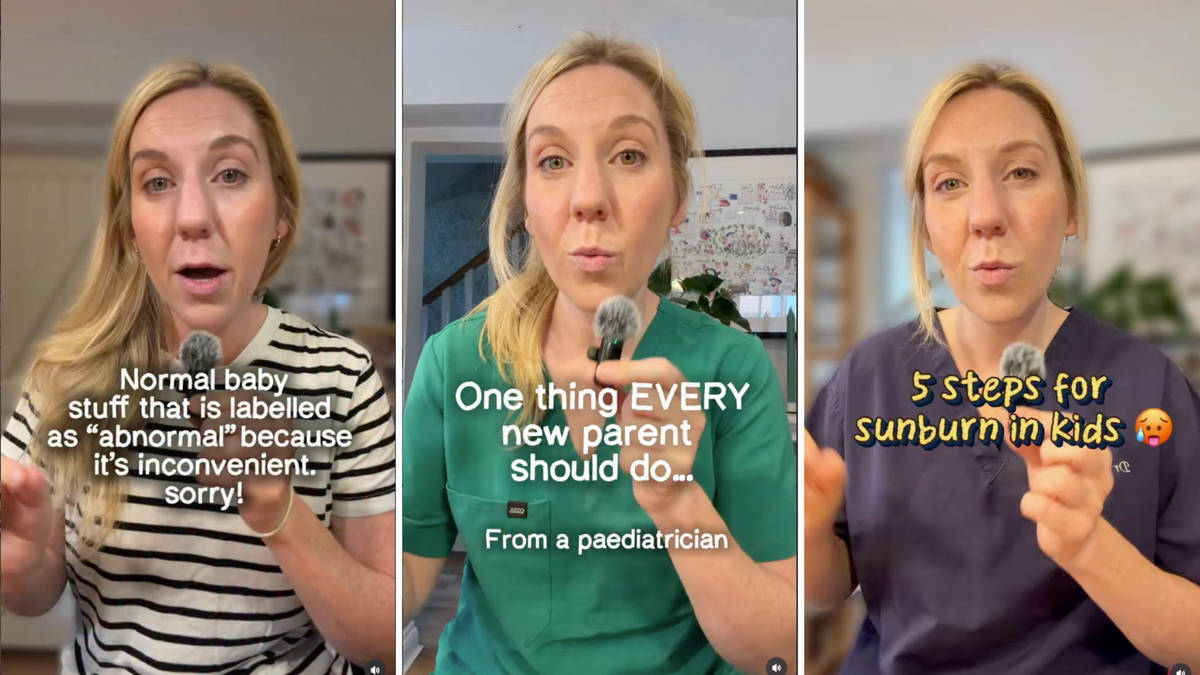
Paediatrician Dr Lillie Parker has called on the NHS to embrace social media-savvy doctors as a frontline defence against health misinformation, arguing that public health bodies must move beyond impersonal online posts and harness the communication skills of clinicians who already command large digital audiences. Speaking at the UK Health Security Agency’s annual conference in Manchester, Dr Parker—who has more than 100,000 followers on Instagram—said that in an era of shrinking access to GPs and health visitors, smartphones have become the most effective route to reach families. “Humans are craving human interaction,” she told delegates, as experts from the UKHSA and World Health Organisation gathered to discuss managing communications in an age of misinformation. Yet she acknowledged that there remains an “anxiety” around allowing medics to use their communication skills online, even as official accounts struggle to break through. Her remarks come at a time when parents are increasingly overwhelmed by conflicting health advice on social media, and when institutions such as NHS England are only beginning to experiment with platforms like TikTok in an effort to reach younger audiences.
Dr Parker, who describes herself as an “NHS clinician first and always will be”, criticised the way many public health organisations currently communicate, saying that text-heavy posts are unlikely to capture attention in the split seconds users spend scrolling. “A carousel post of text coming from an organisation is not what the public are going to engage in,” she said. “In that 1.8 seconds they are going to scroll past, they will not be reading what you have to say.” She suggested that bodies like the UKHSA and the WHO are beginning to recognise the value of human voices on screen, but that NHS England has been slower to adapt. “I think organisations like UKHSA and the WHO are actually recognising this, probably before NHS England is,” she said. “But I think all of those organisations need to see that human beings are the way to get to people, albeit human beings on a screen.” Her argument is rooted in a broader observation about the erosion of face-to-face public health services: fewer health visitors, fewer GPs, and fewer opportunities for families to receive trusted guidance in person. In their place, she said, nearly everyone now carries a smartphone—and doctors who are already trained in communication are uniquely placed to meet families where they are.
The paediatrician’s own journey into content creation began about three years ago, after she noticed that friends and family members who were having children were becoming overwhelmed by the sheer volume of online noise and misinformation. “I think we all know that parents have access to more information than ever before,” she said. “But actually, far from empowering parents, I’ve found that it’s been very overwhelming for people, and it’s making a generation that are more anxious and feel more pressure than ever to get things right when it comes to health, when it comes to raising children and children’s health in particular.” That realisation prompted her to start sharing evidence-based advice on Instagram, where she now reaches more than 100,000 followers. But despite the scale of her audience and the clear demand for reliable guidance, she remains an unpaid volunteer in that role. She told the conference that she currently works only 60 per cent of her time for the NHS, and that the rest of her content creation is done for free. “I don’t get paid for the rest of the time,” she said. “But I’m doing it for free because I’m passionate about what I do. So why can’t it be part of my job? I would love that.”
Her call for official recognition of clinician content creators is not simply about personal fulfilment; it is a strategic response to the growing challenge of health misinformation. When asked what organisations should be doing to tackle the problem, Dr Parker was direct: “Use the content creators that are already there.” She argued that doctors are trained in how to talk to the public and how to get messages across, and that their professional credibility offers a powerful counterweight to the anonymous and often misleading accounts that dominate social media feeds. The concern, she said, is that many health bodies remain nervous about giving doctors the freedom to post online, worried perhaps about reputational risk or the unpredictability of live digital engagement. But she insisted that the greater risk lies in leaving the information vacuum to be filled by unreliable sources. Her comments echo a warning from NHS England’s national medical director, Professor Frankie Swords, who recently said that people are seeking out health information from “unreliable” sources. NHS England launched its own TikTok account during the summer, a sign that official institutions are beginning to take the platform seriously—but Dr Parker believes that institutional accounts alone are not enough.
The broader context of her speech is a public health landscape in which misinformation has become a major threat to child health, vaccination uptake, and parental confidence. The UKHSA conference session on managing communications in an age of misinformation brought together experts from the WHO and other leading bodies to discuss how to respond to the rapid spread of false claims online. Dr Parker’s contribution highlights a paradox: at a time when people are more connected than ever, they are also more isolated from trusted professionals. The decline in the number of health visitors and GPs means that many parents no longer have a familiar clinician to turn to for advice, and instead find themselves navigating a chaotic digital environment where anyone can claim to be an expert. In that vacuum, she argued, doctors with strong communication skills and a visible online presence can serve as a bridge between official guidance and everyday family life. But for that to happen at scale, the NHS would need to treat content creation as a legitimate part of clinical work, rather than as a hobby undertaken in spare time.
Dr Parker’s vision is one in which the NHS actively supports and perhaps even employs clinicians to produce public health content, recognising that a well-made Instagram post or TikTok video can be as valuable as a clinic appointment in preventing illness and promoting healthy behaviours. She is careful to position herself as a clinician first, and she is not advocating for doctors to become influencers in the traditional sense; rather, she wants to see the communication skills that are already central to medical training be applied to the digital spaces where families now spend their time. Her message to public health leaders is that the public is hungry for human connection, and that a faceless organisation posting text is no substitute for a trusted doctor speaking directly to a camera. Whether NHS England will take up that call remains to be seen, but the pressure is growing. With misinformation spreading faster than ever, and with traditional services under strain, the argument for putting more doctors on social media is becoming harder to ignore. As Dr Parker put it, everyone has a smartphone, and the people who can reach them through that screen are the ones who will shape the next generation’s understanding of health.