


Paragraph 1: Introduction and Core Accusation
The Temporary Committee for the Rehabilitation of Gelati Monastery has issued a robust statement categorizing recent critical reports in the media and on social networks as a coordinated “disinformation campaign.” The committee asserts that specific persistent groups are deliberately attempting to mislead the public regarding the status of the ongoing rehabilitation project at the UNESCO World Heritage Site. This strong rebuttal comes in response to a wave of criticism and allegations concerning various aspects of the restoration work. The committee frames these criticisms not as legitimate concerns but as orchestrated attempts to undermine the integrity of the project and confuse the public about the actions being taken to preserve the historic monastery. The central thrust of the committee’s response is to defend both the technical decisions and the scientific validity of the rehabilitation methods currently being employed, while simultaneously questioning the motives and expertise of the critics.
Paragraph 2: Defense of the Temporary Roof
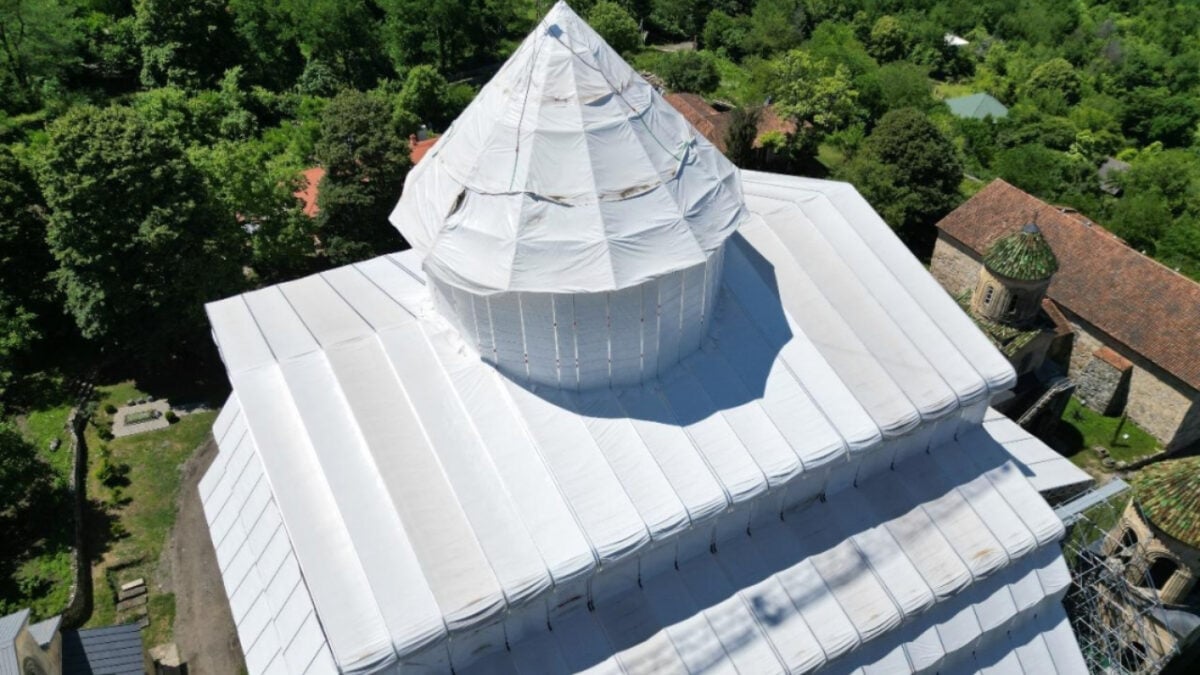
A significant portion of the committee’s response focuses on defending the temporary roof installed over the Cathedral of the Nativity of the Virgin against claims that the structure has left the church covered with “cellophane.” The committee explicitly rejects this characterization, clarifying that the installation of a unified temporary roof has been a primary requirement stipulated by the UNESCO World Heritage Centre since 2020. They detail a rigorous design process that included 19 proposals from Georgian specialists and an additional submission from an Italian team. According to the committee, the final structure, developed under their direct supervision by a collaborative Georgian and German team, was the only practically feasible solution capable of addressing the site’s complex and demanding requirements. Crucially, the committee states that this completed project received the highest possible assessment from the World Heritage Centre, lending international legitimacy to their chosen approach.
Paragraph 3: Technical Specifications of the Roofing Material
To further counter the misleading “cellophane” narrative, the committee provided detailed technical information about the roofing material itself. They emphasize that the covering is not common plastic but a high-tech PVC fabric that was specially manufactured for the Gelati Monastery project. The material was produced over a three-month period at a dedicated facility in Germany, ensuring it met specific standards for conservation work. The committee assures the public that this material fully complies with international conservation standards. By highlighting the bespoke nature of the fabric’s production and its compliance with global guidelines, the committee aims to demonstrate that the roof is a carefully engineered, high-specification intervention rather than a crude or temporary measure. This level of detail is intended to reassure the public that the roof is a considered part of the conservation strategy, approved by top international bodies.
Paragraph 4: Rebuttal of Fresco Deterioration Reports
The committee categorically denied reports that the interior frescoes of the cathedral are suffering from large-scale deterioration or falling off. They stated with “full responsibility” that no such incidents are occurring. The statement clarifies that all critical areas within the Cathedral of the Nativity of the Virgin have been stabilized, and a planned, phased conservation process is currently underway. This strong denial directly challenges alarming social media reports that may have shown images of damage or suggested ongoing structural failure. The committee’s insistence that the frescoes are stable and under professional care is aimed at quelling public anxiety about permanent damage to these irreplaceable works of art, asserting that the situation is under control and being managed by conservation professionals.
Paragraph 5: Explanation of Microclimate Research and Proposals
Addressing criticism of an interim report on the microclimate within the monastery’s churches, the committee defended the work of Italian professor Dario Camuffo, a “leading expert” and founder of the scientific discipline of microclimate research for cultural heritage. The committee explained that the condensation and moisture issue at Gelati is typical of large cathedrals, caused by the interaction of thick stone walls retaining winter cold with warmer spring air. They elaborated on one possible solution proposed by Camuffo: gradually warming the floor from spring until mid-summer to reduce condensation. However, the committee stressed this remains a preliminary working hypothesis that requires further research and a detailed assessment before any implementation. This response seeks to validate the scientific rigor of the research while clarifying that suggested measures are not being hastily applied, indicating a responsible, evidence-based approach.
Paragraph 6: Clarification on ‘Pilot Restoration’ and Conclusion
Finally, the committee addressed criticism concerning the memorandum signed with Italy’s Opificio delle Pietre Dure restoration institute and the accusations that specialists would be conducting “experiments” on the monument. They clarified that the term “pilot restoration” denotes a standard, fundamental conservation practice where materials and methods are first tested on a small, less visible section of wall painting to ensure their safety before any full-scale treatment. The committee dismissed claims of experimental activity as stemming from either “elementary professional ignorance or propaganda.” They reiterated that such preliminary testing is an established and necessary procedure in the conservation of historic wall paintings globally. In conclusion, the committee’s response systematically defends the project’s methodology, material choices, and international collaborations, positioning the rehabilitation as a scientifically sound process and attributing its criticisms to misinformation, ignorance, and a deliberate campaign to mislead the public.