


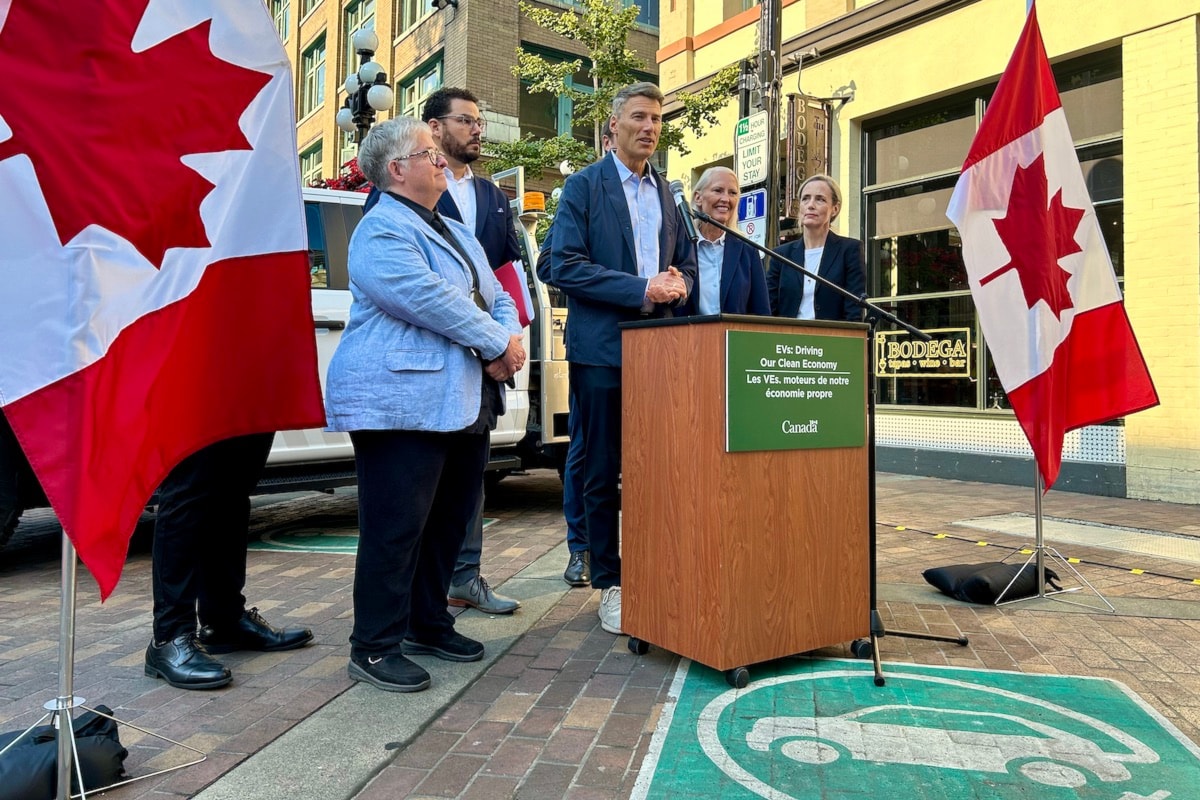
Federal Government Invests $22.7 Million in BC Electric Vehicle Charging Infrastructure Amidst Industry Pushback and Public Concerns
VICTORIA, BC – Amidst growing public skepticism and industry resistance towards electric vehicle (EV) mandates, the federal government announced a significant investment of $22.7 million to expand BC’s EV charging network. Federal Housing and Infrastructure Minister Gregor Robertson unveiled the funding in Victoria, which will support the installation of 480 new charging stations across the province. This move comes as the federal government aims to accelerate the adoption of electric vehicles to combat climate change and reduce reliance on fossil fuels. However, the path to widespread EV adoption faces challenges, including public perception, industry lobbying, and infrastructure limitations.
Robertson’s announcement coincides with increasing apprehension surrounding government-imposed EV mandates, both federally and provincially. Recent polls suggest a decline in public support for these mandates, which dictate a certain percentage of new vehicle sales must be electric. The federal mandate requires 20% EV sales by 2026, escalating to 60% by 2030 and 100% by 2035. British Columbia’s targets are even more ambitious, aiming for 26% by 2026, 90% by 2030, and 100% by 2035. This divergence in public opinion and government targets has created a tense backdrop for the ongoing debate on EV adoption.
Minister Robertson directly accused the auto and oil industries of orchestrating “misinformation and propaganda” campaigns to undermine public confidence in EVs. He labeled these efforts “regrettable and immoral”, particularly given the current challenges of affordability and climate change. He argued these industries are attempting to protect their vested interests by slowing down the transition to electric vehicles, potentially jeopardizing the progress towards a cleaner transportation future.
Criticism of the EV mandates isn’t limited to industry lobbying. Barry Penner, chair of the Energy Futures Institute and former BC Liberal environment minister, advocates for the removal of mandates, arguing the province’s focus is misplaced. He estimates BC requires 40,000 additional charging stations by 2030, a stark contrast to the currently available 5,000. Penner believes the government is prioritizing EV sales without adequately addressing the crucial need for supporting infrastructure. This “cart before the horse” approach, he contends, could lead to an oversupply of EVs that dealers struggle to sell, further complicating the transition.
The economic implications of the mandates are also a subject of debate. Penner expressed concerns about potential penalties for dealerships that fail to meet the mandated EV sales targets. Dealers exceeding the mandated ratio face a $20,000 penalty per vehicle or the option to purchase credits from other automakers, often benefiting companies like Tesla, which exclusively produces electric vehicles. This, Penner argues, inadvertently channels funds towards specific manufacturers, potentially distorting the market and creating unintended consequences. Echoing Penner’s concerns, BC Conservative Transportation critic Harman Bhangu also questions the feasibility of achieving the mandate targets, citing insufficient charging infrastructure and the high cost of EVs as significant barriers.
Conversely, Glenn Garry, president of the Victoria Electric Vehicle Association, supports Robertson’s claims of industry misinformation. He points to various options available to dealers to offset costs related to mandate compliance, including investments in charging infrastructure. Garry highlighted the auto industry’s initial willingness to participate in the mandate program, suggesting their change of heart followed US President Donald Trump’s criticism of EV mandates. He downplayed concerns about charging infrastructure, emphasizing that most EV charging occurs at home, minimizing the immediate need for extensive public charging networks.
Acknowledging the need for improved infrastructure, Minister Robertson affirmed the government’s commitment to further investments in charging stations across Canada. He emphasized the dual purpose of supporting Canadian jobs in the auto and battery sectors while aggressively pursuing the transition to electric vehicles. Despite the challenges and dissenting voices, Robertson maintained a positive outlook on the future of EVs, emphasizing the ongoing growth and scaling of the EV market. The federal government’s investment in BC’s charging infrastructure marks a significant step in the ongoing national debate on EV adoption, underscoring the commitment to a cleaner transportation future while navigating complex issues of public perception, industry influence, and infrastructure development.