


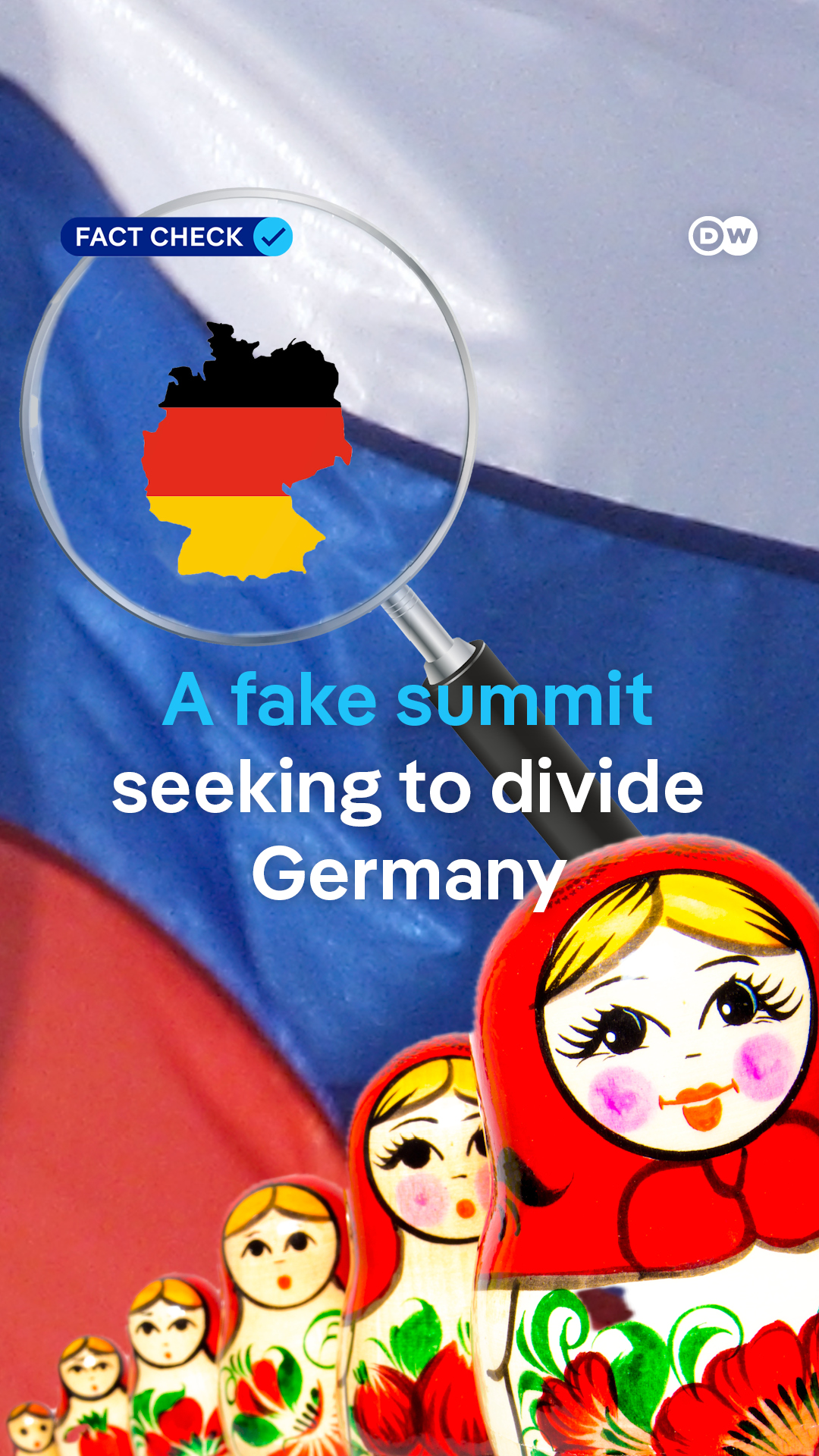
Fake ‘Time to Divide Germany’ Summit Exposed as Russian Disinformation Ahead of Crucial Elections
BERLIN — Just weeks before voters in Germany’s eastern states go to the polls, social media platforms have been flooded with promotional videos for a summit that does not exist. Called “Time to Divide Germany,” the invented conference is being advertised in slick, television-style clips that feature alleged experts and moderators discussing German partition, historical borders, and the post-war order. One video claims a coalition of journalists, academics and former politicians would soon gather in Berlin to endorse a formal split into several independent territories; another shows a supposed former NATO official warning that German unity is unsustainable. The broadcasts carry familiar network logos, use chyron graphics and appear at first glance remarkably realistic. But according to DW FactCheck, they are entirely fabricated. The summit has no verifiable website imprint, no registered participants, no booking for any convention centre, and no record in reputable event calendars. Instead, the clips contain digital fingerprints typical of artificial intelligence-generated content: odd lip syncing, distorted hands, inconsistent shadows among panellists. They are being disseminated by networks of anonymous social media accounts, many of which have been traced to bot farms. German authorities and independent investigatorscribe them to a broader Russian disinformation effort known as Operation Overload–also called Matryoshka–which has been active in German-language online spaces for months. The timing is deliberately aligned with elections in Saxony, Thuringia and Brandenburg, states where trust in established parties ahs already eroded, and where protests over migration, inflation, and Ukraine aid have created fertile soil for conspiracy narratives.
The fake summit is not a simple hoax but a intricate multi-layer deception. The term “Matryoshka” used by researchers captures how the operation works. At the outer layer, a social media user sees video of a news flash about an upcoming summit. If they search for more information, they discover a related Telegram channel apparently run by insiders; there, organisers share “leaked” schedules and draft resolutions. Those documents contain names of fictitious institutions–such as a “Working Group on the European Territorial Order” and a “Foundation for Historical Reconciliation”–each with its own polished website, social media profiles, and pseudo-scholarly papers. Users whoget deeper may find interviews with fake witnesses who claim that preparations for the summit are proceeding and that foreign intelligence agencies are aware of it. What appears to be a chain of evidence is in fact a cycle of mutually reinforcing inventions. None of the institutions mentioned exists; none of the quoted analysts can be traced; photos of the supposed participants are synthetic, and no real journalist attended any event, nor was any reporter able to secure an interview. The objective is not necessarily to convince the public that a division of Germany is imminent. Rather, by producing an endless series of such fictions, Kremlin-linked actors hope to exhaust fact-checkers, distract media and make every official statement seem like another layer of manipulation. As one disinformation analyst put it, “If you can get people to argue about whether a fake summit is real, you have already won; the real summit you wanted to prevent is doomed to be overshadowed.” The “Divide Germany” videos are therefore not a crude attempt to persuade voters that unification has ended; they are a means of surrounding democratic debate with so much noise that quiet concern for the common good gets drowned.
This method has been observed before, but Operation Overload is distinguished by its scale and automation. Researchers who track digital threats in Central Europe say Russia’s aim is to flood information ecosystems with a high volume of low- and high-quality fakes simultaneously, ranging from crude memes to sophisticated deepfakes. The name “Overload” refers to that deliberate saturation. Instead of one big lie that can easily be exposed, Moscow sends thousands of small lies, forcing fact-checkers to actas a triage doctor at a overcrowded casualty ward. Matryoshka, meanwhile, points to the recursive construction: every fake contains a smaller fake and points to another, so that debunking one thread only reveals another. The campaign has targeted Germany with particular intensity because Berlin has become one of Kyiv’s most important military and economic partners in Europe. German weapons, financial aid and political backing are essential for Ukraine’s defensive struggle, and the Kremlin clearly judges that destabilizing Germany is the most effective way to cripple European support. The fake summit narrative dovetails with longstanding state media themes in Moscow: that Germany is an “artificial” state, that the West is collapsing, and that only radical change can restore peace. German domestic security services have repeatedly warned about Russian attempts to influence public opinion; ing recent years, the Federal Intelligence Service has spoken of a “new qualitative dimension” of cyber manipulation. The operation is not confined to Germany. Similar fake events have been seeded in Poland, France, and the Baltic states, but the “Divide Germany” staple is reserved for a country whose wartime guilt makes its unity symbolically powerful and politically fragile. By targeting the very idea of German cohesion, Russian influence architects hope to weaken the cohesion of the European Union itself.
Germany’s eastern regional elections in September 2024 carry significant weight beyond their regional remit. In Thuringia, polls put the far-right Alternative for Germany at around 30 percent, ahead of all other parties; in Saxoby, the party has also led in surveys. A new left-populist party, the Sahra Wagenknecht Alliance, combines left-wing economic positions with conservative social agenda and skepticism of military aid to Ukraine; it has entered all threeparliaments. A fragmented party system will make coalition negotiations extremely difficult, possibly leaving regional governments weak and vulnerable. That is exactly what Moscow wants. A divided Germany, or at least a divided political landscape, would hamper military aid decisions, delay reforms and amplify fatalist narratives. The fake summit taps into fears of political fragmentation by literalizing them. When voters see repeated images of “experts” advocating dividing Germany, they may beginto believe German statehood is fragile; if enough people believe that, actual political behavior changes. The campaign also feeds existing grievances in post-communist eastern Germany: economic disparities, rural neglect, distrust of mainstream media, rage over immigration. Russian state media have long told eastern Germans that they are treated as second-class citizens by a western elite; these elections provide a channel for that resentment. The fake summit presents itself as a solution: if the Federal Republic were dissolved, they suggest, local pride could be restored and Moscow’s strategic adversaries pushed back.
Fact-checkers and journalists have been working overtime to expose the fraudulent videos. DW FactCheck published a detailed investigation identifying clues: invented presenter names, template websites, and metadata linking the videos to known Russian-affiliated accounts. German public broadcasters, including ARD and ZDF, have aired segments reportingthat the summit is fake; init social media platforms removed some of the most viral copies, though copies resurface quickly. The European Union’s Digital Services Act applies to large platforms, requiring them to comply with election integrity obligations. German authorities have stressed that platforms must do more, especially before elections. The German Foreign Office launched a communication campaign to document foreign interference and counter narratives. State and federal election authorities are monitoring disinformation because even if no actual vote manipulation happens, disinformation can intimidate voters, suppress turnout, or distort preferences. Civil society has also stepped in: media literacy workshops in schools, online toolkits, and rapid-response collaborations between fact-checkers and psychologists. Researchers saythe most important defense is a public that knows the techniques: when a video promiss a sensational political event, check official sources, search for coverage by credible newsrooms, ask whether any real journalist has reported from the location. In a campaign named Overload, the aim is to make people stop checking. The first response must beto slow down, to verify, and refuse to be dragged into the puppet theatre.
The fake “Time to Divide Germany” summit will not happen. But its afterlife in feeds, chat groups and comment threads may have lasting effects. Every share reinforces mistrust; every anxious debate about its authenticity draws attention from real issues; every person who sees the video and wonders if Germany might earnestly split has lost a bit of faith in the country’s stability. For the Kremlin, that is mission accomplished. The operation is not about literally changing borders–it is about altering perceptions to shape outcomes in countries that support Ukraine and uphold democratic norms. It is no coincidence that less than a month before the regional elections, hundreds of coordinated accounts began promoting a “divide” narrative. German democracy is being stress-tested by an adversary adept at finding cracks. Yet the same campaign carries the seed of its own failure. Operation Overload and Matryoshka have been exposed, repeatedly, by fact-checkers, journalists, and democratic governments. The public, though fatigued, is not helpless. Citizens who recognize a manipulated clip as manipulation take away its power. What the Kremlin cannot survive is transparency. Germany’s democratic institutions, independent courts, free press and civil society still have the capacity to name what is false and to protect what is true. Voters entering ballot booths in Saxony, Thuringia and Brandenburg will decide many things; but one of them is whether they allow a fictional summit to undermine confidence in their real, imperfect constitutional democracy. If the answer is no, then Operation Overload, for all its sophistication, has failed yet again.