


Paragraph 1: The Foreboding Warning on Voter Suppression
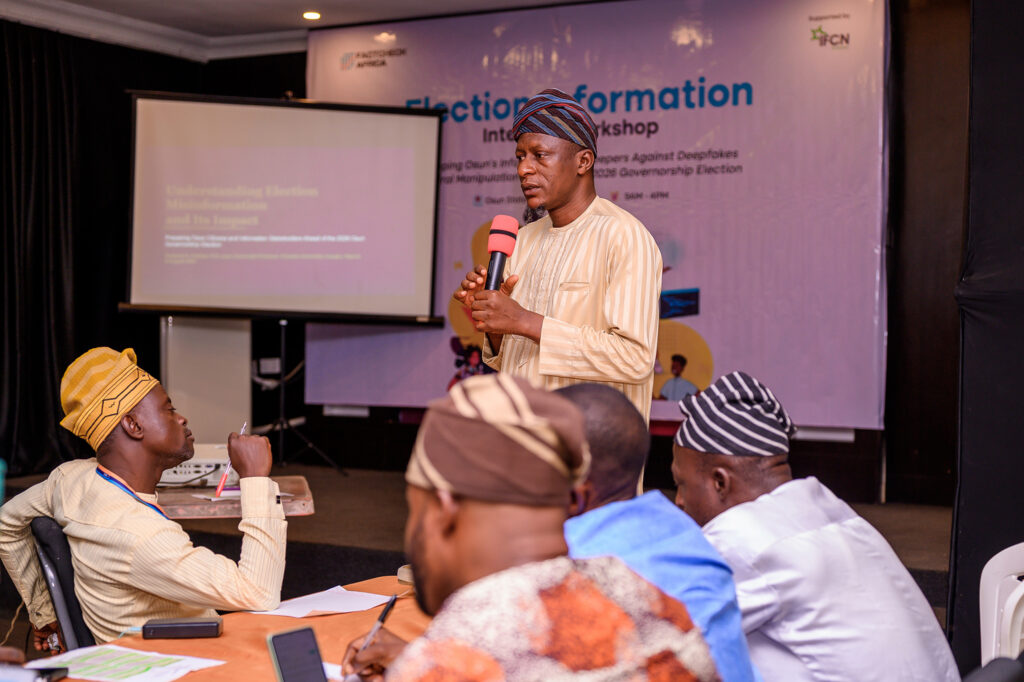
In a decisive pre-election intervention aimed at safeguarding democratic participation, Dr. Rasheed Adebiyi, an Associate Professor at Fountain University, Osogbo, has issued a stark warning that a deliberate proliferation of false security reports and misleading information regarding polling-unit locations could severely suppress voter turnout in the highly anticipated 2026 Osun State governorship election. This urgent caution was delivered during a meticulously organized workshop convened by FactCheckAfrica, a prominent organization dedicated to combating information disorder, specifically designed to prepare journalists, media practitioners, and key information stakeholders for the electoral cycle ahead. The workshop, which took place on August 8, 2026, at the Osogbo Holiday Inn Hotel & Suites Ltd., Dada Estate, carried the thematic banner “Preparing Osun Citizens and Information Stakeholders Ahead of the 2026 Osun Governorship Election,” signaling a proactive approach to mitigating the toxic influence of false narratives on the electoral process. Dr. Adebiyi’s address was not merely a theoretical exposition but a practical warning grounded in the volatile realities of Nigerian electoral politics, where the integrity of information can be as decisive as the ballot itself. He meticulously dissected the ecosystem of falsehood, emphasizing that the information landscape is no longer just a supplementary aspect of elections but a primary battleground where the fate of candidates and the legitimacy of the democratic process are contested. By identifying the specific mechanisms through which misinformation operates—particularly the terrifying prospect of authentic-looking security alerts claiming violence at specific polling units—the professor underscored how tactical psychological warfare can directly translate into physical voter apathy, effectively disenfranchising citizens without any need for thuggery or ballot box snatching.
Paragraph 2: Deconstructing the Triad of Information Chaos
In his comprehensive exposition, Dr. Adebiyi introduced a critical taxonomy of information disorder that is essential for stakeholders to understand: misinformation, disinformation, and malinformation. He carefully defined misinformation as the unintentional sharing of false information, where the disseminator lacks the intent to deceive but nevertheless contributes to a polluted information ecosystem. In stark contrast, disinformation is the deliberate creation and propagation of falsehoods with the specific intention to deceive, manipulate, or cause harm, often weaponized by political operatives to tilt the electoral scales in their favor. Adding a third, often overlooked layer, malinformation involves the malicious sharing of genuinely true information taken out of context or used with the intent to cause reputational damage or incite violence. These three forms, intertwined and often mutating in real-time across social media platforms, represent a direct and existential threat to the credibility of the 2026 Osun gubernatorial race. The academic meticulously articulated the direct consequences of these information disorders, particularly focusing on voter behavior. He posited that false security reports—such as fabricated news of bombings, coordinated attacks, or hostage situations—are among the most potent tools for voter suppression, as they instill primal fear in citizens who might otherwise brave the lines to cast their votes. Furthermore, he highlighted the insidious nature of rumors concerning changes to polling-unit locations, which effectively create a fog of confusion on election day. When voters arrive at their customary polling stations to find their names missing or the location shifted, the frustration and disorientation often lead them to abandon the exercise entirely. The Professor also warned about the broader chaos induced by fake statements attributed to the Independent National Electoral Commission (INEC), outdated video footage recirculated as current violent events, and the premature declaration of election results by partisan actors, all of which disrupt the orderly flow of voting and undermine the foundational trust in the electoral machinery.
Paragraph 3: The Systemic Erosion of Trust and Post-Election Threats
Beyond the immediate logistical disruptions on election day, Dr. Adebiyi issued a profound caution regarding the long-term systemic damage that misinformation inflicts upon democratic institutions and social cohesion. He detailed how the relentless onslaught of falsehoods reduces public trust in the electoral process, creating a cynical citizenry that believes the outcome is predetermined or corrupted, regardless of the actual conduct of the election. This pervasive distrust leads to increased fear and societal tension, breeding an environment where citizens retreat from civic participation and where inter-community relations become fraught with suspicion and hostility. The academic further noted that these narratives effectively deepen political division, fracturing the social fabric along partisan lines and transforming political disagreements into existential conflicts. Moreover, the reputations of candidates are routinely destroyed through smears and fabricated scandals, forcing them to defend against ghost allegations rather than communicate their policy platforms to the electorate. Instructively, Adebiyi emphasized that this assault on truth does not cease when the polls close; rather, it often intensifies during the post-election period, which is frequently the most volatile phase of any electoral cycle. He warned specifically about the coordinated distribution of fake election results, the brazen false declarations of victory by unauthorized individuals, the manipulation of result sheets—whether through Photoshop or actual physical tampering—and the orchestration of false rigging narratives. These post-election information operations are particularly dangerous, as they are designed to delegitimize the declared outcome, provoke civil unrest, and undermine the constitutional handover of power. By targeting the verification processes of INEC, security agencies, and domestic/foreign election observers, these malicious actors seek to cast an illegitimate shadow over the entire electoral process, potentially leading to post-election violence and the instability of the entire state.
Paragraph 4: The Journalistic Imperative: Verify, Validate, Value
To combat this sprawling threat, the workshop pivoted towards equipping journalists and fact-checkers with the necessary tools to act as sentinels of truth, emphasizing a shift from passive reporting to active gatekeeping. The participants were strongly urged to adopt a rigorous, three-pronged approach—“Verify, Validate, Value”—before publishing or amplifying any election-related claim. This framework compels them to move beyond the frantic pace of breaking news and to interrogate the veracity of every piece of information that crosses their desks. The session recommended that before disseminating anything on election day or during the campaign period, journalists should subject the claim to a battery of five critical questions designed to filter out malicious content. These questions were delineated as: Is this claim true?; Who is the original source of this information?; Has the information been independently verified by a trusted third party?; Who stands to benefit if the public believes this claim?; and, equally important, Will sharing this information potentially increase tension or incite violence? This reflective questioning process is designed to slow down the viral dissemination of falsehoods, creating a crucial time-lag that allows for proper fact-checking and debunking. By internalizing this framework, journalists transform from mere conduits of information to defenders of electoral integrity. A key component of the workshop’s operational guidance was the recognition that journalists must not wait for viral falsehoods to reach their peak before responding, but rather they must actively track emerging narratives on WhatsApp groups, Facebook, and local radio call-in shows to identify and debunk falsehoods in their nascent stages, thereby preventing the initial misinformation from gaining the momentum that makes correction almost impossible to achieve.
Paragraph 5: The Emerging Frontier of Artificial Intelligence Threats
The high-level deliberations at the workshop also confronted the rapidly evolving technological landscape that has made the creation of sophisticated misinformation accessible to virtually anyone. Israel Olátúnjí Tijani, the founder of ChatVE and a noted data scientist, delivered a compelling presentation on the proliferation of manipulated content, describing it as a “super-charged” threat to information integrity. He observed that while manipulating images and videos was once the domain of technical experts, the advent of free and low-cost artificial intelligence tools has democratized deepfakery. Today, he warned, photorealistic images, convincingly cloned voices, and face-swapped videos can be manufactured within minutes, requiring no more skill than typing a prompt into a generator. This technological leap is exacerbated by the unique media consumption patterns in Nigeria, particularly in the Osun State context, where content spreads rapidly through closed WhatsApp groups, Facebook, and increasingly through local-language radio call-in programmes. These channels often function outside the purview of fact-checkers, allowing manipulated content to reach millions of citizens in Yoruba and Pidgin before any official fact-checking institution can even identify the original post, let alone debunk it to a mass audience. Tijani stressed that countering this requires a coordinated, multi-layered verification and response system that does not rely on a single method. He urged journalists and fact-checkers to integrate open-source intelligence (OSINT) techniques with hyper-local verification. The strategy outlined included the systematic use of reverse image and video searches to find the original context of a file, meticulous metadata checks to examine file creation data, advanced geolocation and chronolocation to determine if an event actually occurred in Osun State at the claimed time and place, and rigorous cross-checks with established fact-checking organizations like FactCheckAfrica itself.
Paragraph 6: The Limits of AI Detection and the Power of Local Knowledge
In a crucial caveat that rounded out the technical session, Tijani emphasized a fundamental limitation in the fight against synthetic media: corruption cannot be reliably detected by artificial intelligence alone. While AI detection tools are advancing, they are far from infallible and can often produce false positives or be easily defeated by simpler compression techniques used in WhatsApp broadcasts. He therefore recommended that these tools be viewed as supplementary aids rather than definitive arbiters of truth. The true differentiator, he argued, lies in the application of human intelligence, specifically deep local knowledge. He expounded on this by noting that familiarity with Nigerian and Yoruba sociocultural contexts is an irreplaceable asset in detecting manipulated content. For example, an AI-generated video might accurately depict a landscape but fail to render the specific architecture of an Osun village, the particular shade of a traditional fabric worn, or the intricate nuances of the Yoruba language spoken in a specific local dialect. Such inconsistencies, while sometimes imperceptible to globally-trained detection algorithms, are immediately obvious to a native Yoruba observer or a local journalist intimately familiar with the region’s customs and geography. Therefore, the workshop concluded with a powerful call to action: empowering local communities and journalists to act as the first line of defense. By combining the rigorous verification workflows—reverse searches, metadata checks, geolocation, and local cultural insight—Osun stakeholders can effectively dismantle the machinery of information disorder. As the 2026 election approaches, the collective resolve of journalists, fact-checkers, and ordinary citizens, armed with the “Verify, Validate, Value” ethos and sophisticated digital forensics, will ultimately determine whether the information environment remains fertile ground for democratic sovereignty or becomes a poisoned well that jeopardizes the will of the people. The takeaway was stark, yet hopeful: the defense of the election lies not in what is shared, but in the disciplined verification of what is believed.