




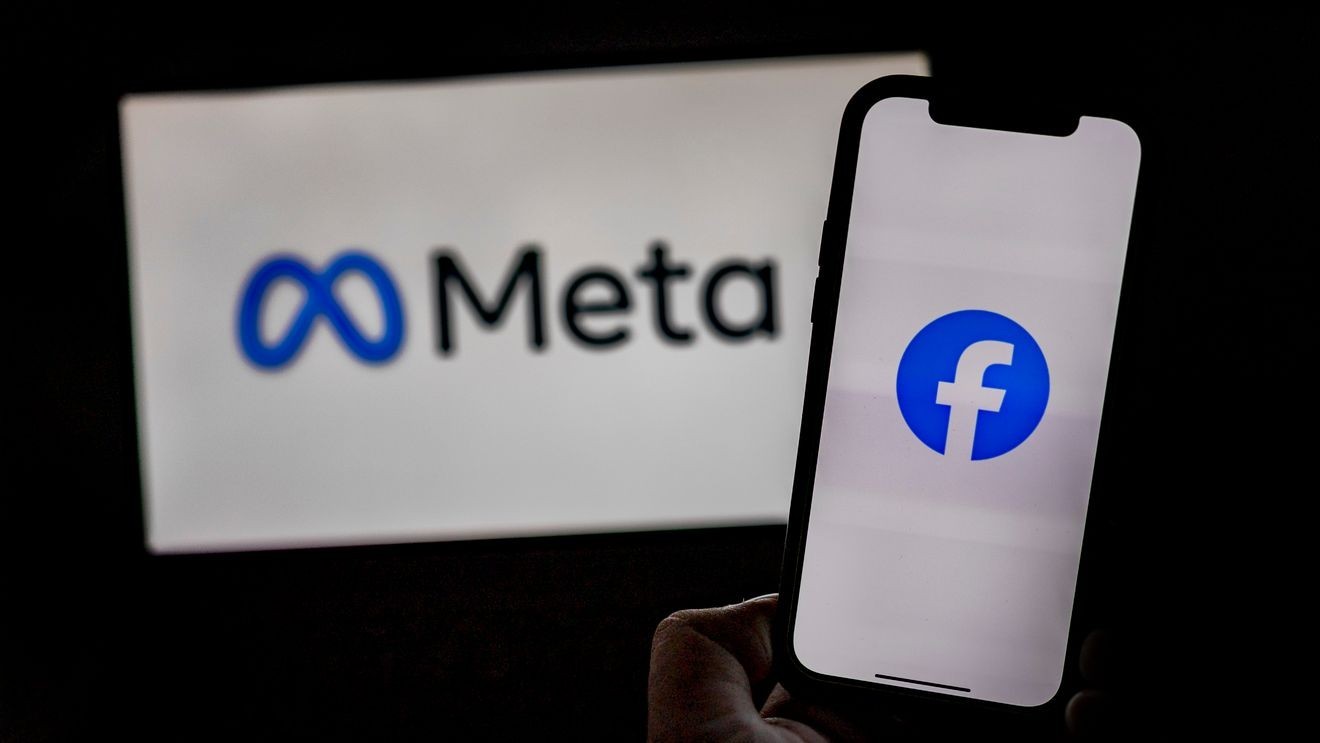
SANTA ROSA, PHILIPPINES — A sweeping change to Meta Platforms Inc.’s content moderation policy has brought technology, politics, and civil rights concerns into collision on the eve of a new American administration. In a photo illustration taken on January 8, 2025, in Santa Rosa, Philippines, the Meta and Facebook logos appear on a screen, a fitting symbol for a digital empire preparing to alter how it polices the speech of more than three billion users. The image, captured by photographer Ezra Acayan for Getty Images, showed the two familiar blue logos glowing side by side in an effort to illustrate the significance of the corporate announcement that accompanied it. Meta has announced the discontinuation of its fact-checking program, the system that once relied on independent organizations to review and label false or misleading content on Facebook and Instagram. In its place, the company is transitioning to a community-driven model that relies on users to add context to potentially misleading posts. The stated purpose of this change is to promote free expression, with Meta officials casting the old system as an overly broad, error-prone apparatus that had become entangled in ideological disputes. However, the announcement has generated immediate concern among misinformation researchers, digital rights advocates, and former platform moderators, who fear the shift could open the floodgates to misinformation and hate speech just as the United States prepares for the upcoming Trump presidency. The policy decision, while framed as a technical adjustment to how posts are annotated, is being read by many observers as a strategic repositioning of Meta in a transforming political landscape. It reflects the company’s attempt to shed the role of global arbiter of truth and to embrace a more hands-off approach to user-generated content. Whether this bet will pay off, or whether it will unleash a fresh wave of harmful content, will likely be one of the defining questions for social media in 2025.
The new model draws heavily on a philosophy that has gained popularity among some tech executives: that the public, not corporate moderators, should decide what is true. Under the previous arrangement, Meta funded and worked with independent fact-checking organizations around the world. These groups reviewed posts flagged by users and by automated systems, and when a claim could not be verified, they attached labels that warned readers the information was disputed. That system was introduced after the 2016 U.S. presidential election, when Facebook was heavily criticized for allowing foreign interference, Russian propaganda, and conspiracy theories to reach millions of voters. In the years that followed, it expanded to many countries and languages, but it never managed to escape controversy. Conservatives frequently accused the fact-checking partners of bias, while progressives argued the company was not doing enough to stop the spread of dangerous falsehoods, especially around health and elections. Meta’s new community-driven approach turns the process over to the people who use the platforms. Instead of professional fact-checkers, users will be invited to submit annotations, explanations, and contextual information that can be attached to a post. If enough users from a diverse range of backgrounds mark the same note as helpful, it may be shown prominently with the original post. This mechanism is broadly similar to the Community Notes feature on X, the platform formerly known as Twitter, which has become a model for many social media companies searching for a less centralized moderation strategy. Meta has not yet revealed all the technical details of how its version will work, but the direction is clear: the company wants to move away from top-down editorial decisions and toward a crowdsourced system that is cheaper, faster, and more difficult for critics to accuse of institutional bias. The success of the system will depend on whether a sufficient number of users are willing to dedicate their time to reviewing posts, verifying claims, and writing notes that can withstand scrutiny from people with opposing viewpoints.
The scale of the change is enormous. Facebook and Instagram are among the most widely used social media platforms in the world, and together they have served as primary sources of political information, commerce, and communication for billions of people. The discontinuation of the fact-checking program means that posts on these platforms will no longer carry the same kind of authoritative labels that readers had become accustomed to since their introduction. Instead, the platform will rely on an algorithmic ranking system to elevate user-generated context. Proponents of community-based moderation argue that this approach can be faster than traditional fact-checking and can adapt to emerging slang, memes, and local knowledge. They also contend that it restores agency to regular users, who are no longer passive recipients of decisions made by invisible editors. But critics point out that the system is unproven at the scale Meta operates. X’s Community Notes feature has faced its own problems, including notes appearing too slowly, failing to attract enough participants in many countries, and sometimes being weaponized by organized groups to push their own narratives. Meta’s version will have to avoid those pitfalls while also handling billions of posts in dozens of languages across diverse cultures and legal systems. The removal of professional fact-checking also leaves a vacuum in accountability. Fact-checkers not only labeled content, they also provided original reporting, data, and context that is not easily replaced by remarks from anonymous users. Civil rights organizations have already begun to ask whether the new model will be able to detect and neutralize coordinated disinformation campaigns, especially in countries where media freedom is limited and users may face danger for sharing alternative views. The stakes are especially high in developing nations, where mobile data is cheap, Facebook is often synonymous with the internet, and false rumors can inflame communal violence, disrupt elections, or harm public health.
The concern among experts is not abstract. Misinformation researchers have documented the ways in which false content spreads more quickly than accurate information, often with help from algorithmic amplification. By shifting from professional fact-checking to a community-driven system, Meta is effectively betting that the wisdom of crowds will be sufficient to keep harmful claims from going viral. But social science research offers reasons to be skeptical. Falsehoods are often emotionally charged, and the same psychological mechanisms that drive their spread, including anger, fear, and tribal identification, may also discourage users from correcting them. Moreover, the new system is voluntary: users have to see a potentially misleading post and take the time to research it, write a note, and submit it for review. For every viral conspiracy theory, there may be only a handful of qualified users willing to respond, and their notes may be buried beneath a flood of reactions and shares. Hate speech poses an even more difficult challenge. Fact-checking was designed primarily for claims of fact; it was not a comprehensive solution for racism, sexism, harassment, and other forms of harmful expression. Yet the removal of professional oversight could create an environment in which hateful content is allowed to fester if a community of users decides it is acceptable. Meta has said it hopes to reduce mistakes and avoid removing posts that are only unpopular or unflattering. That goal is admirable, but rights advocates argue that in the pursuit of fewer false removals, the company may fail to remove posts that incite violence, attack vulnerable groups, or undermine public health. The potential for damage is greatest in countries with fragile democracies, where Facebook and Instagram play a central role in political organizing and where misinformation about elections can have lethal consequences. Even in stable democracies, the move is likely to reshape the experience of social media by making users more uncertain about the reliability of what they see.
The timing of the announcement is as significant as the policy itself. With less than two weeks before Donald Trump is sworn in as president again, Meta is clearly positioning itself for a Republican-led government that has repeatedly accused tech companies of censoring conservative voices. Trump and many of his allies have threatened to put legal pressure on social media platforms, and some have called for changes to Section 230, the provision that shields platforms from liability for user-generated content. By ending its fact-checking program and embracing a community-driven system, Meta may be attempting to defuse those threats and present itself as a neutral conduit for speech rather than a politically motivated publisher. The company has also made other gestures in the same direction in recent months, including changes to its content moderation teams and its public statements about free expression. The shift also aligns with a broader trend in the tech industry: a retreat from the ambitious, centralized content moderation programs that were created after 2020, when misinformation about elections and COVID-19 prompted platforms to take a more aggressive stance. That era is ending. Executives are now talking about the importance of free expression and about the dangers of over-censorship, and about the need to let users decide what is appropriate. Whether this is a genuine philosophical change or a calculated move to appease political power is a matter of debate. But the result is the same: one of the largest information ecosystems in human history is about to hand over significant editorial responsibility to its users. That experiment is taking place at the same time as the United States, the United Kingdom, and the European Union are all considering new digital regulation, and as the world prepares for a series of national elections in major countries. Political leaders in many countries have promised to hold platforms accountable for harmful content, and Meta’s decision may complicate those efforts by removing one of the few independent checks on viral misinformation.
The implications of Meta’s decision will unfold over months, not days. The company will need to design, test, and launch its community-driven system across Facebook and Instagram, and the transition will almost certainly be bumpy. Some platforms that have adopted similar systems have seen uneven results, with context notes appearing late, proving useless on breaking news, or being manipulated by coordinated campaigns. Meta’s challenge will be to build a system that is both inclusive and resistant to manipulation, but those two goals may conflict. If the community-driven model is too permissive, users may be exposed to everything from health hoaxes to election conspiracies without warning. If too restrictive, it will face the same accusations of bias it sought to escape. Meta has promised to continue making some content decisions, particularly around illegal activities and imminent violence, but the philosophical boundary between illegal content and merely false or objectionable content is often difficult to draw. Advertisers may also react. Brand safety was one of the primary reasons large companies demanded stricter moderation in the past, and a visible increase in misinformation or hate speech could prompt a new advertising exodus, hurting Meta’s revenue and embarrassing the company at a moment when it wants to project confidence. Regulators are watching as well, and experts have emphasized the importance of independent oversight, transparency reporting, and accountability. This significant policy shift, symbolized by the Meta and Facebook logos in the photo illustration from Santa Rosa, represents a new chapter not only for the company but for the global public square. As Meta prepares for the upcoming Trump presidency, its decision to retire the fact-checking program is a gamble that the marketplace of ideas can police itself. The next crises, elections, and viral falsehoods will provide the test. Whether the community-driven model proves to be a bold move for free expression or a dangerous weakening of social media safety, the consequences will be felt far beyond the Philippines, across Facebook, Instagram, and the millions of users who rely on them for news, connection, and civic life.