


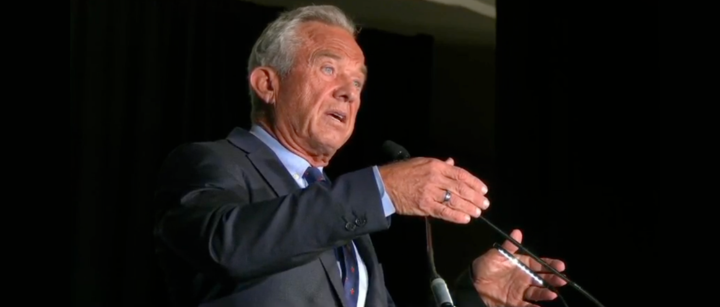
Health and Human Services Secretary Robert F. Kennedy Jr. returned to his anti-vaccine roots on Sept. 17, headlining a one-day conference in Washington, D.C., hosted by Children’s Health Defense, the nonprofit he once led and that regularly spreads vaccine misinformation. In a keynote address lasting more than an hour, Kennedy delivered a litany of familiar false and misleading claims about vaccines, while seeking to reassure his hardline supporters that he remained their “strong and steadfast friend at the White House.” His appearance marked a notable shift from earlier this year, when Kennedy had largely stopped talking about vaccines, reportedly at the request of the White House, even as the nation faced a surge of measles cases not seen in a generation. At times he had offered only lukewarm recommendations to vaccinate, frustrating his anti-vaccine base. But in August, Kennedy appeared beside President Donald Trump as Trump signed an executive order calling for the combined measles, mumps and rubella vaccine to be split apart, with Trump inaccurately describing the MMR vaccine as “quite lethal.” Kennedy then falsely claimed on cable television that new evidence supported breaking up the combination shot, and he opened an ongoing feud with Pennsylvania Gov. Josh Shapiro over measles-associated deaths in that state. The conference itself was organized by a group that describes itself as working to “restore and protect the health of children by eliminating exposures to environmental toxins,” but it is widely regarded as one of the largest sources of inaccurate vaccine information. Just three days before the event, the group’s X account falsely said that for every vaccine, “your child is more likely to die from the vaccine than from the disease,” and added that anyone who still thinks the COVID vaccine wasn’t intentionally designed to cause infertility is a conspiracy theorist.
In his speech, Kennedy, a former litigator, repeatedly suggested that vaccines are not safe, had not been properly tested, and are driving a dramatic rise in chronic conditions, including autism. At one point, he displayed the package insert for a hepatitis B vaccine, highlighting the list of post-marketing adverse reactions and claiming that the many listed conditions “include almost all of the injuries, like diabetes, death, sudden infant death syndrome, anorexia, allergic reactions, allergies, asthma, autoimmune diseases.” This was misleading. As fact-checkers have long explained, conditions that appear in package inserts have not necessarily been shown to be caused by vaccines, and some have been specifically studied and shown not to be caused by vaccines. Kennedy also conveniently omitted the package insert’s own caveat, which states: “Because these reactions are reported voluntarily from a population of uncertain size, it is not possible to reliably estimate their frequency or establish a causal relationship to a vaccine exposure.” He pushed a conspiratorial narrative that scientists previously “weren’t doing the studies to find out … what the risks were of these products,” adding, “And so we don’t know, and we are finding that out now.” The HHS website itself, however, says that every authorized or approved vaccine goes through safety testing, including clinical trials and continued monitoring after the products reach the market. Kennedy also said HHS was supporting new research and clinical trials and that for the “first time” researchers were looking into vaccination and “a range of health outcomes,” including autism. It remains unclear what those studies would examine, but researchers have continuously studied vaccination, and an extensive body of research has found no link between vaccines and autism.
Autism featured prominently in Kennedy’s address, but his claims were heavily misleading. He juxtaposed data from a 1970 study in Wisconsin showing an autism rate of less than 1 in 10,000 with current national data showing a prevalence of 1 in 31, implying a dramatic epidemic caused by vaccines. Researchers say the data are not comparable, and much of the increase in autism is related to changes in diagnostic criteria, screening, available services and awareness of the condition. Kennedy also claimed that research from the UC Davis MIND Institute led by Irva Hertz-Picciotto showed that the autism “epidemic is real,” contrary to assertions that “we’re just noticing it more.” A 2009 study co-authored by Hertz-Picciotto found that one-third of the increase in autism diagnoses in California could be attributed to changes in diagnostic criteria, but it did not examine all the factors that could lead to changes in recognition of the condition. The MIND Institute later said in a statement that the study “did not indicate that autism was an epidemic.” Kennedy went further, claiming, “I’ve never in my life seen somebody my age, a 70-year-old man, with full-blown, profound autism.” But autism researchers said that while older people are less likely to have an autism diagnosis, many nevertheless meet the criteria for autism. Catherine Lord, a clinical psychologist and autism researcher at the David Geffen School of Medicine at UCLA, previously said, “Many of them would not have been recognized as such but they absolutely do exist.” After Kennedy spoke, the audience heard from Dr. Andrew Wakefield, the disgraced British physician who fraudulently proposed a link between autism and vaccines in 1998 and continues to make the false claim. Despite the ongoing measles outbreaks in the U.S., and more deaths from the disease in the last two years than in decades, Kennedy mentioned measles only once, saying, “You care about every child who dies from measles. They get headlines. Shouldn’t we, I’d ask you, care about children who are dying or suffering or being injured by vaccine injuries?”
Kennedy used the conference to reassure his supporters that he had their backs while also seemingly asking for patience, because “the government moves slowly.” “You have a strong and steadfast friend at the White House,” he said. “We’ve accomplished in 19 months … things that would have seemed unthinkable two years ago.” Indeed, Kennedy, along with the White House, has pushed to reduce the number of recommended childhood vaccines in the U.S. and has reconstituted the Centers for Disease Control and Prevention’s independent advisory board, filling it with several individuals who have previously spread vaccine misinformation. Major medical associations, including the American Academy of Pediatrics and the American Academy of Family Physicians, have spoken out against the changes to vaccine recommendations and issued their own guidance; many of the changes have been temporarily blocked by a court. Kennedy also said HHS would be looking into the safety of electromagnetic fields and “chemtrails,” both topics of interest to Children’s Health Defense. The “chemtrails” conspiracy theory alleges that the commonly seen contrails, or the normal condensation trails left behind by airplanes, are actually chemicals that can harm people or be used to control the population. There is no evidence that “chemtrails” exist. The appearance highlighted how Kennedy’s official role as the nation’s top health official continues to blur with his activist past, and how misinformation that he has promoted for years is being amplified from inside the federal government. Many of the claims he made in his address were the same ones he has been making for years, and some were relatively new, but they all pointed to the same overarching theme: that vaccines are dangerous and their risks are being hidden.
Several of Kennedy’s specific vaccine claims have been repeatedly fact-checked. He asserted that a CDC study found that “fewer than 1% of vaccine injuries are reported,” referencing a 2010 report from health insurer Harvard Pilgrim funded by the federal Agency for Healthcare Research and Quality, which briefly mentioned that figure for adverse events. But reported adverse events are not necessarily vaccine-caused, and one of the report’s authors said the 1% figure “takes into account that many adverse effects of vaccines are mild and expected so not worth reporting.” Other research has found that the Vaccine Adverse Event Reporting System, which accepts voluntary, unverified reports, more completely identifies serious adverse events after vaccination, and it is not the only way health authorities monitor vaccine safety. Kennedy also misleadingly claimed that just one childhood vaccine, the COVID-19 vaccine, “was subject to a placebo-controlled trial,” adding, “we have no idea what the risk profile is for these products.” That is false: various childhood vaccines, including the polio, chickenpox and rotavirus vaccines, were originally tested against placebos. These claims rely on moving the goal posts on what constitutes a placebo-controlled trial, such as asserting that placebos can only be saline. It is also not always ethical or feasible to test a vaccine against a placebo when an effective vaccine already exists, and there are other valid ways of assessing vaccine safety. Kennedy further misrepresented the science on thimerosal, a mercury-based preservative that has been phased out of most vaccines, blaming it for “devastating our children’s brains and causing a whole litany, a grim inventory, of physical and brain injuries.” As fact-checkers have written before, multiple studies have evaluated the safety of thimerosal, and there is no evidence it is harmful to human health in low doses. It contains ethylmercury, a different and less toxic type of mercury than the methylmercury that accumulates in fish. Thimerosal was removed from most vaccines in the U.S. as a precaution more than 20 years ago, and since then no vaccines for children have used it, other than flu vaccines that come in multi-dose vials.
Kennedy also touted health statistics as evidence of the administration’s success, but his characterizations were again misleading. He pointed to falling obesity as evidence, claiming, “Obesity rates have dropped 7.3% since 2022, most of it in this year — these two years,” citing Gallup polling. Gallup surveys did find that obesity among American adults fell by about 3.1 percentage points, or 7.8%, between 2022 and 2026, but three-quarters of that decline came between 2022 and 2024, before Trump took office, undercutting the suggestion that current policies were responsible. Kennedy also said, “Real food sales went up by 8% this year.” That statistic likely comes from a financial-industry analysis that reportedly looked at a handful of specific categories, including yogurt, nut butters and frozen foods, and concluded that sales of unprocessed or minimally processed products grew about 7% faster than highly processed products in those same categories. Experts have said those findings are too limited to say much about whether Americans are eating healthier overall. In sum, Kennedy’s speech to Children’s Health Defense reprised many of the false and misleading claims he has made for years, from vaccine injuries and autism to placebo trials and thimerosal, while adding new subjects such as electromagnetic fields and chemtrails. The setting — a conference hosted by a leading source of vaccine misinformation, with Andrew Wakefield also on the program — underscored the extent to which Kennedy is using his official position to amplify scientifically unsupported claims. Even as federal health agencies confront real measles outbreaks, deaths, and court challenges over changes to immunization policy, Kennedy’s message to his anti-vaccine audience was clear: the fight over vaccines is far from over, and he intends to continue leading it from inside the government.