


Fact-Checkers Debunk BRICS Summit Misinformation, Old Videos and AI Images Fuel a Week of Viral Falsehoods
The just-concluded BRICS Summit 2026 in New Delhi was a global spectacle, bringing together leaders of major emerging economies for discussions on trade, security and multilateral cooperation. Yet even before the summit’s final session had ended, the internet was flooded with false narratives targeting the event and its participants. From a fabricated blast near the Red Fort Metro Station to a computer-generated image of Russian President Vladimir Putin posing with Prime Minister Narendra Modi, from an old clip repackaged as a fresh naval collision in the Arabian Sea to a decontextualised video from Canada, the week offered a startling reminder of how easily misinformation can spread during high-profile diplomatic moments. Fact-checking organisation Newschecker has released its top fact-checks from this period, and each one reveals a different method of deception. Old footage is being recycled and given new dates; artificial intelligence is being used to create convincing but entirely fictional photographs; and real events are being stripped of their original context to fit entirely different narratives. The stakes are high. False reports about explosions can trigger panic on the streets of a capital city. Fake images of world leaders can alter public perception of international relations. Misattributed videos can inflame communal tensions and undermine social cohesion. In the case of India and Pakistan, a misleading naval clip can raise the temperature between two nuclear-armed neighbours. This article explores these top fact-checks in detail, explaining what was claimed, what was actually true, and why these corrections matter. It also highlights the growing challenge facing journalists and ordinary citizens alike: how to tell truth from falsehood in an age of viral content. As the following paragraphs demonstrate, the methods of fact-checking have become as sophisticated as the methods of disinformation, but the battle is far from over. Every social media user has a role to play in slowing the spread of falsehoods.
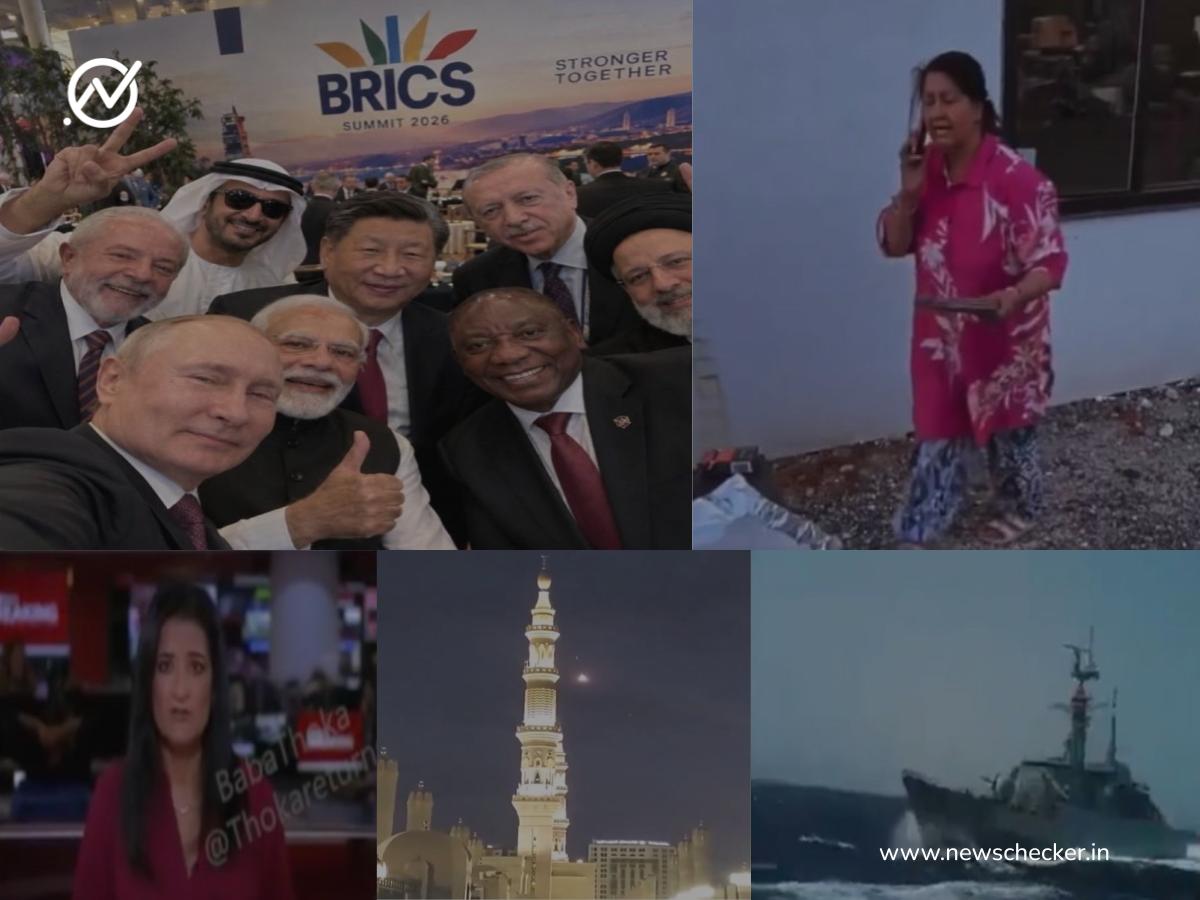
Perhaps the most dangerous claim was the one involving an explosion at the Red Fort Metro Station in Delhi. According to viral posts, the blast occurred just minutes before the BRICS Summit 2026 concluded, killing at least eight people. The posts were accompanied by video footage that appeared to show smoke and chaos. Messages on social media called the supposed attack a serious security lapse and speculated about possible perpetrators. Some users claimed the blast was timed to disrupt the summit’s closing moments, while others used the occasion to criticise the authorities in Delhi. Newschecker, however, discovered that the entire premise was false. The video in circulation was not from 2026, and it had no relation to the Red Fort area. It was an old clip that had been shared with a new and fabricated caption. No credible media organisation reported any explosion near the Red Fort Metro Station on the day of the summit’s conclusion, and no police or government alert was issued. In fact, security in the national capital had been extraordinarily tight during the summit, with thousands of personnel deployed and multiple checkpoints in place. An explosion of the kind described in the viral claim would have been impossible to hide. The false report is a textbook example of how disinformation operates. By attaching a specific time and place to an old piece of footage, the creator gives it an appearance of urgency and authenticity. The mention of “just minutes before the summit concluded” was deliberately designed to increase anxiety. Many users clicked share before pausing to verify. The damage was limited only because fact-checkers responded quickly and because mainstream news outlets did not pick up the story. But the episode demonstrates a worrying trend. During major geopolitical events, the number of malicious false claims increases dramatically. Governments, security agencies and media organisations are often placed in a reactive position, having to issue denials after lies have already circulated. This specific fact-check should remind readers that an unverified video is not evidence; it is simply a claim. The true test lies in finding the original source, the full context, and independent confirmation.
Another viral moment involved a photograph of Russian President Vladimir Putin taking a selfie with Prime Minister Narendra Modi and other world leaders at the BRICS Summit. The image was shared widely, with several users commenting on the relaxed and friendly atmosphere among the leaders. It looked, for all intents and purposes, like a genuine behind-the-scenes moment. But Newschecker’s investigation revealed that the photograph was generated by artificial intelligence. There was no such selfie taken during the summit. The AI-generated image was created using advanced software that has become increasingly accessible to the public. It combined the faces of real leaders, a plausible background and convincing lighting to produce a photograph that had never existed. The discovery of the image’s true origin is a sign of the times. For years, experts have warned that AI-generated images could be used to spread false narratives, and this episode offers a concrete example. The faked selfie may seem relatively harmless compared to a false story about a bomb, but it still has a corrosive effect on public trust. If people cannot believe their own eyes, they may start to distrust all information. The fake photograph also carries political implications. It creates an impression of warm personal bonding between leaders who have complicated relationships, and it can be used to support a variety of narrative agendas. Some social media users may see the image as evidence of a strong alliance, while others might use it to accuse the leaders of hypocrisy. Neither interpretation is grounded in reality. Fact-checkers were able to identify the image as artificial by examining details such as facial boundaries, hand postures and background elements that did not match actual photographs from the summit. They also searched official photo archives, which contained no such image. The fight against AI-generated misinformation is one of the most complex challenges of the digital age. As the technology improves, the need for robust detection tools and media literacy becomes more urgent. The Putin selfie is a reminder that the visual evidence of the future will not always be evidence.
Amid the summit coverage, a separate video gained traction on social media, showing a woman alleged to be an Indian-origin Hindu landlord in Canada objecting to tenants cooking beef on her property. The clip was shared with angry captions about cultural conflicts, property laws, and the treatment of immigrants in Canada. It quickly became a talking point among users in India and abroad. However, Newschecker found that the claim was not accurate. The video did not establish the identity of the woman, nor did it prove the alleged context. It was not possible to verify that the incident involved a Hindu woman, a rental property, or the issue of cooking beef. The clip may have been staged, or it may have been taken from a completely unrelated event. It could even have been an old video that had resurfaced with new captions. In the absence of verifiable facts, the viral claim should never have been presented as news. Yet it was repeated by numerous accounts, many of which framed it as an example of a supposed clash between religious traditions and modern living. This kind of content is dangerous because it touches on religious sensitivities and can easily provoke anger. It turns a complex social issue into a simplistic spectacle, with real people becoming symbols in a culture war. Fact-checkers had to trace the video back to its earliest known upload, examine the language spoken in the clip, and look for other identifying details. Without this careful work, the false narrative would likely have continued to grow. The episode illustrates that misinformation is not always about politics; it is also about social identities and everyday relationships. It reminds us that a short clip, disconnected from its larger context, is a blank screen onto which any narrative can be projected. The top fact-check from this week once again confirms that not everything that goes viral is true, and that the most emotionally charged content is often the least reliable. For social media users, the lesson is simple: before sharing a video that purports to show a real dispute, one should ask whether the source, individuals and location have been properly verified.
The week also saw a video that was said to show a Pakistani naval vessel colliding with an Indian Navy ship in the Arabian Sea on September 15, 2026. In a region where military encounters are rare but carry enormous significance, this claim was destined to attract attention. Dozens of accounts shared the clip, along with captions that accused Pakistan of recklessness or that demanded a strong Indian response. Fact-checkers at Newschecker quickly established that the footage was old, and that it had no connection to the alleged incident. The video had been available online for some time, and it appeared to be from a different naval exercise or accident. The ships depicted did not match the official descriptions of the vessels involved, and there was no operational confirmation from either navy. The Indian Navy and Pakistani Navy have not announced any such collision. In military matters, the lack of official confirmation is itself an important signal. If two naval vessels had collided, there would likely be official statements, visual evidence, and international news coverage. Instead, there was only a recycled clip on social media. The technique used in this case is common in disinformation campaigns. Old crash or combat footage is taken from archives and given a new timestamp, often linked to a politically sensitive date or event. The intention is to create confusion, stir nationalist sentiment, or sow distrust between adversaries. In some cases, the deceptive video might be spread by ordinary users who do not realise it is old. In other cases, it may be part of an organised effort to manipulate narratives. Either way, the effect is the same: the public is misled, and already strained relations can become even more fraught. The naval video also demonstrates the importance of time-sensitive fact-checking. By the time official sources respond, the content may have been viewed hundreds of thousands of times. Debunking reports can help, but they rarely achieve the same reach as the original falsehood. Journalists and fact-checkers are therefore working against the clock, trying to verify or debunk content before it goes viral. The public can help by resisting the urge to share high-stakes military videos without first checking their authenticity.
The final top fact-check involved a video allegedly showing Saudi Arabia intercepting and destroying a Houthi-launched drone over Mecca in September 2026. Like the other viral pieces, the clip was old. Newschecker found that it had been posted before and was completely unrelated to the recent incident described in the captions. The setting is significant: Mecca is the holiest city in Islam, and any claim of a drone attack over the city would naturally evoke strong emotions. The false video appeared to show a ballistic interception in the sky, and the captions encouraged viewers to believe that a dangerous attack had been prevented only moments before. In reality, the footage was from an earlier event in the ongoing conflict in Yemen, when Saudi air defences had intercepted a projectile in a different context. There was no evidence that a Houthi drone had flown over Mecca on the claimed date. The spread of this video is another example of how real conflicts are exploited by digital deception. In the age of viral news, a video can cross the world in minutes, detached from its actual timeline, location, and purpose. Combined with the other fact-checks from the week, it paints an unsettling picture of the current information landscape. BRICS Summit 2026 was not only a diplomatic gathering; it was also a target for false narratives. A fake explosion threatened to cause panic in New Delhi. An AI-generated selfie threatened to distort public understanding of personal diplomacy. A misleading video from Canada threatened to provoke communal tensions. An old naval footage threatened to inflame a sensitive military relationship. And a drone intercept video threatened to confuse the reporting of an ongoing conflict. Together, these incidents show that misinformation is not a series of isolated mistakes; it is a systemic problem that affects every part of the news cycle. Fact-checkers like Newschecker play an indispensable role, but they cannot solve the problem alone. Social media platforms need stronger moderation and transparent algorithms; governments need to promote media literacy; and users need to adopt a more cautious approach to online content. The simplest advice remains the most effective: check the source, look for official confirmation, and do not share if you have doubts. A week of fact-checking has proven that these small habits can make a big difference. The truth may not always travel as fast as a lie, but it can still win if enough people are willing to look for it.