


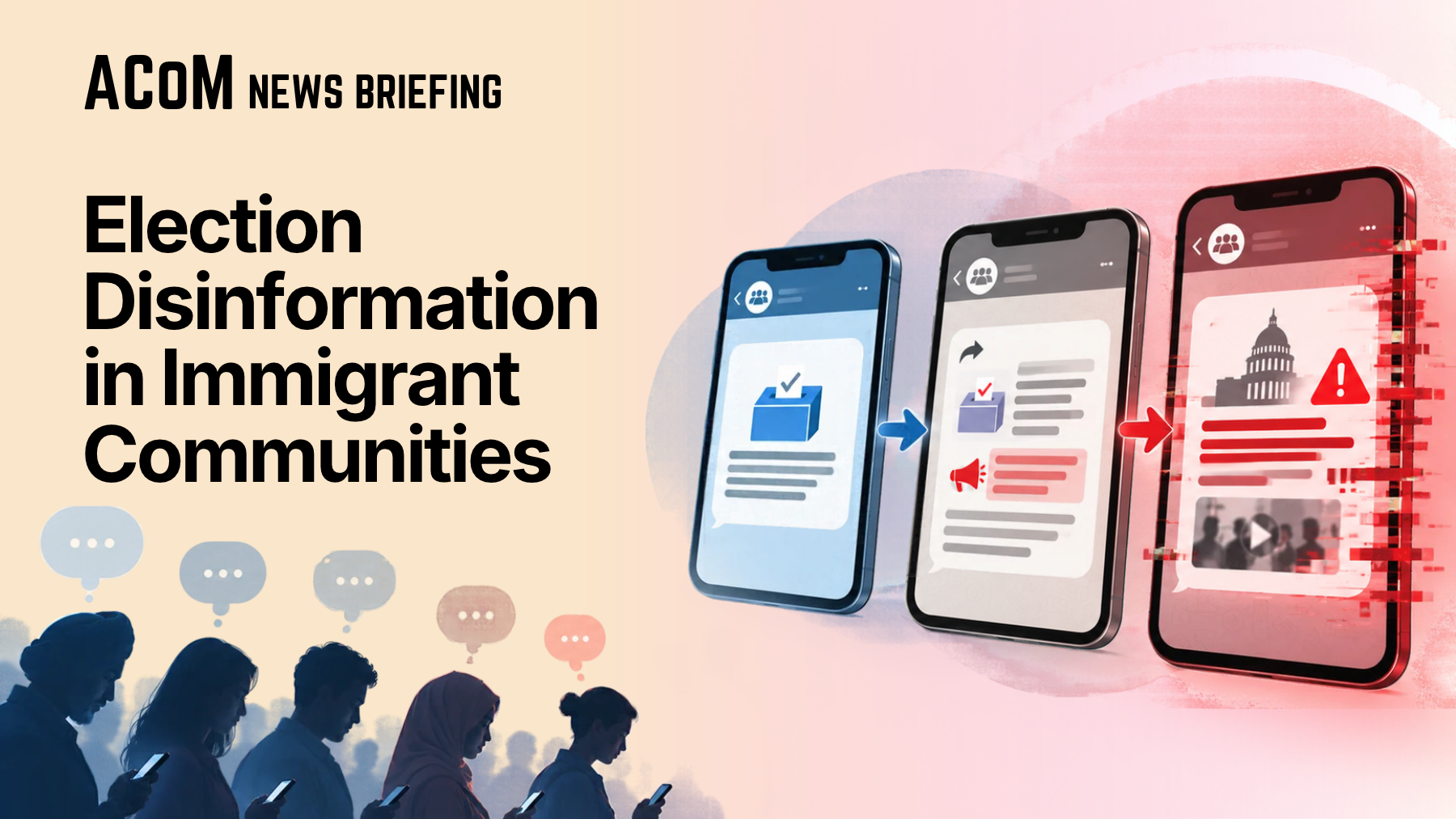
Who Gets the Last Word? ACoM Briefing Takes On Election Disinformation in Immigrant and Diaspora Communities
Who gets the last word when election disinformation spreads through trusted community networks? That is the provocative question at the heart of a special briefing scheduled for Friday, October 23, 2026, at 11 a.m. PST, presented by ACoM. With the midterm elections just weeks away, the briefing confronts one of the most corrosive forces in modern democratic life—not the noisy, publicly visible misinformation that dominates mainstream social media feeds, but the quiet, private, and highly persuasive falsehoods that circulate inside the closed digital spaces where immigrant and diaspora communities talk to one another. Organizers have assembled a team of experts to discuss how false and misleading information about voting and immigration issues could keep eligible voters from participating altogether. This is not a hypothetical concern; in previous election cycles, viral messages have warned immigrants that voting would subject them to ICE checks, that casting a ballot would forfeit their immigration status, or that they would be deported for exercising their constitutional rights—successfully scaring large numbers of people away from the polls. The 2026 conversation expands that analysis, looking at new platforms, new technologies, and new linguistic challenges, with particular attention to artificial intelligence, deepfakes, misleading campaign videos, and inaccurate voting information produced by chatbots. Crucially, attendees will leave the briefing with a short guide to identifying AI-generated disinformation, a practical tool designed to extend the conversation far beyond the virtual room.
The briefing is grounded in a paradox: in the digital age, the greatest threat to democracy may come from the spaces Americans trust the most. For many immigrant and diaspora communities, public platforms like X, Facebook, or Instagram are secondary to the real conversation—and the real influence—that happens in private, encrypted networks such as WhatsApp group chats, WeChat community forums, and other messaging apps that feel intimate, safe, and trustworthy. In these spaces, information arrives not from algorithms but from people: a grandmother forwards a voice note about election fraud; a landlord warns the entire building that ballots are traceable; a religious leader shares a viral article claiming undocumented residents will be prosecuted for voting. The message arrives alongside birthday greetings, prayer requests, and practical discussions about work schedules, and thus the falsehood takes on the same emotional weight as everyday trusted communication. Because these platforms are encrypted, fact-checkers, election officials, and even platform moderators rarely see the content. There is no public post to debunk, no viral metric to track, no transparent thread to flag. Each forward becomes a private recommendation, and each recommendation carries the authority of the person who sent it. The result, as ACoM and the briefing speakers will argue, is a recipe for silent suppression: eligible voters who are exposed to repeated falsehoods from reliable people eventually become convinced that participation is dangerous. In a midterm year, when turnout traditionally lags behind presidential cycles, even a small number of suppressed voters can tip a district, a state, or the balance of a chamber of Congress.
The briefing is notable for its sharp focus on the intersection of language and platform choice. It will explore the “other” internet—the multilingual web of messaging apps that have become primary news sources for entire communities. For Spanish speakers, WhatsApp is a vital artery of information, carrying everything from family updates to forwarded messages about political outcomes. The platform is a fact-checker’s nightmare: messages can be copied, edited, and re-sent in seconds, and the most dramatic claims often win the race for attention. For Chinese-speaking communities, WeChat is more than a messaging app; it is a super-app that blends social media, payments, news, and community organizing into a single digital lifeline. Within WeChat, conversations range from coordinating carpools and sharing neighborhood alerts to heated debates about American politics, often influenced by Chinese-language media operating under different editorial standards than those in the United States. Recent research has shown that these closed spaces can be exploited to sow confusion about voting requirements, citizenship rights, and the legal consequences of participating in elections. The briefing will hear directly from the Chinese Digital Engagement Project at Chinese for Affirmative Action, a civil rights organization based in San Francisco, as well as from experts who have spent years studying how to penetrate these networks with accurate, culturally competent information. Language, they will emphasize, is not merely a translation problem; it is a trust problem. An English-language fact check may be accurate, but its message will only be accepted if it arrives in the vocabulary, idioms, and context of the community—delivered by a voice that community already knows and believes.
Artificial intelligence adds a deeply urgent layer to the problem. The 2026 midterm cycle is unfolding in a media environment utterly transformed by generative AI, and the briefing will dissect three specific threats. First, deepfakes: synthetic audio, video, and images that place candidates, election officials, or public figures in fabricated scenarios, making them appear to say things they never said. A realistic video of a politician declaring that voting is unnecessary, or an audio clip of a local official advising immigrants to stay home, can circulate inside closed networks for days before detection. Second, misleading campaign videos: cheap, AI-assisted editing tools now allow even amateur propagandists to produce convincing content that cropped and manipulated sequences imply false narratives about candidates and ballot measures. Third, inaccurate voting information from chatbots: commercial AI assistants are increasingly consulted for everyday questions, including election logistics. The briefing promises a live, side-by-side comparison, presenting the same voting-related questions to a chatbot in Spanish and in English. According to organizers, this demonstration will reveal a troubling phenomenon: while English responses tend to be cautious, hedged, and accurate, Spanish responses are often less precise and occasionally outright incorrect. This discrepancy represents a new form of digital inequity—one that pushes the most reliable information toward English speakers while leaving vulnerable communities to navigate a maze of guesswork. Because these AI tools remain largely unregulated and rapidly deployed, the gap is likely to persist through November. The briefing is designed not only to expose this disparity but to teach attendees how to recognize AI-generated content and respond to it before it shapes a family member’s decision about whether to vote.
To tackle these cross-cutting issues, ACoM has gathered leaders with deep experience in civic technology, community organizing, and journalism. Cameron Hickey, CEO of the National Conference on Citizenship (NCoC), brings a research-driven perspective grounded in data analysis and network study. NCoC has a long history of working to strengthen civic participation, and Hickey’s background in disinformation research adds an empirical layer, illuminating how untruths travel through digital networks and what interventions can interrupt them. Jinxia Niu, representing the Chinese Digital Engagement Project at Chinese for Affirmative Action, offers on-the-ground insight from the Bay Area, where Chinese-speaking residents navigate a barrage of WeChat rumors about elections and immigration enforcement. Her work rests on the conviction that the best antidote to a trusted falsehood is a trusted truth—delivered by a community organization, a respected local voice, or a culturally fluent messenger, not an anonymous account on a foreign platform. Laura Zommer, co-founder and CEO of Factchequeado, speaks for the Spanish-speaking world. Factchequeado is a model of collaborative fact-checking, designed to place accurate, accessible information in the exact spaces where Latino communities already gather. Zommer has spent years building partnerships across media organizations in Latin America and the United States, and her work demonstrates that speed, linguistic authenticity, and collaboration with trusted leaders are essential to outrunning viral disinformation. Together, the three speakers illustrate the full architecture of an effective response: sophisticated research to understand how lies spread, cultural knowledge to reach the communities most affected, and fact-checking infrastructure agile enough to match the speed of a neural network.
The central deliverable of the briefing—the short guide to identifying AI-generated disinformation—is intended to circulate far beyond the screen. In the final stretch before November, this guide could serve as a lifeline for community organizations, church groups, neighborhood associations, and family members who find themselves acting as informal fact-checkers. The theme “who gets the last word” is more than a rhetorical flourish; it is a challenge to the entire civic ecosystem. In an environment where a deepfake can be manufactured in minutes and a rumor can be forwarded hundreds of times before the morning commute ends, the “last word” will not come from a government agency or a social media corporation. It will come from the individuals who press pause, check the source, and refuse to forward falsehood. It will come from organizers who equip their members with simple verification steps and from multilingual fact-checkers who answer questions on the platforms where those questions are asked. The event on Friday, October 23, 2026, at 11 a.m. PST, presented by ACoM, is designed to ensure that everyone who attends leaves with those tools in hand. As the midterms approach, the stakes are simple and profound: protecting the right of every eligible person—regardless of language, legal status, or country of origin—to participate in the democratic process without fear, deception, or manipulation. The last word, the speakers will argue, belongs to the people. But they can only claim it if they are armed with truth, and truth, in a closed WhatsApp group or a WeChat thread, is decided by whoever speaks first—and best.