


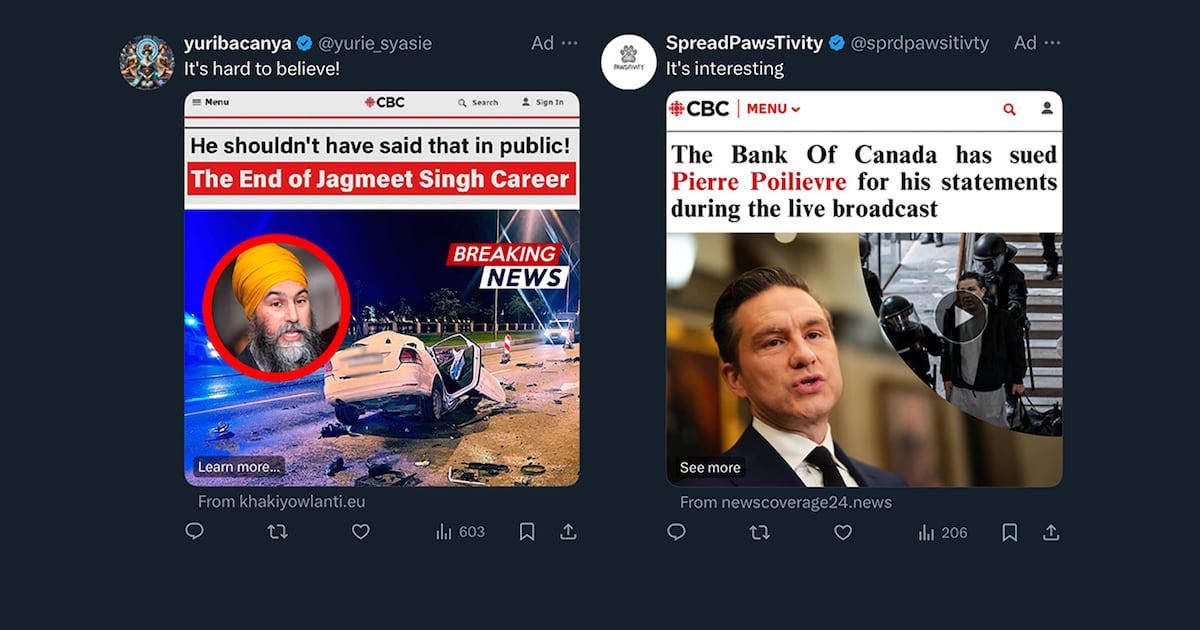
X Ads Mimicking Canadian News Outlets Raise Concerns about Disinformation
Social media platform X, formerly Twitter, has become a breeding ground for deceptive advertising practices, with ads mimicking legitimate Canadian news outlets increasingly appearing on the platform. These ads often promote dubious products or misinformation campaigns, exploiting the trust users place in established news brands. This trend is not isolated to Canada but represents a growing global phenomenon, exacerbating the already pervasive issue of online disinformation. The ease with which these ads can be created and disseminated on X, combined with the platform’s algorithmic amplification, poses a significant threat to the integrity of information and the public’s ability to distinguish between credible news sources and manipulative advertising.
The deceptive ads often employ sophisticated tactics to mimic the look and feel of authentic news websites, utilizing similar logos, fonts, and color schemes. They frequently feature headlines designed to be sensational or emotionally charged, enticing users to click through to external websites. These linked websites may promote various products, often of questionable quality or efficacy, or disseminate misinformation aligned with specific political or ideological agendas. The ads exploit the inherent trust users have in established news brands, leveraging their reputation to lend credibility to the advertised content. This practice undermines the credibility of legitimate news organizations and erodes public trust in journalism as a whole.
The proliferation of these ads on X can be attributed to several factors, including the platform’s relatively lax advertising policies and the ease with which users can create and distribute promoted content. X’s advertising model, which prioritizes reach and engagement, can inadvertently amplify deceptive ads, exposing them to a wider audience. The platform’s algorithms, designed to personalize content based on user preferences, may also contribute to the spread of these ads, creating echo chambers that reinforce existing biases and beliefs. The lack of robust verification processes and limited human oversight in X’s advertising ecosystem further exacerbates the problem, allowing bad actors to exploit vulnerabilities and spread misinformation with relative impunity.
The implications of this trend are far-reaching, impacting not only individual users but also the broader societal landscape. Exposure to deceptive advertising can lead to financial losses for individuals who purchase advertised products, as well as the spread of harmful misinformation that can influence public opinion and behavior. This can have serious consequences for public health, political discourse, and social cohesion. The erosion of trust in legitimate news sources further weakens democratic institutions and makes it more difficult for citizens to make informed decisions. The rise of synthetic media, including AI-generated text and images, adds another layer of complexity, making it increasingly difficult to distinguish between authentic and fabricated content.
Experts and analysts are calling for a multi-pronged approach to address this growing problem. Social media platforms like X must implement stricter advertising policies and invest in more robust verification processes. This includes enhancing human oversight and developing more sophisticated algorithms to detect and remove deceptive ads. Media literacy initiatives are crucial to empower individuals to critically evaluate online information and identify manipulative tactics. These initiatives should focus on educating users about the characteristics of credible news sources, the hallmarks of deceptive advertising, and the importance of fact-checking information before sharing it online. Collaboration between governments, social media platforms, news organizations, and civil society organizations is essential to develop effective strategies to combat the spread of disinformation and promote media literacy.
Furthermore, ongoing research is needed to understand the evolving tactics employed by those spreading disinformation and to develop countermeasures. This includes investigating the psychological mechanisms that make people susceptible to deceptive advertising and exploring the use of artificial intelligence and machine learning to identify and flag potentially harmful content. Transparency in advertising practices is also critical, with social media platforms providing more detailed information about the source and funding of promoted content. Ultimately, addressing the challenge of disinformation requires a collective effort, involving individuals, organizations, and governments working together to foster a more informed and resilient information ecosystem. The future of informed democratic discourse depends on the ability to effectively combat the spread of misinformation and ensure that credible news sources are not drowned out by deceptive advertising practices.