


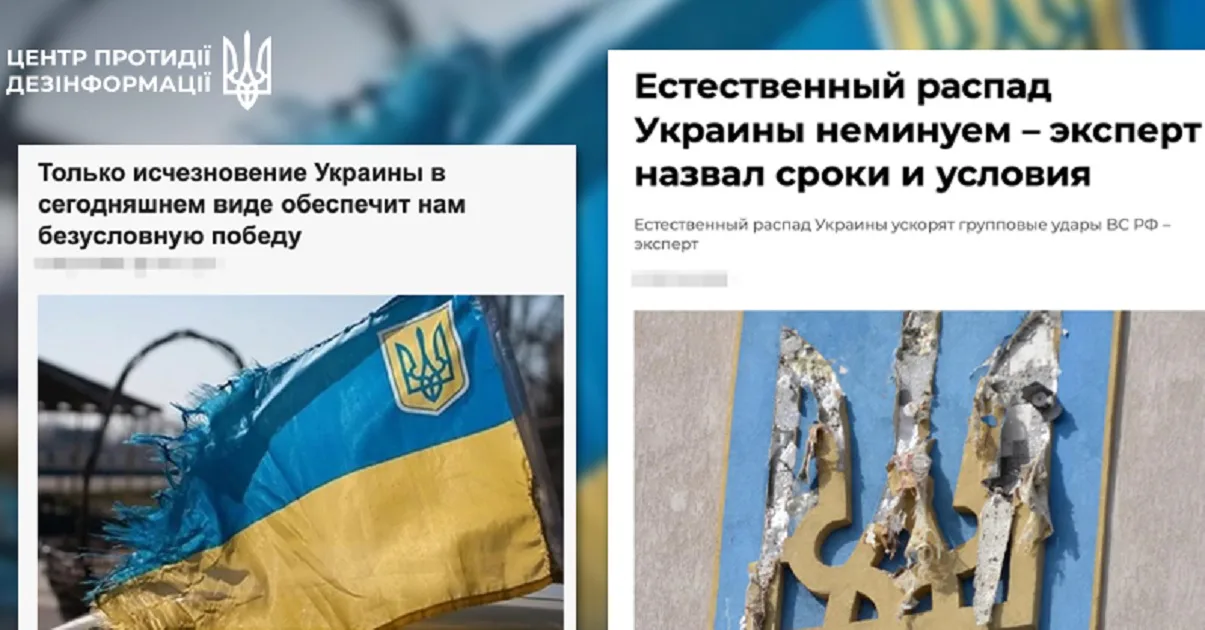
Russia has intensified a disinformation campaign about alleged territorial claims on Ukraine by its Western neighbours, according to a stark warning issued by the Center for Countering Disinformation (CCD) under Ukraine’s National Security and Defense Council. The report, carried by Ukrainian News Agency UNN, says hostile media outlets linked or sympathetic to the Kremlin have published a series of manipulative materials claiming that the Ukrainian state supposedly has no future and that its territories will be divided among Russia, Poland, Hungary, Romania, and Belarus after a collapse. Russian dictator Vladimir Putin himself has recently spoken in ways that feed this narrative, repeating themes he has used for years to question the legitimacy of Ukrainian statehood and its borders. The CCD stated emphatically that such claims are completely unfounded and dangerous. European states, it reminded readers, repeatedly reaffirm their recognition of Ukraine’s territorial integrity and continue to provide Kyiv with comprehensive military, financial, and humanitarian assistance in its confrontation with Russian aggression. The new wave of falsehoods is not an isolated incident but part of a broader information warfare strategy that targets Kyiv’s allies, public opinion in Europe, and the credibility of democratic institutions. Ukrainian officials argue that the Kremlin has once again resorted to projection and distortion because it cannot achieve its goals on the battlefield, and it is now trying to rewrite the narrative around its war of aggression.
The narrative about the division of Ukrainian lands among neighbouring states has deep roots in Russian imperial propaganda. For decades, Moscow has promoted the idea that Ukraine is an artificial construction, a territory assembled at different times from pieces of the Russian, Polish, Austro-Hungarian, and Ottoman empires. This myth has been revived in official television programmes, pseudo-academic articles, and statements by pro-Kremlin politicians. In Putin’s historical discourse, Volhynia is said to be historically Polish, Zakarpattia is presented as Hungarian, Bukovyna is linked to Romania, and Belarus is sometimes described as having claims to parts of the north. The underlying theme is that Ukraine, as an independent country, does not deserve to exist and that modern borders are accidental and temporary. The CCD said this is not a harmless historical debate. It is a weapon used to deny the rights of a UN member state and to prepare a justification for foreign intervention. By repeatedly asking, “Whose territory is this?”, Russian propaganda attempts to legitimize the very idea of redrawing maps by force. At the same time, Moscow accuses Western nations of the same imperial behaviour it practices. This is a deliberate ironic inversion: Russia has annexed Ukrainian Crimea and parts of eastern and southern Ukraine, while Poland, Romania, Hungary, and Belarus have made no territorial claims against Kyiv. Nevertheless, the Kremlin continues to circulate maps, fake interviews, and manipulated statistics intended to show that Ukraine’s Western allies are secretly preparing to carve it up.
According to the CCD, the main purpose of Russian fabrications about “the division of Ukraine among its neighbours” is to destabilize regional security, justify Moscow’s own war of aggression, and sow distrust between Kyiv and its Western partners. The logic is straightforward: if Ukraine’s friends are plotting to take its territory, then Russia can present itself as the only true defender of Ukrainian sovereignty. In fact, this is a gross distortion of reality. Russia is the only country that has actually seized Ukrainian territory and is currently waging a full-scale war to subdue the entire country. The Kremlin’s propaganda seeks to blur this fact by suggesting that all surrounding powers are equally hostile to Ukrainian independence and equally willing to benefit from its destruction. Such stories are especially dangerous in the current political environment, when European governments are debating how much support to provide to Ukraine and for how long. If enough Western voters believe that Ukraine is doomed to be partitioned, they may conclude that continued aid is futile. The CCD therefore views this campaign as an attempt to influence political outcomes in democratic countries, to weaken the transatlantic consensus, and to create an excuse for peace agreements that would legitimise Russian conquests. By manufacturing a panic about Western territorial ambitions, Moscow hopes to make its own annexation look like just one part of a global scramble for Ukrainian land, thereby shifting the blame for the war onto the shoulders of Ukraine’s allies.
Concerns about this new wave of Russian disinformation are not limited to Ukraine. German security agencies have reportedly recorded an intensification of Russian influence operations ahead of state elections, particularly in eastern Germany. The far-right Alternative for Germany (AfD), which advocates restoring relations with Moscow and opposes military assistance to Ukraine, is showing high ratings in three federal states. This creates a fertile ground for exactly the kind of stories that the Kremlin is now producing. Russian propaganda does not always aim to make foreign audiences love Russia; it often aims to make them despair about Ukraine, distrust their own governments, and turn against international commitments. The partition narrative fits neatly into these tactics. It can be used by populist politicians to argue that Ukraine is not a stable partner, that its fate is sealed, and that European nations should pursue their own narrow interests instead of defending a country allegedly about to disappear. Ukrainian Foreign Minister Dmytro Sybiha has responded by calling on European governments to ban Russian propaganda resources across the continent. In a separate development, reported by UNN on 31 July, Sybiha urged European institutions to act decisively after a wave of Kremlin disinformation, saying that Russia’s media machine must not be allowed to operate freely in democratic information spaces. His statement was a direct response to the intensifying influence campaigns that seek to exploit European political fragmentation and weaken support for Ukraine during the most difficult phase of the war.
The methods used to spread these false claims are increasingly sophisticated. Kremlin-controlled broadcasters, Telegram channels, social media bots, and local proxy groups all cooperate to amplify the same message. In recent months, fact-checkers have exposed fake documents allegedly showing secret treaties between Poland and Ukraine, manipulated satellite images suggesting military deployments near the border, and fake statements attributed to European officials. The stories are translated into multiple languages and adjusted to local audiences. In Poland, the narrative focuses on historical grievances and ethnic tensions; in Hungary, it exploits the language of national minorities and alleged oppression in Transcarpathia; in Romania, it raises questions about historical links between Bukovyna and Romania; in Belarus, it feeds into official Minsk’s dependency on Moscow and claims that Belarusian soldiers are being deployed to seize territory. None of these claims has any factual basis, but the CCD warns that repetition itself can cause long-term harm by changing public perceptions. Once a conspiracy theory is repeated often enough, many audiences begin to treat it as a legitimate geopolitical analysis. The Kremlin also uses fear of annexations to distract from its own atrocities, including missile strikes, executions, and mass deportations. It tries to make the war appear as a contest of equal imperialisms rather than a clear case of aggression against a sovereign state. The CCD stressed that Ukraine’s Western neighbours have behaved honourably and that every indication from Poland, Romania, Hungary, and Belarus over the past three years has been that they recognise Ukraine’s borders as they are recognised by international law.
Despite the intensification of this propaganda, Ukrainian officials and their international partners are not remaining passive. The Center for Countering Disinformation constantly monitors the information environment, identifies foreign influence operations, and works with media, civil society, and state institutions to debunk fraudulent claims. Ukraine has also increased cooperation with European fact-checking networks and security agencies, which are increasingly aware of Russian methods. However, officials say that more needs to be done, especially at the political level. Russian propaganda resources, including legal channels and websites operating in Europe, should be subject to sanctions and bans, as Sybiha demanded. Democratic governments should also invest in media literacy, because false narratives are most effective when citizens cannot distinguish between credible journalism and manipulation. The CCD’s statement is both a warning and a call for action: if Moscow is allowed to define Ukraine’s future in the minds of European voters, it may win a decisive victory even without military success. The report concludes that Kremlin rumours about the partition of Ukraine are a part of the war itself. They are not meaningless conspiracy theories, but strategic weapons aimed at disabling political support for Ukraine. The only effective response is to reaffirm the principle of sovereignty and territorial integrity, to maintain long-term assistance for Kyiv, and to expose Russian propaganda every time it attempts to rewrite history. Ukraine has no intention of disappearing, its neighbours have no intention of seizing its lands, and the international community must continue to act on that truth.