


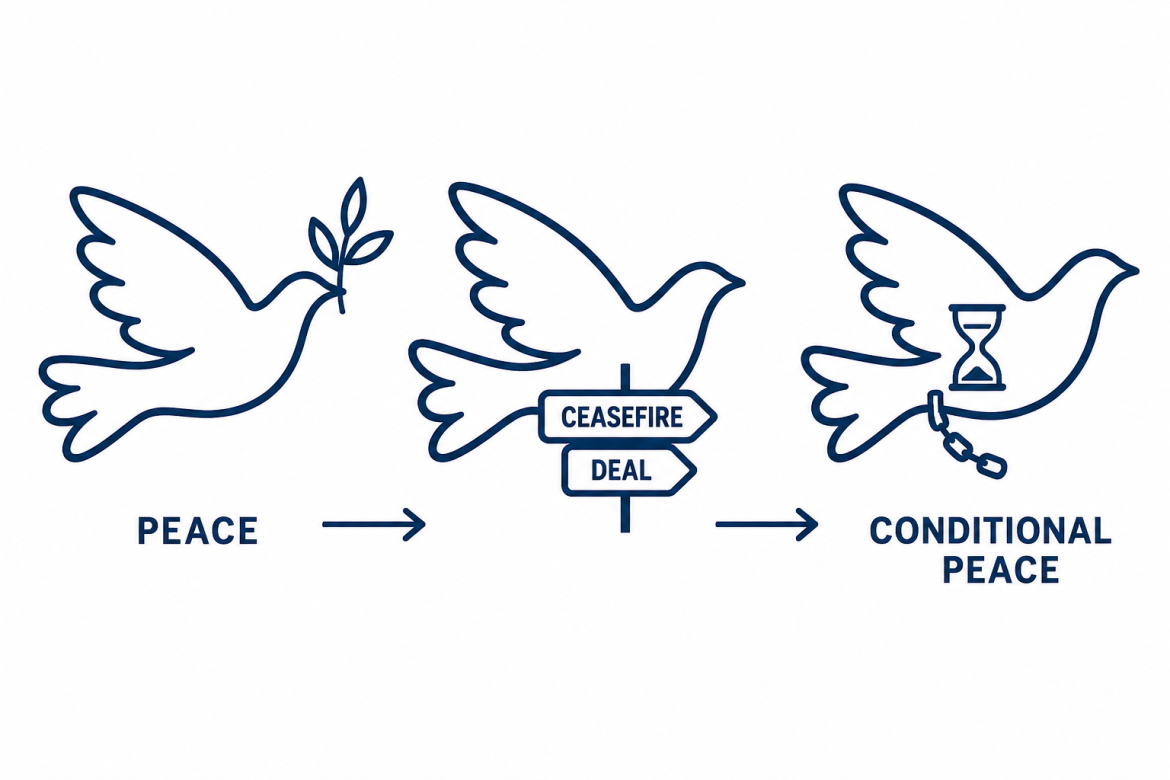
When “Peace” Becomes a Weapon: New Study Reveals Semantic Shift in Disinformation During Russia’s War on Ukraine
BRUSSELS – Disinformation is normally described as a problem of facts. Researchers analyze false claims, manipulated images and fabricated sources; fact-checkers expose lies; social media platforms remove misleading posts. But a new study published by BROD, one of the fifteen hubs of the European Digital Media Observatory (EDMO), argues that a more dangerous layer lies beneath factual accuracy. In “The Semantic Shift of the Concept of Peace during the Russian Invasion of Ukraine,” published in the peer-reviewed Journal of Contemporary European Studies, a BROD researcher examines how the concept of peace – one of the most fundamental categories of international law, diplomacy and political morality – has become a battleground of meaning. The study’s central insight is that disinformation is not only a set of false statements. It also works by altering the semantic frameworks through which citizens understand political reality. If the word “peace” can be detached from justice, from Ukraine’s sovereignty and from the principles of the United Nations Charter, then a self-serving narrative of “peace” can be used to legitimize aggression, demand concessions and undermine the defense of an invaded state. The study appears at a time when “peace talks” are a daily theme in European politics – not necessarily because there are honest efforts to end the war, but because the word “peace” has become a rhetorical weapon. The research invites readers to understand meaning as an infrastructure: when that infrastructure is weakened, facts become easy to bend and common sense begins to shift. According to the article, the Russian invasion of Ukraine has caused not only physical destruction but a crisis of language. In official speeches, news broadcasts and social media, “peace” now stands for two incompatible programs. For Kremlin rhetoric, peace can mean imposed neutrality, recognition of occupied territories and the end of Ukraine as an independent political actor. For Ukrainian and most Western leaders, peace requires the restoration of territorial integrity and security guarantees that would make a new aggression impossible. These are not different opinions; they are mutually exclusive realities. When incompatible meanings coexist, audiences can become confused, weary and vulnerable to the simpler and more emotional version of the word. This is the semantic shift the study diagnoses: a slow transformation in which a universal value is narrowed, emptied and repurposed.
To explore this shift, the study combines methods from conceptual history, critical discourse analysis and media studies. Instead of collecting a list of individual lies, it traces the evolution of the term “peace” across a wide range of sources: political speeches, government documents, mainstream news coverage, digital campaigns and social media conversations in several countries. The study treats language as a social practice. Words gain meaning through use, and they are used differently by different actors. The research therefore asks a series of questions: Who says “peace”? In what context? What objects are linked to it? What opposites are constructed? What kind of future does it promise? The study maps a semantic network that includes phrases such as “just peace,” “sustainable peace,” “peace plan,” “peace formula,” “peace at any price,” “ceasefire,” “negotiations,” “neutrality,” “demilitarization” and “special military operation.” All these expressions are connected to the meaning of peace, and all are contested. The study also pays attention to translation. The Ukrainian, Russian and English words for peace may appear identical, but they carry different associations and memories. In Russian state discourse, war was long not called war; the official term “special military operation” already prepares audiences to understand peace as the end of that operation, not as the end of aggression. In Western media, peace is often associated with the immediate humanitarian goal of stopping the fighting. That association is perfectly understandable, but it can obscure questions of responsibility, justice and the future risk of further invasion. The semantic shift described by the research is therefore subtle. The word “peace” does not suddenly become a lie. It becomes a hollow symbol whose meaning depends on whoever speaks it. This is how disinformation can operate without the need for a single false fact: by using a beloved word as a Trojan horse.
The most striking transformation identified in the article is the movement of the concept of peace from a post-war ideal to a rhetorical instrument for ending the war on the aggressor’s terms. During the early phase of the invasion, Russian media described the attack as a “peacekeeping” operation and claimed that it was necessary to protect the Russian-speaking population of eastern Ukraine. In European political debate, peace is often invoked to demand an immediate ceasefire and negotiations, while the victim of aggression is expected to be “realistic.” The study argues that this creates a semantic cover for aggression. When Russian representatives say they are ready for peace while continuing missile strikes, and when some Western commentators repeat the call for talks, the strange phrase “peace through war” begins to sound normal. The study suggests that this is not simply a propaganda trick but a conceptual manipulation. It changes the horizon of what is politically imaginable. Once peace is redefined as the mere absence of fighting, the conditions under which fighting ends become less important. Ukraine’s insistence on a genuine and internationally guaranteed peace can be portrayed as an unreasonable demand made by “war hawks.” The concept of “peace” is thus decoupled from the values that gave it meaning in international order. The article looks at the way this process played out in the discourse of political leaders and in media reporting: some commentaries present territorial concessions as a “compromise” or a “realistic solution,” without mentioning that such concessions would legitimize the use of force. This is not a debate about policy; it is a debate about the meaning of words. The study demonstrates that in the context of Russia’s war, “peace” has become a policy position. The question is not whether one wants peace – everyone says yes – but what kind of peace, on whose terms and with what consequences for the international system. The analysis of this semantic shift helps explain why some European audiences have become receptive to narratives that blame Ukraine for the continuation of the war.
These findings have far-reaching consequences for the study of disinformation. For years, fact-checkers have concentrated on verifying factual accuracy. That work remains essential. Yet the new study shows that a well-documented fact can be embedded in a corrupted semantic universe. A Russian spokesperson can say “Russia remains committed to peace” and, in a narrow grammatical sense, the sentence is true: it contains the word “peace.” But it says nothing about the meaning attached to that word. This suggests that the “post-truth” era cannot be understood only through lies and false statements; it is also an era of conceptual instability. The danger is not simply that people are deceived by a particular claim, but that the language through which they interpret politics is gradually pulled out of shape. The study therefore calls for expanding the toolkit of disinformation research. Alongside fact-checking, it proposes semantic mapping: identifying the terms most vulnerable to manipulation and tracking how their meanings change across time, platforms and languages. It also emphasizes the need for what can be called semantic resilience. Citizens should be trained to ask not only “Is this true?” but “What does this word mean to the person using it?” This is a more demanding kind of media literacy. It requires historical knowledge, awareness of propaganda techniques and the ability to tolerate complexity. In an era where algorithms favor simple and emotionally potent words, complex meanings are often the first victim. The word “peace” is particularly effective as a weapon because it sounds comfortable, uncontroversial and universally desirable. Few people want to appear critical of peace. That makes the manipulation of the concept all the more dangerous. The study relates this conceptual warfare to the broader challenge of foreign information interference, showing that foreign influence operations do not only create fake accounts, spread rumors and organize fake protests; they also seek to change the basic categories of public debate. By redefining “peace,” “security” and “democracy,” they make certain political choices impossible to express. That is why the article is not a purely linguistic exercise. It is an investigation into how power exercises itself through language.
BROD’s position within the European Digital Media Observatory gives the study a practical and institutional dimension. EDMO is a network of independent fact-checking organizations, academic researchers and media literacy initiatives that work across the European Union to detect, analyze and expose disinformation. It was created to respond to the growing threat of information manipulation, especially from authoritarian actors. BROD, as one of its fifteen national and regional hubs, contributes expertise from Belgium and connects it to the wider European effort. This context is important because the study is not detached academic work. It is designed to inform the daily practice of detecting and resisting disinformation. The publication of the article in a peer-reviewed journal demonstrates the seriousness of the research: it moves the debate on disinformation beyond the immediate cycle of debunks and falsehoods, toward the structural conditions that make falsehoods effective. EDMO’s cross-border structure is particularly suited to the study of semantic shifts. The same phrase can function very differently in different languages and cultural contexts. A slogan like “stand for peace” might be protective in one country and a Trojan horse in another. Only a multilingual network can track such divergences and understand when a concept is being instrumentalized by foreign actors. In Belgium and throughout Europe, Russian narratives about Ukraine rarely appear as obvious lies. They often hide inside acceptable words such as “peace,” “security,” “dialogue” and “pragmatism.” A fact-checker who looks only for “false” and “true” may miss the operation that empties a word of its content. BROD’s research is designed to look at these longer processes and to build early warning mechanisms for semantic manipulation. The study also offers a bridge between academic conceptual history and the practical world of fact-checking. This is a rare and valuable combination. It reminds European institutions that defending democracy also means defending the words through which democracy is imagined. The fight against disinformation cannot be merely reactive; it must be conceptual.
The final message of the study is that language is never neutral. For journalists, policymakers and ordinary citizens, the first question in every peace debate should be: “Whose peace do you mean?” A peace that leaves Ukraine without independence is not peace; it is occupation. A peace that rewards territorial conquest is not an agreement; it is an invitation to a future war. The concept of peace in international law has, in the post-1945 experience, been intimately linked with justice, sovereignty, human rights and security. Emptying the concept of these qualities does not make the world more peaceful; it makes the word available for manipulation. The article joins a broader reflection on the fate of political concepts in the digital age. “Peace,” “freedom,” “democracy,” “sovereignty” and “solidarity” are all vulnerable to semantic shifts: their meaning can be stretched, narrowed, inverted or emptied while their emotional aura remains intact. The study recommends that media reporting on the war avoid false symmetry. It is not equivalent when a defender says, “We are ready for peace as soon as aggression stops,” and when an invader says, “We are ready for peace once Ukraine surrenders.” Both use the same word, but they do not refer to the same thing. The article calls on journalists to specify the content of peace: the restoration of Ukraine’s territorial integrity, the withdrawal of troops, war-crimes accountability, security guarantees and the rebuilding of civic life. It also calls on educators to include in media literacy programs the tools of conceptual analysis. Students and citizens should learn how words gain political power, how they are shaped by history and how they can be deliberately distorted. Finally, the study calls on civil society organizations to focus not only on individual fake news items but on the wider narrative environment that gives those items their persuasive force. The struggle for peace and the struggle for meaning are inseparable. If the word “peace” is allowed to become a mask for domination, the possibility of a just peace becomes more distant. The study does not offer simple solutions. It offers a necessary beginning: a sharper attention to language. At a time when war is waged not only with missiles and drones but with dictionaries and headlines, calling something by its true name is an act of political courage. Defending peace means defending the meaning of peace.