








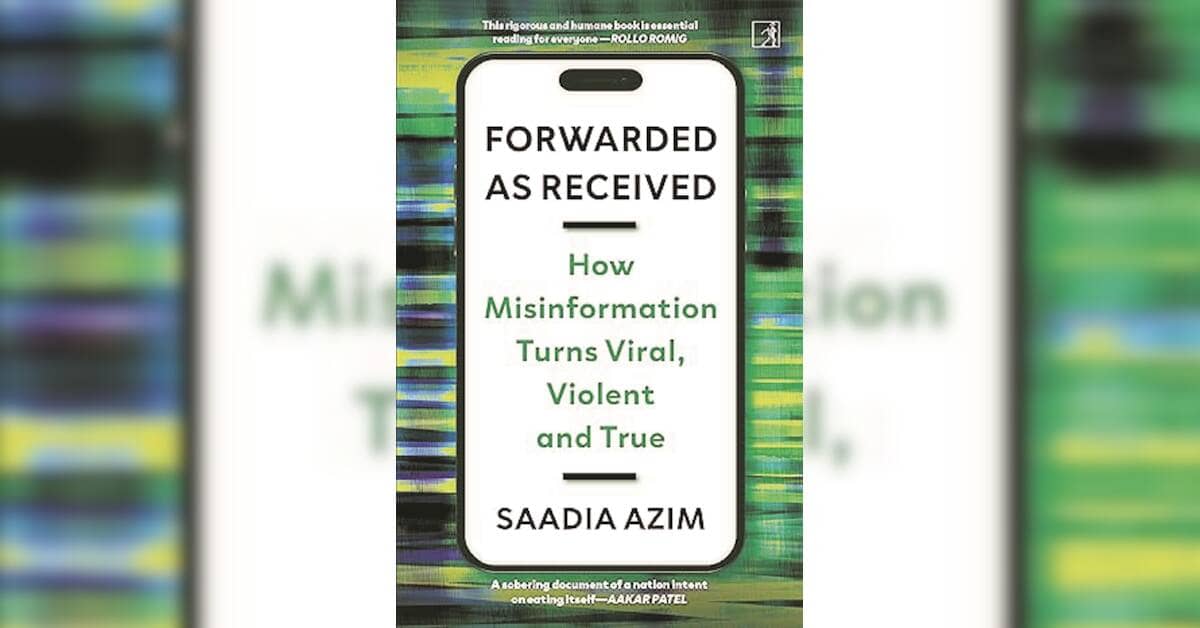
In an era where a single forwarded message can trigger violence before a fact-checker has even opened a database, Saadia Azim’s Forwarded as Received: How Misinformation Turns Viral, Violent and True is an urgent and exhaustive investigation into the anatomy of a digital crisis. Published by Simon & Schuster India, the 494-page book is priced at ₹599 and arrives at a moment when a rumour can travel through social media and messaging platforms faster than anyone can say “fact check.” The advent of artificial intelligence has deepened the problem, making it possible for manipulated images, voice clones and algorithmically amplified falsehoods to deceive even the most discerning reader or viewer. Azim begins with a clear philosophical position: the solution to misinformation is not censorship or state control. In her Author’s Note, she writes, “The way forward will not come through censorship or control, but through the slow, difficult work of rebuilding trust — creating digital spaces where dignity is the rule, not the exception and where citizens reclaim their right to truth and conversation.” In doing so, she invokes the original promise of the internet: a space that offered freedom to individuals, the ability to share meaningful dialogue beyond physical limits, and the capacity to spread information at a speed humanity had never known. That promise, Azim argues, has been corrupted by the same architecture that made it possible, and her book sets out to trace how misinformation turns viral, how it becomes violent, and how it eventually acquires the weight of truth through endless repetition.
Azim’s most forceful evidence is drawn from murders that took place directly because of fake news. She offers detailed retellings of contemporary Indian cases in which ancient brutality became a viral impulse, and none is more haunting than the 2015 lynching of Mohammad Akhlaq in Uttar Pradesh, a killing triggered by rumours circulated on social media. Through such cases, Azim shows how false information can transform ordinary neighbours into mobs, how anonymity lowers the threshold for cruelty, and how misplaced social trust allows harmful content to spread across communities with devastating speed. She also observes that in the aftermath of these killings there has been a striking “absence of collective remorse.” Instead of public accountability, there is often denial, deflection and continued circulation of the same false narratives. This absence of remorse, Azim argues, makes the spread of disinformation not merely a cultural problem but a policy issue. If people can be incited to violence by a forwarded message and no one feels responsible, the ordinary mechanisms of justice and social repair fail. The book therefore insists that misinformation must be understood not as an individual moral failing but as a structural condition of the modern information environment, one that requires systemic responses from the state, platforms, communities and citizens alike.
Beyond the crimes that occur because of fake news, Forwarded as Received also scrutinises the many cases in which misinformation and disinformation run rampant in the aftermath of a real tragedy. Azim points to the way social media platforms prioritise content that creates and echoes outrage, ensuring that inflammatory claims are seen more often than careful corrections. Algorithms reward anger, speed and novelty, not accuracy or nuance, and this creates an environment where the first version of events is often the one that sticks, regardless of its truth. The book then shifts to a psychological study of the people who forward and amplify such content. Azim identifies a peculiar mindset in the phrase “forwarding as received”: people who share suspicious messages often do so from a sense of civic responsibility, believing they are alerting their family and friends to a danger or an injustice. Yet the act of forwarding as received also seems to absolve them of accountability. They tell themselves that they are not making a claim; they are merely passing along what someone else said. This mental shortcut, Azim argues, is dangerously effective. It allows false information to travel through trusted social networks while the person who pressed the forward button feels both virtuous and blameless. She calls for a more intentional approach to consuming and engaging with news, one that leaves space for verification even at the individual level, and she asks readers to consider what responsibility they bear for what they help become viral.
One of the most consequential arguments in the book concerns the speed of fact-checking. Azim notes that the efforts made by the state and by independent fact-checkers to verify and debunk false claims rarely match the speed and reach of the original viral content. By the time a correction is published, the misinformation has already shaped perceptions, hardened biases and, in some cases, led to violence. To counter this asymmetry, she proposes a robust “prebunking” mechanism. Prebunking, as Azim explains, means proactively warning people about misinformation and false claims before they encounter them, building psychological resistance in the same way vaccines build immunity to disease. Instead of merely reacting to rumours, institutions would prepare the public for the kinds of false narratives that are likely to circulate around elections, communal events, health emergencies and natural disasters. She also calls for a robust feedback mechanism from social media platforms themselves, urging them and lawmakers to ensure that there is enough human intervention to weed out posts spreading disinformation and those targeting individuals, communities, religions and castes. In a country as diverse as India, she warns, the failure to act is not neutral; it allows prejudice and hate to be amplified under the cover of algorithmic neutrality. Platforms cannot be left to self-regulate, nor can they be allowed to hide behind the sheer volume of content. The book insists that human judgement, informed by local languages and social context, must remain at the centre of content moderation.
The book, however, is not without its limitations. Azim tends to repeat the same problems and solutions after every few chapters, and the structure can feel circular. Forwarded as Received works more like a textbook than a work of narrative non-fiction, because constant exposure to the material strengthens memory and understanding, but for a reader not engaged in academic or policy work, the repetition may weaken the reading experience. Another criticism is that after a certain point, the extensive detailing of crimes and incidents resulting from fake news and polarised online narratives feels closer to a monograph than to a compelling, page-turning narrative. The author seems so determined not to leave out any event that the larger story can become fragmented, with one horrific episode blending into the next. A more selective and tightly edited narrative might have allowed the emotional weight of each case to land more powerfully, while also keeping the argument moving forward. In its current form, the book is an invaluable reference, and its sheer breadth is impressive, but the reading experience can be dense. These flaws matter, especially for a subject that depends on public engagement; a reader who feels overwhelmed by repetition may set the book down before reaching its most actionable recommendations.
Regardless of its shortcomings, Forwarded as Received joins the expanding list of compelling non-fiction accounts published in recent years that explore how India lives online and what misinformation means for democracy, community and safety. The book does not offer easy solutions, and it does not pretend that digital literacy alone can undo the damage caused by viral falsehoods. Instead, it makes a persuasive case for a combination of individual responsibility, platform accountability, prebunking measures and policy interventions, all guided by a commitment to dignity rather than control. For citizens, the book is a warning about the dangers of forwarding without thinking. For journalists, it is a reminder that verification must be faster, more transparent and more contextual. For policymakers, it is a demand that misinformation be treated as a serious structural problem, not as noise or bad actors at the margins. Above all, Forwarded as Received is a call to remember the internet’s original promise and to fight for it: a space where people can converse across difference, where truth is not determined by the loudest or most repeated message, and where dignity is the rule, not the exception. As Azim demonstrates, the alternative is already visible in the violence and social mistrust that fake news leaves behind.


