


“If It’s Not on Facebook, It Doesn’t Exist”: How Meta’s News Ban Fueled Wildfire Misinformation and Conspiracy Theories
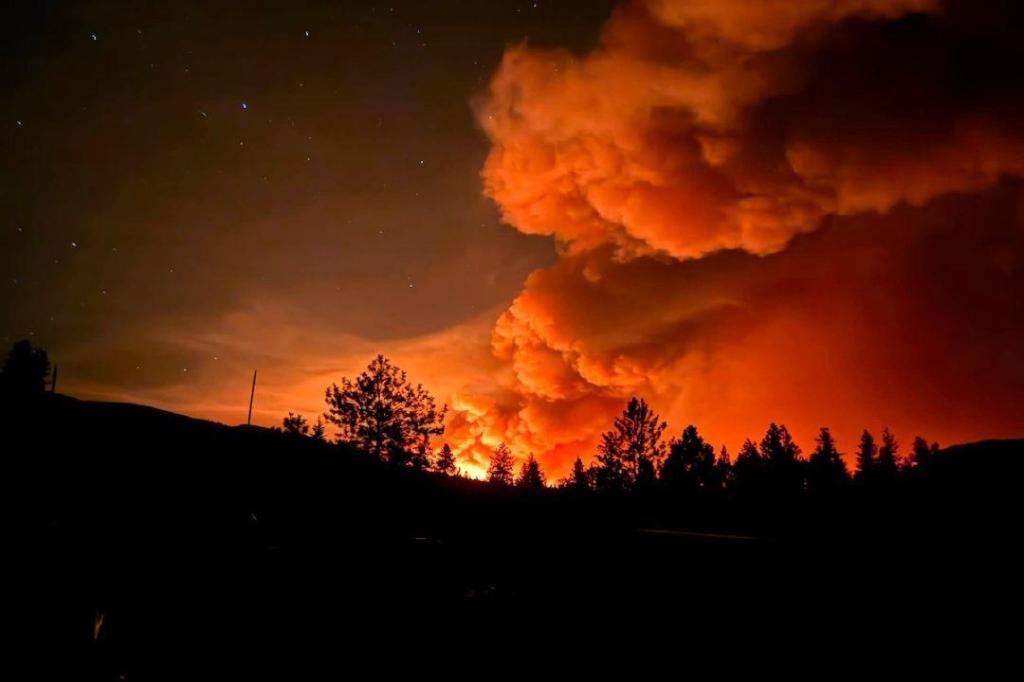
When the Bush Creek East wildfire was destroying homes in the Central Okanagan and raining embers upon Kelowna in the summer of 2023, the event was shocking not only to evacuees but to observers across the country. For Blair Visscher, a Vernon resident, the shock ran far deeper than the smoke-filled skies and the devastation unfolding on the ground. Like many people at the time, Visscher was glued to Facebook, desperately searching for reliable information about the rapidly escalating emergency. But what she encountered there was troubling in a deeply different way. Beyond the images of flames, smoke and destruction, she found a worrying swirl of divisive messages, conspiracy theories and outright misinformation at the very moment when accurate, life-saving information was most critical. The Bush Creek East wildfire emergency was itself bifurcated in an important way: it ignited on July 12 and was not classified as being held until late September, by which time it had consumed 45,600 hectares. But in the middle of that long stretch of danger and uncertainty, on Aug. 2, something strange happened: news articles sharing information about the blaze vanished from Facebook. That was because parent company Meta had begun stripping Canadian news from its Facebook and Instagram platforms as a way of dodging the Online News Act, a federal policy aimed at forcing the Silicon Valley giants to recoup some of the value those platforms enjoyed from hosting Canadian journalism. Instead of Meta paying for Canadian news to exist on its platforms, Canadian news simply stopped existing there. Low-quality information, Visscher and others now argue, is filling the void left by the departure of news media on Facebook—and the consequences for public safety during climate-driven emergencies are becoming impossible to ignore.
Visscher has delved deeply into this troubling phenomenon in her master’s thesis at UBC Okanagan, and her findings paint a stark picture of how social media algorithms, corporate greed and a collapse in public trust have combined to create a perfect storm of misinformation during wildfire emergencies. Her hypothesis, she explained in an interview with The Morning Star, was that the Meta news ban created a genuine information vacuum into which conspiracy narratives could rapidly expand. Working with her supervisor, environmental humanities professor Greg Garrard, Visscher explored ways to track the growth of conspiracy narratives and understand why they gain so much more traction than official information. She quickly realized that any meaningful analysis had to account for the algorithmic pressures that shape what Facebook users see—pressures that are rarely considered when people scroll through their feeds. The Meta news ban, she discovered, only exacerbated an existing problem. Tracing the first seeds of social distrust, and distrust in government and expertise, she landed on the COVID-19 pandemic as the starting point of a crisis in institutional credibility. “There was very little repair done in terms of rebuilding of government trust or trust in experts,” she said, noting that her forthcoming PhD work will move toward exploring how to repair that trust. For her master’s thesis, Visscher studied three major wildfire events: Fort McMurray in 2016, White Rock Lake in 2021 and Bush Creek East in 2023. She has spent time living in all of the affected areas, and together, these fires form an instructive timeline. Fort McMurray took place before the pandemic, and Visscher noted a high level of public trust in official sources of information at that time. The White Rock Lake wildfire occurred amid the pandemic, and consequentially, her findings shifted. She found that about four per cent of the Facebook discussion around White Rock Lake consisted of conspiratorial narratives, mixed with a strong dose of distrust, anger and questioning. Not all of that had to do with COVID-19; much of it, she said, had to do with the Facebook algorithm itself. “Official information existed, and a lot of people were going to Facebook to check, and it just wasn’t there because their algorithms didn’t promote it to them. So then people were like, well, there isn’t anything. If it’s not on Facebook, it doesn’t exist.”
One of the central messages Visscher wants to communicate is that Facebook is not a neutral platform. It is designed to maximize engagement, and it does so by amplifying content that is angry, divisive and emotionally charged—traits that keep people scrolling for hours and drive higher advertising revenue. “If you aren’t seeing official information, that’s likely just because your algorithm is not showing it to you,” she said. “Unfortunately, we do live in an era where we need to check our municipal website, check our regional website, check BC Wildfire Service, because there isn’t a platform that’s going to pull all that together for you in any helpful way.” The problem becomes critical when a wildfire emergency strikes and people need timely, accurate information to evacuate to safety—and instead run into a wall of misinformation on a platform that has abdicated all responsibility concerning the quality of information it disseminates and actively promotes through its algorithms. Visscher is deeply pessimistic about the possibility of reform from within Meta. “Meta is in the business of making money,” she said. “I don’t have high hopes that we can create change within Meta.” Her research suggests the issue is worsening over time. When she studied the 2023 Bush Creek East blaze, she found that content promoting conspiracy theories made up 16.6 per cent of the Facebook discussion—more than four times the proportion she had documented during the White Rock Lake fire just two years earlier. What she is seeing now, amid the current wildfire season, is a wave of questions about how wildfires are being fought, how decisions are being made about evacuation orders, and how fires are being started. She is careful to note that these questions often come from a good place; the real problem is the conclusions people are eventually led to by social media’s deranged algorithmic boosting of theories devoid of facts, detached from reality, but full of infuriating and otherwise engaging content.
Visscher’s research into the psychology of misinformation has led her to a nuanced understanding of why conspiracy narratives take root so effectively during emergencies. “I think a lot of the narratives that we see that lean more into what we would call conspiratorial start from a really genuine place of real questions,” she explained. “We want to know more. How are these things being decided? And then people come up with answers that they think makes the most sense for them.” This human impulse—to seek explanations, to fill gaps in knowledge, to feel a sense of agency amid chaos—is being ruthlessly exploited by algorithms that prioritize outrage over accuracy and virality over truth. In the vacuum left by the departure of professional journalism, conspiracy theories offer simple, emotionally satisfying answers to frightening and complex questions. Why is my neighbourhood under evacuation order while another is not? Why are resources being allocated in a particular way? Why did the fire spread so quickly? In the absence of accessible, official, and emotionally resonant information, people are left to make sense of events on their own, often with the help of content designed to provoke rather than inform. Visscher notes that during the current wildfire season, many of the questions circulating on Facebook centre on the technical aspects of firefighting and emergency management—legitimate inquiries that have no legitimate answers available on the platform. Instead, users are met with theories suggesting arson, government malfeasance, or other hidden causes. The result is a dangerous feedback loop: the less trustworthy and visible official information becomes, the more people rely on social media; the more they rely on social media, the more the algorithms feed them content that confirms their fears and deepens their distrust.
So what can be done? While Visscher holds out little hope for Facebook to change course and adopt a more conscientious approach to how it builds its algorithms, she points to a number of practical steps that can be taken—and in some cases, are already being taken—by officials, journalists and communities. BC Wildfire Service, she notes, is doing excellent work posting educational and engaging videos about what they are doing and how they are doing it. But there is a major caveat: “Again, not everybody sees those.” To truly combat misinformation, she argues, officials need to understand what type of content performs well on Facebook and other platforms. In other words, it is time to make legitimate information more engaging. “Official messaging still tends to have a very traditional use of language where it’s devoid of emotion,” Visscher said. “One of my recommendations, other than just making sure you’re posting on social media, is using emotionally resonant language, trying to connect with people on a human level before offering the information, which would help be promoted by the algorithm.” Journalists, too, have a critical role to play. Visscher suggests they devote more time to telling human-centred stories during wildfire events, where time and resources allow. She observed that, starting in 2021, official updates and voices increasingly overshadowed evacuee stories during wildfire coverage. “I think journalists play such an important role in allowing us in our communities to see our stories uplifted, to witness our grief, and to help us understand what’s going on,” she said. “So my recommendation to journalists is, if you have the time and capacity, maybe add a story from somebody within the community first before an official update.” She also emphasizes the need to address the root cause of many of these narrative battles: climate change. The reality that climate change is driving more frequent and severe wildfires, she argues, cannot be overstated. Yet it is precisely this reality that many users reject, preferring instead to embrace theories that absolve humanity from responsibility or point to sinister hidden actors. “A lot of what I see is people pushing up against that idea, that it couldn’t possibly be climate change, it has to be something else,” Visscher said, adding that a shared acceptance of climate change as the underlying driver would eliminate a whole category of conspiracy narratives.
Despite the grim nature of her findings, Visscher ends on a surprisingly hopeful note. She acknowledges that when she first began her research, she found it difficult to read through comments that were aggressive, cruel, or plainly harmful. But over time, her perspective shifted. “By the end of this research, I’ve really just come to the understanding that everybody’s just trying to make sense of some really scary things happening in our communities,” she said. “And at the end of the day, everybody has the same goal: we want everybody to be safe. We want to prepare ahead of time for fires.” This empathy, she believes, is essential for anyone trying to understand the spread of misinformation or to build bridges with people who have fallen down conspiracy rabbit holes. Dismissing them as gullible or malicious only deepens the divide; recognizing their underlying fear and desire for safety opens the door to communication. At the same time, she urges individuals to take personal responsibility for where they get their information during emergencies. “And then maybe just turn Facebook off for a bit and check the municipal website instead,” she advised. This simple act, she suggests, could do more to protect people than any algorithm change or policy intervention. In an age of climate-driven emergencies, where one wrong piece of information can be the difference between evacuation and tragedy, the ability to step away from the noise of social media and seek out verified, official sources is not just a matter of digital literacy—it is a matter of life and death. Blair Visscher’s research is a stark warning about the consequences of allowing corporate algorithms to shape our access to information, but it is also a reminder that communities are resilient, that people are fundamentally seeking safety and connection, and that the antidote to misinformation lies in better communication, greater transparency, and a renewed commitment to telling the human stories behind the flames.