





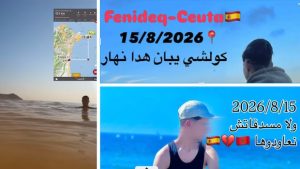



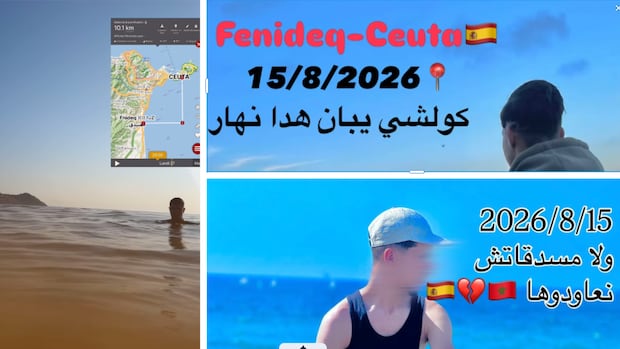
In the days leading up to the largest mass arrival of migrants to Europe in recent years, a short video posted to Instagram accumulated 1.4 million views. It shows a young man submerged up to his neck in water; the camera then pans to land in the distance. In the top-right corner, a map traces a sea route from Fnideq, Morocco, to Ceuta, a Spanish enclave on the northern tip of Africa. When a commenter asked what had happened, the account holder responded with a simple claim: “we’ve arrived.” That video was one of many viral posts on Instagram, TikTok and other platforms that appear to have helped mobilise at least two irregular migration waves from Morocco into Ceuta this summer. The first, on July 30, involved more than 72,000 people crossing the border in a single day, overwhelming the Spanish enclave and setting off a political crisis in Europe. The second, attempted on August 15, ended in dozens of arrests after Moroccan and Spanish security forces were deployed in force. The accounts belong to several online communities that form part of a broader ecosystem focused on migration-related culture, mixing music, memes and imagery. Some tap into, and appear to be trying to profit from, the desperation of mostly African and Middle Eastern youth seeking better lives abroad. Governments and organisations disagree over whether a single entity was behind the events in Ceuta or whether migration was weaponised for geopolitical aims. What is clear, according to an investigation by CBC’s visual investigations team with Bellingcat researcher Sebastian Vandermeersch, is that misinformation, amplified by multiple online communities, helped drive the summer’s waves toward Ceuta. Moustafa Ayad, executive director for Africa, the Middle East and Asia at the Institute for Strategic Dialogue, said the episode is a stark illustration of how false and manipulated content can have “real-world impact” when it is amplified across social media and directed at people who are desperate for answers. The mass movements of July and August were not spontaneous demonstrations; they were preceded by days of online buildup and by a mix of rumour, aspiration and organised messaging that turned an otherwise impossible journey into a concrete plan.
The online buildup before the July 30 crossing was initially triggered by misinformation suggesting that a Spanish court ruling meant Spain would no longer turn away migrants arriving by sea. The claim, although false, spread quickly through Arabic-language social media and provided what many interpreted as a legal opening. As the rumour travelled, scores of faceless accounts began publishing posts with similar language and recycled images, using maps, arrows and dramatic music to present Ceuta as within reach. Some of those posts gained millions of views. The consequences were significant. More than 72,000 people crossed the border on July 30, many of them wading through shallow water or swimming around breakwaters to reach Spanish territory. Local authorities were swamped, and the Spanish government deployed military personnel to the enclave. The event triggered a political crisis that resonated across Europe, where migration has remained a deeply divisive issue. Since then, the vast majority of those who crossed at the end of July have returned to Morocco, according to Spanish and Moroccan officials, but at least 5,000 remain in Ceuta, many living on a beach with help from charities. Nearly 100 people died trying to make the crossing, underscoring the human cost of the surge. Ayad, whose team tracked the social media activity in real time, said the pattern left no doubt about the power of these platforms to shape migration. “Misinformation and manipulation can have real-world impact,” he said, especially when they are amplified across online communities and aimed at people who are “desperate for answers.” The court ruling rumour, he said, did not create the desire to migrate, but it told thousands of people that the moment to leave had arrived.
The mechanics of how the crossings were organised online are now becoming clearer. Social media posts did not simply provide moral encouragement; many offered operational information. Some accounts funnelled followers into WhatsApp chats, where users coordinated plans and shared information about how to reach Ceuta. Others offered advice directly in their main feeds. One Instagram video titled “the shortest distance,” viewed more than 320,000 times, shows a reinforced fence topped with barbed wire. The clip marks the Spanish and Moroccan sides with their respective flags and adds large red-and-yellow arrows — the colours of the Spanish flag — pointing to a specific section. The message is unmistakable: for anyone trying to cross the fence, that is the best spot. The BBC has reported that its journalists exchanged direct messages with anonymous accounts that promised advice on entering Ceuta in exchange for money; in one case, about $750 was requested up front. Following the July 30 crossing, Meta and TikTok agreed to fact-check posts and to remove content that might help criminal organisations exploit would-be migrants. But a second wave of posts began building before August 15, promoted as the next “window” for entering Spain by land and sea. CBC found some of the same accounts that had helped mobilise the July 30 crossing, along with many new accounts created in the days before the date. Several posts used variations of the message: “15/08/2026. Everything will become clear on this day.” This time, Moroccan and Spanish authorities were prepared. Thousands of police were deployed on both sides of the border, and according to Morocco’s state broadcaster, nearly 300 people were arrested that Saturday. The Moroccan government said it was monitoring “the circulation of social media posts and messages of unknown origin” encouraging the crossing and would act against those responsible. Several Instagram accounts involved in the July 30 crossing have since been disabled, but the pattern they established — rumour, coordination, exploitation, eventual arrest — is now a template for future surges.
Why did these messages find such an audience? Researchers point to a steady increase in successful crossings before the court ruling rumour surfaced. The Mixed Migration Centre, a migration research organisation based in Geneva, found that Ceuta, long a destination for migrants, had become the most popular entry point into Spain in the first three months of this year, surpassing other, more traditional routes. According to figures reported by the Spanish government to the International Organization for Migration, more than 2,200 people entered Spanish territory by land through Ceuta by the end of May — three times as many as during the same period a year earlier. The reason for this shift is unclear, but researchers say stricter patrols on other migration routes, including in the Strait of Gibraltar and the Atlantic, may have pushed more people towards the enclaves on Africa’s northern coast. This context gave the social media misinformation a measure of credibility. “It did play a role in the misinformation that was shaping up on social media, basically presenting a picture like, ‘hey, you can make it,’” said Bram Frouws, director of the Mixed Migration Centre. But Frouws cautioned against attributing the surge itself to social media. “Social media [and misinformation] didn’t shape the desire or the aspiration to migrate,” he told CBC from the Netherlands. “The wish to migrate is already there.” The distinction is important. Social media did not invent the idea that Europe could offer a better life, but it provided the coordinates, the date and the collective reassurance that an individual might not be alone in trying to cross. For a young person in Morocco or Algeria, seeing thousands of others respond to the same posts could be enough to transform a private dream into a shared action.
Many of the accounts identified by CBC reflect a broader mood of disillusionment and desperation among young people in North Africa and beyond. They use aspirational images and language that valorise migration, often pairing European symbols with references to painful departure. The responses to the posts underline the depth of that desperation. “People are hard up,” said Ayad. For young people facing unemployment as high as 40 per cent in Morocco, along with a lack of political agency and respect for their rights at home, migration-related messaging “is going to read like ‘now is the time.’” Because Ceuta and Melilla, Spain’s two North African enclaves, provide the only land borders between Africa and the European Union, much of this content is rooted in the region. Many accounts appear to originate in North African countries, including Morocco and Algeria; other reports suggest some are run from Italy and Turkey. Some accounts use European or EU flags and mention a range of possible destinations, without explicitly saying they are selling a way to get there. One account, posting days before the August 15 crossing attempt, showed an image of the Eiffel Tower with the words “Leaving has become our only concern.” Another post showed a map tracing a swimming route from Fnideq to Ceuta. Another promised, simply: “and in the end, we will meet in Europe.” That account, according to its account details, had changed its username six times. Although it had existed since June 2025, all of its posts were dated August 3. Every post used a popular Arabic hashtag mentioning Germany, Belgium, Italy, Paris and “al-Ghorba,” an Arabic word with layered meanings encompassing life abroad, exile, and alienation from loved ones. Another account’s biography declares: “Immigration isn’t running away; it’s the search for opportunity.” Influencer-style accounts with similar themes are followed by thousands of people, and more than one repeatedly features photos of people in wetsuits posing on beaches or treading water, an apparent reference to the swimming route from Fnideq to Ceuta.
Taken together, the summer’s events offer a case study in how migration is organised, monetised and manipulated in the era of social media. The ecosystem is not monolithic. It includes young migrants sharing advice in WhatsApp groups, influencers performing solidarity, and anonymous operators who appear willing to sell guidance to the most desperate. The BBC’s reporting on paid promises of entry indicates that exploitation can take place on an individual level, while the scale of the viral campaigns suggests that some online actors are also trying to monetise the attention itself, accumulating followers, engagement and reach. There is so far no public consensus on whether a single organisation or state actor orchestrated the movements, and Spanish and Moroccan authorities have not produced evidence of one. What remains is measurable in human terms: nearly 100 known deaths, thousands of people stranded in an enclave that was never designed to hold them, and a security apparatus now permanently braced for the next online “window.” Attempts to counter misinformation, including fact-checking agreements with Meta and TikTok, may limit some false claims, but they do not address the conditions that make those claims believable. The wish to migrate, as Bram Frouws put it, was not created by social media. Yet, as the viral videos show, social media can make an impossible dream look like a nearby destination. It can turn a legal rumour into a mass movement, a cryptic date into a coordinated attempt, and a short video shot in the sea into a promise of arrival. The videos are more than content; they are now social infrastructure for migration. CBC attempted to contact several accounts referencing the July 30 and August 15 waves but received no response. The disabled profiles, the empty promises and the unfinished journey of the man in the video remain an open warning: until the desperation behind migration is addressed, online mobilisation will keep finding new ways to turn hope and grief into a crossing.


