


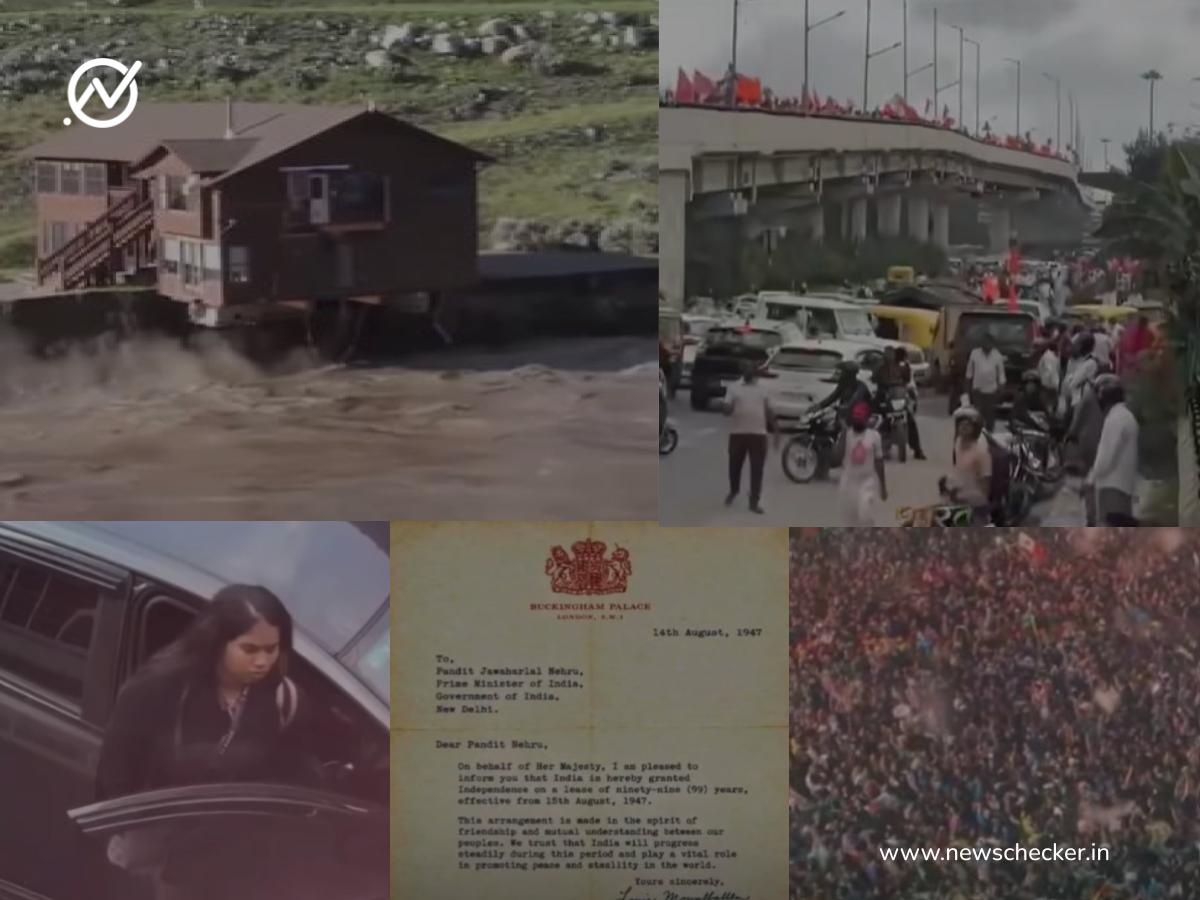
This week saw a relentless cascade of misinformation across various spectrums of public life, from natural disasters to political rallies, historical records, and personal reputations. The fact-checking organization Newschecker has compiled a roundup of five distinct cases that highlight the evolving and deeply troubling tactics used to deceive the public online. These cases underscore the pervasive challenge of verifying content in an era where digital tools can manipulate context and forge documents with unprecedented ease. Whether it is the rehashing of old, tragic footage to exploit a current catastrophe or the cross-border transplantation of video clips to fabricate political support, the underlying goal remains the same: to manipulate public perception and sow confusion. The breadth of these deceptions—ranging from a fabricated letter purportedly written by Lord Mountbatten to a baseless smear campaign against a Tamil Nadu Minister—demonstrates that no aspect of modern life is immune to falsehood. An analysis of these specific incidents reveals the critical importance of rigorous fact-checking methodologies and the dire need for widespread media literacy to counteract the viral nature of manipulated content.
The first significant fact check addressed the devastating flash floods that struck Nepal on August 26. In the immediate aftermath of such calamities, social media platforms often become flooded with unverified and emotionally charged visuals, and this instance proved no different. A video comprising two separate segments—one showing a massive, slow-moving mudslide descending upon a landscape, and another depicting a house being violently and instantly swept away by a churning wall of water—began circulating widely across social networks. Users shared this composite footage with the claim that it depicted the catastrophic reality of the Nepali floods, aiming to raise awareness and elicit sympathy for the victims. However, a rigorous investigation by Newschecker uncovered that the clips were neither recent nor from Nepal. The footage was old, originating from previous incidents in other geographical locations, and had been repurposed and recontextualized to fit the current tragedy. This phenomenon of the ‘zombie video’—where outdated clips resurface during fresh crises—is a persistent challenge in disaster reporting. The spread of such out-of-context visuals not only misleads the public about the scale and location of the damage but also diverts critical attention and resources away from the actual relief efforts. It creates a corrupted historical record of the event, making it harder for researchers and journalists to trace the true extent of the disaster. This case serves as a stark reminder that in the chaotic information ecosystem following a tragedy, skepticism is a crucial tool, and basic reverse image searching remains a vital defense against the exploitation of human suffering for social media engagement.
Political narratives are a prime breeding ground for misinformation, and this week’s second fact check highlighted the sophisticated use of cross-border misattribution. A video depicting an absolutely massive, sea-of-humanity crowd, filling every visible inch of a public space, was shared extensively across social media platforms. The viral claim asserted that this footage was from Congress leader Rahul Gandhi’s ‘Chhatron Ki Goonj’ student event held in Pune, Maharashtra. The visual was compelling evidence of grassroots support and political clout, and it was quickly amplified by supporters to showcase the momentum behind the opposition leader. However, Newschecker’s analysis conclusively debunked this claim. Through meticulous geolocation and forensic examination of visual cues such as architectural styles, road signage, and the specific layout of the venue, fact-checkers determined that the video was not shot in India at all. The footage actually originated from Mexico, likely depicting a different political campaign, cultural festival, or civic event. This kind of disinformation is particularly insidious because it uses authentic, real-world footage—rather than an obviously fake AI animation—to fabricate evidence of political strength. By transplanting a video of a massive crowd from one continent to another, those spreading the falsehood effectively manufacture public opinion. This tactic manipulates the electorate by creating a false narrative of overwhelming support or viral discontent, thereby distorting the political landscape. The success of this debunking effort demonstrates the critical importance of scrutinizing the metadata and inherent visual characteristics of videos, as well as the need to cross-reference claims with official event coverage and local news reports.
Perhaps the most technically alarming and historically significant disinformation of the week was the circulation of a fabricated letter allegedly written by Lord Mountbatten, the last Viceroy of India, addressing Prime Minister Jawaharlal Nehru. The forged document claimed that India was not granted permanent independence on August 15, 1947, but rather was handed over on a 99-year lease, which would theoretically expire in 2046. This explosive and provocative claim, if believed, would fundamentally challenge the very foundation of the Indian republic and national sovereignty, tapping into deep-seated anxieties about colonial legacies and external control. Newschecker’s investigation revealed that the letter was entirely AI-generated. Using advanced Large Language Models, the creators were able to simulate the formal, archaic prose expected of a mid-20th-century colonial official, complete with official letterhead, signatures, and a plausible structure. Fact-checkers employed a combination of digital forensic techniques, including typographical analysis, inconsistency checks in the language model’s output, and cross-referencing with actual archival documents from the British Library and Indian National Archives. The generation of such historical forgeries represents a terrifying new frontier in misinformation. As AI tools become more accessible and sophisticated, the ability to manufacture entirely fake historical artifacts—from letters and treaties to photographs and video—becomes easier. This threatens not only public trust in historical scholarship but also national cohesion, as fabricated documents can be weaponized to undermine the legitimacy of borders, constitutions, and governments. The debunking of this AI-generated letter highlights the essential role of digital forensics in modern journalism and archival science, as institutions must now defend against synthetic content designed to erase or rewrite history.
Misinformation is also a tool for personal destruction, particularly when it targets public figures, most often women. The fourth fact check centered on a viral video showing a woman getting out of a car wearing a short black dress, which was widely shared with the claim that she was Tamil Nadu Minister S. Keerthana. The clip was accompanied by critical and often misogynistic commentary aimed at condemning the minister’s clothing choices, thereby attempting to discredit her professionalism, moral character, and public integrity. This is a classic tactic in smear campaigns: using selective visual evidence to trigger a moral panic and undermine a person’s authority based purely on appearance. Newschecker investigated the claim and conclusively found it to be false. The woman in the video was an unrelated individual, and the footage had no connection to Minister Keerthana or any of her official activities. The misidentification likely stemmed from a deliberate attempt to target the minister, using an existing, unrelated clip to attack her reputation. This incident highlights the dangerous intersection of visual disinformation and deep-seated gender bias. It demonstrates how easily a pre-existing video can be weaponized against a specific individual, and how quickly online mobs are willing to condemn someone based on a few seconds of decontextualized footage. Fact-checkers had to verify the minister’s public appearances, compare facial features and biometric details against official imagery, and confirm that the location and vehicle in the video did not match her known routines. The rapid spread of this falsehood reveals the broader crisis of digital vigilantism and online character assassination, where reputation can be destroyed without a single shred of verified evidence, underscoring the need for platforms to act swiftly against such harassment.
The final case in the roundup involved a video showing a large gathering carrying saffron flags, which was widely shared as evidence of the ‘Aarakshan Hatao Andolan’ (anti-reservation movement) protest at Jantar Mantar on August 21. The visuals seemed to align perfectly with the ideological aesthetic of the movement, making the claim appear plausible to many social media users. However, Newschecker’s verification process revealed that the footage was not from the specified anti-reservation protest, nor was it from Jantar Mantar at that time. Instead, the video was found to originate from Jaipur and was unrelated to the August 21st event. This case demonstrates that misinformation often leverages the reputation of a well-known protest site and the visual cues of a specific movement to create a false sense of validation. By attaching a location like Jantar Mantar, which is historically associated with activism, and pairing it with familiar flags, the deception gains a superficial credibility. The debunking of this and the other four cases reveals a systemic issue: the public is consuming content at an alarming rate without performing basic due diligence. The collective work of fact-checkers this week serves as a vital public service, mitigating the damage of these deceptive narratives. The overarching takeaway is the absolute necessity of media literacy. While fact-checkers act as the digital immune system of society, they cannot work alone. The onus is on the citizenry to adopt a skeptical mindset, to perform simple reverse image searches, to verify sources against official reports, and to pause before hitting the share button. As artificial intelligence and manipulation tools become more sophisticated, the ability to create convincing fakes and constantly alter context will only grow. These five debunks serve as a stark warning that the truth is frequently the first casualty in the age of viral misinformation, making rigorous, independent journalism and a vigilant, questioning public our strongest defenses in preserving an informed and democratic society.