


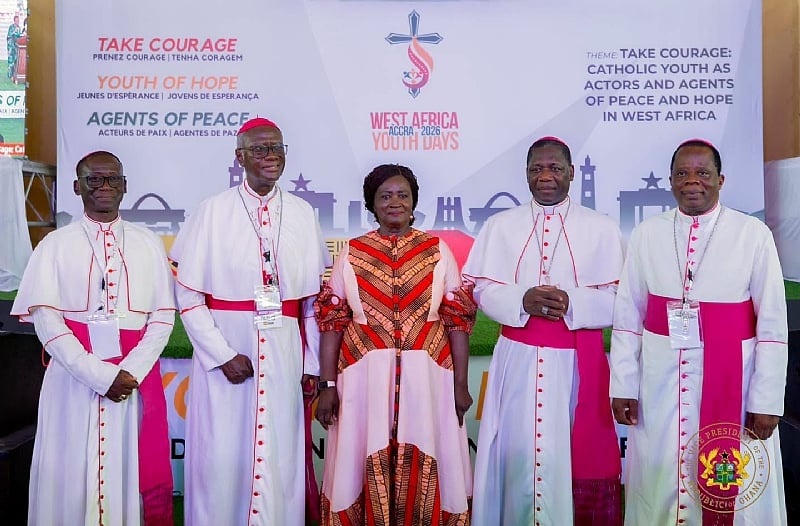
The Vice President of Ghana, Professor Jane Naana Opoku-Agyemang, has issued a powerful call to the young people of West Africa, urging them to become responsible digital citizens and to actively safeguard the region’s social fabric against the rising tide of misinformation, prejudice, and content that undermines peace and social cohesion. Speaking on Tuesday at the opening ceremony of the 2026 West Africa Youth Days in Accra, Ghana, Prof. Opoku-Agyemang addressed an audience of hundreds of young delegates and stakeholders gathered from across the sub-region. The event, organized by the Regional Episcopal Conference of West Africa (RECOWA) and hosted by the Ghana Catholic Bishops’ Conference, has become a major platform for discussing the challenges and opportunities facing the youth in a fast-changing world. The Vice President’s comments came at a time when digital platforms across the continent are increasingly being used to spread divisive narratives, ethnic tensions, and violent extremism—threats that are particularly acute for a young generation already grappling with high unemployment and socio-economic exclusion. Her speech skillfully balanced the dangers of the digital age with its enormous promise, underscoring that these tools are not inherently good or bad, but reflect the intentions of the people who use them.
Prof. Opoku-Agyemang lauded the widespread connectivity and rapid adoption of social media among West Africa’s youth as a sign of progress, but she also warned that these platforms could be turned into arenas of division and conflict. “Although technology and digital platforms have the potential to deepen divisions within society, they can also be powerful tools for promoting knowledge, creating opportunities, and building peaceful communities,” she said. She specifically emphasized the responsibility that comes with this power: young people must be mindful of the information they consume and share online, as their choices have direct consequences for real-world social harmony. The Vice President’s call to action is a response to a troubling rise in hate speech, fake news, and echo chambers that often fan ethnic and religious tensions in multi-faith, multi-ethnic countries such as Nigeria, Ghana, Ivory Coast, and the Sahel states. In an era when an identifiable tweet or viral image can trigger communal clashes, the need for digital discernment and responsible sharing has never been more urgent. She encouraged constructive use of these tools—posting content that uplifts, informs, and supports community based solutions—thus turning social platforms into bridges rather than battlefields.
In order to fully harness the positive potential of this digital revolution, the Vice President argued that the foundation must be education and the expansion of opportunity. Prof. Opoku-Agyemang called for sustained investments at the national and regional levels to open doors for young people through quality learning, skills development, and entrepreneurship initiatives. She stressed that greater access to knowledge and viable livelihood opportunities directly equips youth to take on meaningful roles in society, reducing the likelihood that they will be susceptible to radicalization (which often exploit economic despair) or tempted to leverage their skills in destabilizing ventures. Her words resonate with the African Union’s Agenda 2063 aspirations, which prioritize youth development, and with the UN Sustainable Development Goals (SDG 4 for inclusive education, SDG 8 for decent work). She reminded the young audience that they are the leaders not just of tomorrow but today, and that their role must extend beyond the keyboards of digital devices to the creation and building of a secure and prosperous West Africa. The Vice President’s emphasis on deliberate effort in human capital is a direct acknowledgment that in the region where almost one-third of the population is aged 15-34, the future of the sub-region lies almost entirely in their hands.
The mood of the conference took a more somber turn when the President of the Ghana Catholic Bishops’ Conference, Reverend Matthew Kwasi Gyamfi, took the stage to equate the region’s challenges to a “perfect storm” of crises. He identified economic hardship, persistent youth unemployment, and the escalating menace of violent extremism as the three principal threats plaguing West Africa today. His comments are backed by the graph of instability from the Sahel, and a military intervention where terrorism fueled by geopolitical conflicts has displaced millions, forced school closures, and put extortionate strain on sovereign governments. Rev. Gyamfi’s pointed out that many of these territory conversions are finding fertile ground in the villages of Niger, Burkina Faso, and Mali, and are slowly creeping toward coastal states. He warned the youth not to submit to fear or despair but to remain resilient and confident in their ability to contribute to their communities. His message focused on the intrinsic spiritual and emotional strength of the young people, encouraging them to see themselves as solve problems, not victims: “Do not surrender to the pressures of the day, but hope courageously and become builders of peace.” He made a call for a collectiveness leadership of virtues—personal integrity, inclusive local governance and religious collaboration—as an essential tool against violent ideologies that prey on marginalization.
The 2026 West Africa Youth Days, organized by RECOWA and hosted under the auspices of the Ghana Catholic Bishop’s Conference, stands as a singular regional initiative to foster a dialogue between the Church, the state, and the youth. The event, which takes place in Accra, has drawn young delegates from across all the 15-member West African states, alongside bishops, clergy, development partners, and civil society. The conference, which also includes workshops, seminars, and cultural exchange, is designed to produce a practical agenda for youth-oriented policy and development in the sub-region. In a region where the Catholic Church operates one of the largest networks of school and health facilities, the Bishops’ role extends far beyond the sanctuary; it provides critical infrastructure for civilization and social welfare. The event accentuates the Church’s commitment to the advancement of the youth and its vision to confront modern challenges with new creativity. This year, the theme and the discourse centered on “Youth and Digital Responsibility: intervening peace and solidarity in the virtual age;” the representatives engaged in intense conversations on how to create a systemic environment, as well as methodological filters and civic programs, to curb online abuses to help digital ethics serve the common good. It also allowed a moment of solidarity as participants shared their personal experiences with extremism and the hope of unified action.
Finally, as the three-day gathering concluded with a resounding call to action, the consensus was that the future of West Africa does not rest on natural resources or oms, but on the mettle, courage, and orientation of its young people. The Vice President’s speech and the Bishop’s words not only framed the gravity of the current crisis, but offered a realistic, spirit : turn digital amplifiers into instruments of peace; channel the energy and frustration into self-empowerment, and, most of all, never to lose faith or courage in the shared resolve. The Government of Ghana, together with the Catholic Church, pledged to sponsor collaborative follow-ups to the outcomes of the meetings, including new media literacy frameworks for youth organizations and ramped up micro-financing for youth-led social enterprises. In the faces of those many young delegates, promising takeaways emboldened—they themselves saw the responsibility and power they hold, that the influx of information may be unlimited, but the capacity for discernment and empathy is the true mark of leadership. Now, as these young people return to their varied landscapes, the 2026 West Africa Youth Days’ success will have to be measured by the lasting change they produce in the foreign lands and the peace that they hormeattle. They are tasked with turning the Vice President’s words into daily actions—they are, and will continue to be, the architects of West Africa’s modern age.