


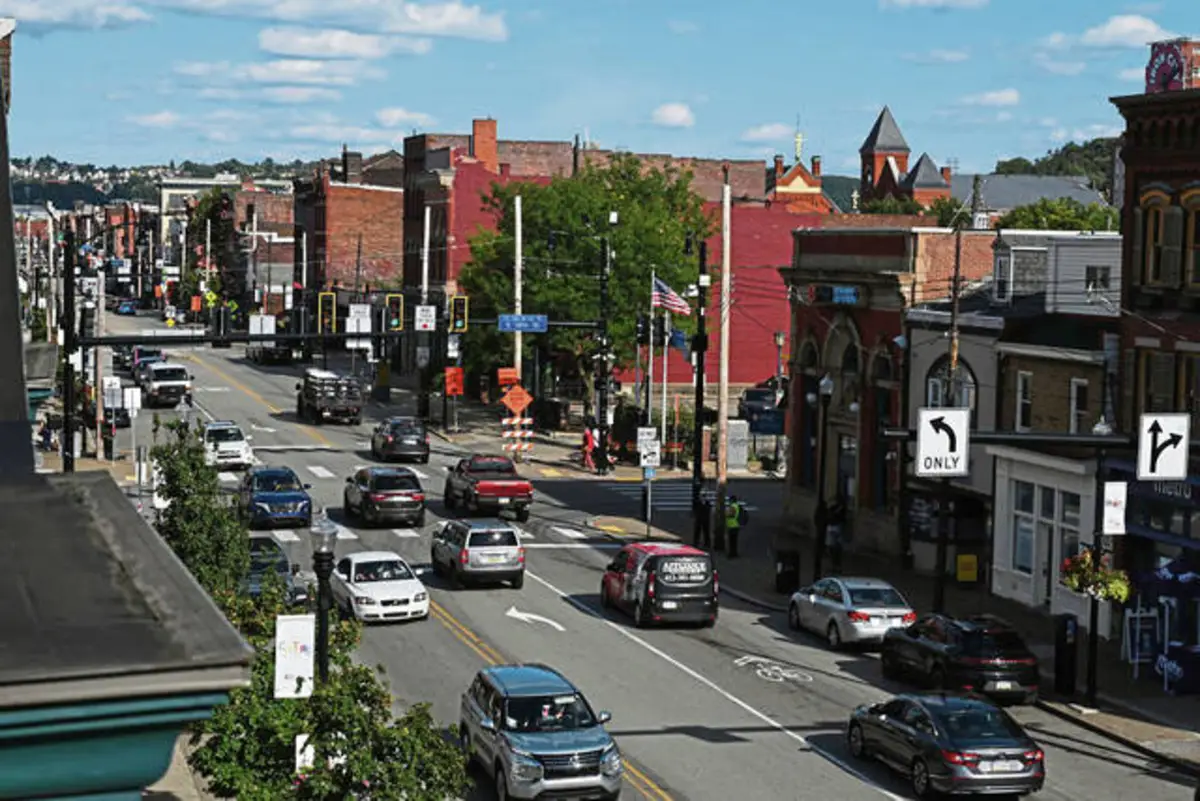
PITTSBURGH — Anonymous flyers distributed to some residents in Pittsburgh’s South Side are spreading inaccurate information about a proposal to create a neighborhood improvement district, prompting Councilman Bob Charland, D-South Side, to denounce the mailing as “a deliberate disinformation campaign” and refer the matter to law enforcement agencies. Charland said the mailers first appeared last week and falsely tell residents they will be forced to pay into a fund intended to pay for improvements along East Carson Street, even though the proposal being considered by City Council would not require homeowners to pay anything. The anonymous letters are signed “South Side NID Expansion Committee” and include the tagline “Make South Side Great Again!” according to copies reviewed by TribLive. The return address listed is a UPS store on East Carson Street. Charland said he is not entirely sure what the people behind the flyers hope to accomplish, but he speculated that they may be trying to sow confusion among residents or discourage South Side residents from supporting the measure. The misleading mailers come just as City Council prepares to host a second public hearing on Wednesday on the proposed neighborhood improvement district, which is designed to fund services such as grafiti removal, neighborhood events and enhanced public safety in the commercial corridor. That hearing is expected to give supporters and opponents another chance to weigh in on a measure that has already drawn significant attention. Charland stressed that residents should read the actual legislation rather than rely on anonymous mailings, especially since the flyers targeted people who live outside the proposed footprint and would not be subject to any new assessment. The councilman also said he has formally reported the flyers to law enforcement agencies that may investigate potential mail fraud. The episode has injected confusion into what was already a closely watched public policy debate about the future of one of Pittsburgh’s most vibrant business districts.
The letters themselves show conflicting and fabricated numbers, according to the copies reviewed by TribLive. One version tells a resident that they will have to pay $125 a month, while another lists the monthly cost at $1,250 — an enormous discrepancy that suggests the people behind the mailing did not base their claims on the actual proposal. Charland said the flyers were sent to people who live outside of the proposed neighborhood enhancement district footprint. The proposed district includes the East Carson Street Local Neighborhood Commercial district, portions around Bedford Square and commercial properties along 10th and South 14th streets. Under the actual proposal, single-family, owner-occupied residential properties and tax-exempt properties would not be required to contribute to the fund. That means the very homeowners receiving the false letters would have no financial obligation under the plan as currently drafted. The return address at a UPS store on East Carson Street may be an attempt to conceal the identity of the authors, and the group name “South Side NID Expansion Committee” does not correspond to any known registered organization or public body. Charland said he is not entirely sure what the goal is, but he suggested the mailers could be designed to alarm residents, undermine trust in the public process, or discourage neighbors from attending hearings and voicing support. He noted that the false payment figures are especially troubling because they are presented in a way that mimics an official assessment notice, even though the city has no such notice in circulation. The distribution of the flyers also goes beyond the geographical area that would be affected, raising further questions about whether the mailing was intended to reach as many people as possible to create broad confusion. The city has not identified who is responsible, and no group has claimed credit beyond the anonymous committee name.
Neighborhood improvement districts, often called NIDs, are a governance and financing mechanism that allows commercial areas to pool resources from property owners within a defined boundary to pay for additional services and improvements that go beyond what the city provides. In this case, the proposal would require property owners within the proposed district to pay into a dedicated fund. That money would then be used for improvements like grafiti removal, neighborhood events and enhanced public safety in the business district. A group of neighborhood stakeholders would be responsible for directing how the funds are spent and would also advocate for grants and development that could benefit South Side. The proposed structure is intended to give local business and property owners more control over the cleanliness, marketing and safety of the area, rather than relying on city budgets or volunteer efforts. The explicit exemptions for single-family owner-occupied homes and tax-exempt properties are a key element of the proposal and are central to the argument that homeowners would not be directly assessed. Businesses and commercial property owners within the district would be the ones paying, and they would have a voice through the stakeholder group in how the money is invested. The proposal comes after years of concerns about the East Carson Street corridor, which is dense with restaurants, bars and shops and draws large crowds, particularly on weekends. While the district would not replace existing city services, it would provide a stable funding stream for supplementary services that supporters believe are necessary to maintain a clean and safe environment. Because the district is designed to be governed by local stakeholders, it is seen as a way to respond quickly to issues like grafiti, litter and public safety concerns without waiting for the slower budget cycles of city government. The city’s public hearing process is meant to ensure that residents understand the boundaries, the assessment structure and the exemptions before any final vote.
The public response to the proposal has been largely supportive, but not unanimous. During a July public hearing, property and business owners overwhelmingly voiced support for the measure, according to Charland and reporting from the meeting. Many supporters argued that the commercial district needs a dedicated improvement mechanism to keep pace with the demands of such a busy neighborhood. They pointed to examples of other business districts that have used similar assessment structures to fund clean teams, security patrols and promotional events. But some detractors pushed back at that July hearing, arguing that property and business owners should not be asked to shoulder additional fees at a time when taxes have increased and prices across the economy continue to climb. Those concerns echoed a broader debate in Pittsburgh and other cities about whether special assessment districts place too much burden on commercial property owners, especially smaller businesses that may be struggling with rising rents and operating costs. The false flyers play directly into that anxiety by inflating the potential costs and directing the message at homeowners who would not constitute contributors. The fact that the anonymous mailing surfaced in the weeks between the first hearing and the second hearing has raised concerns that someone may be trying to tip the balance by mobilizing opposition based on misinformation. Charland’s statement urging people to read the legislation appears designed to counter that effect. He said the flyers are not a legitimate part of the public debate and should be treated as an effort to mislead rather than an invitation to engage with the merits of the proposal. The upcoming Wednesday hearing gives residents and business owners the opportunity to hear the actual details from city officials, question the boundaries, and register their support or opposition in a transparent forum. The city council will ultimately decide whether to approve the district, but the public hearing process is the formal channel for community input.
Charland’s decision to report the flyers to law enforcement agencies focuses attention on the potential legal consequences of spreading false information through the mail. The mailing, if it intentionally misrepresents facts in order to induce residents to take action, could constitute mail fraud, a federal offense that involves the use of the U.S. mail system to execute a scheme to defraud. The fact that the letters contain specific but wildly inconsistent dollar amounts, and that they were sent to people who would not be assessed, could be relevant to any inquiry into whether the person behind the mailing knew the statements were false or acted with reckless disregard for their truth. The return address at a UPS store could complicate efforts to identify the sender because mailbox services do not always disclose the identities of their customers without a subpoena. It is not clear whether the law enforcement agencies contacted have opened an investigation, and Charland did not say what agencies will handle the case. The councilman said only that he has reported the flyers and that they may further investigate potential mail fraud. The term “deliberate disinformation campaign” in his news release indicates that he believes the material was not merely an accidental mistake but an intentional attempt to deceive. If investigators pursue the case, they could potentially subpoena records from the UPS store or trace the production and distribution of the flyers. The use of the phrase “Make South Side Great Again!” also borrows from a national political slogan, which some may see as a signal of political motive, though the anonymous group’s actual aims remain unclear. The broader issue, however, is not only legal but civic: anonymous mailings designed to distort a public policy proposal can undermine residents’ trust in the process and make it harder for genuine deliberation to occur. That concern is particularly acute when the false information is directed at residents who are not even included in the affected area and who may have no reason to check the legislation themselves. The city has published the proposal and the hearing process is public, but anonymous misinformation could still create confusion among those who do not follow council proceedings closely.
The next step in the process is Wednesday’s second public hearing, where city council will hear additional testimony on the proposed neighborhood improvement district. Residents and business owners interested in the proposal are encouraged to attend the hearing and to read the full text of the legislation, which is available through the city’s legislative channels. Charland has said that the flyers should not be used as a substitute for official information and that the actual proposal contains clear exemptions that protect homeowners. The hearing offers a chance for the public to hear directly from city staff and council members, to ask questions about the assessment structure, and to express whether they believe additional investment in East Carson Street is needed at this time. The outcome of the hearing could shape the next stage of council deliberation, including any amendments to the boundaries or the assessment formula. The broader question remains whether the city will approve a new district that gives South Side stakeholders a dedicated funding mechanism for improvements, or whether the controversy caused by the false mailers will complicate the path to approval. What is clear, according to Charland, is that the anonymous letters are not an accurate reflection of the proposal and should not drive the decision-making process. The district, if approved, would affect commercial property owners within the defined area, while exempting single-family home owners and tax-exempt properties. It would create a stakeholder body to direct spending on grafiti removal, public safety, events, grants and development advocacy. For now, the residents of South Side are left to navigate a debate between those who see the district as a needed investment in the neighborhood’s future and those who see it as another financial burden during uncertain economic times. The Wednesday hearing will provide the most direct opportunity for the public to be heard, and the councilman has made clear that anyone with questions should look to the legislation, not to anonymous flyers, for the truth about what the proposal would do.