



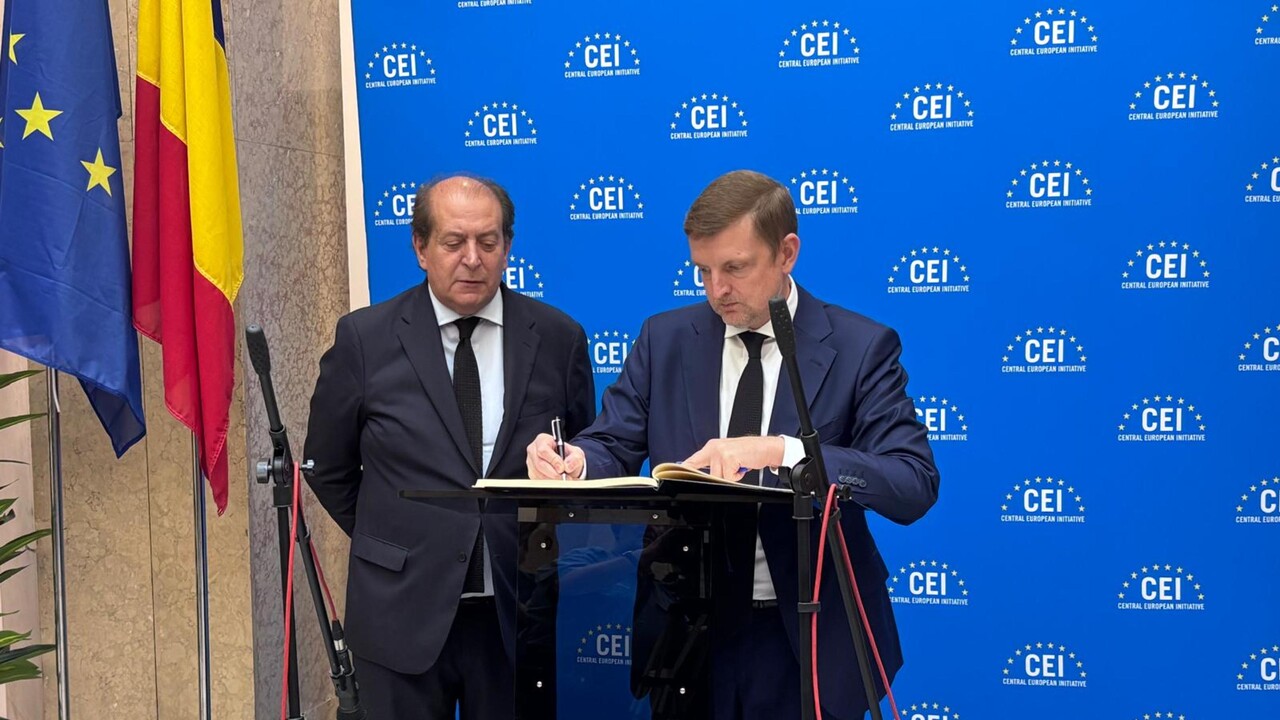
TRIESTE – Ukraine’s Ambassador to Italy, Ihor Brusylo, delivered a blunt and deeply sobering warning on Wednesday after a meeting at the headquarters of the Central European Initiative (CEI) in Trieste: Russia does not believe the European Union is a formidable adversary, but rather a weak link to be exploited. In remarks that quickly resonated across diplomatic circles, Brusylo said that Moscow’s invasion of Ukraine was never merely about Ukraine itself. “Russia also views the EU as a weak link,” he said, adding that “attacking Ukraine was not Russia’s only goal; another goal was to cause Europe to explode—to tear it apart from within.” The choice of Trieste, a city that sits at the crossroads of Latin, Germanic, and Slavic Europe, was itself symbolic. The ambassador’s message was clear: Russia’s war is not just a military conflict on Europe’s eastern frontier, but a political and psychological assault on the entire European project. His words come at a moment of profound instability, with multiple European countries preparing for national elections and the EU itself facing questions about its coherence, competitiveness, and capacity to act as a unified geopolitical force.
The meeting at the CEI General Secretariat headquarters was more than a routine diplomatic encounter. The Central European Initiative, one of the oldest and most inclusive regional forums on the continent, brings together countries from Central, Eastern, and Southeastern Europe, including EU members, candidate countries, and non-members alike. For Ukraine, the CEI is a crucial platform to maintain solidarity among nations that might otherwise drift toward divergent positions on the war. Brusylo’s participation was a deliberate effort to keep the Ukrainian question at the center of regional discussion, even as attention increasingly shifts to domestic concerns in Western Europe. The ambassador’s language, however, suggested that Kyiv is worried about the direction those domestic concerns are taking. The phrase “weak link” is telling: it reflects a belief that Moscow has studied the EU’s internal fractures in depth, and that it sees opportunities not in a frontal military confrontation with the alliance, but in the slow erosion of European unity from within. In this view, every European election becomes a potential battlefield, every protest a potential weapon, and every political party a potential conduit for Russian influence.
Brusylo was explicit about the timing. “We must work together to provide a more concrete response to what is happening,” he said. “As elections in Italy, Poland, Spain, and France approach, disinformation will spread even more.” These four countries represent some of the largest and most influential EU member states, and their political trajectories will shape the future of the bloc. Italy, Poland, Spain, and France are also countries with significant public debate about the cost of supporting Ukraine, migration policy, energy security, and the role of national sovereignty within the EU. It is precisely in these debates, Brusylo suggested, that Russia will seek to inject poison. Disinformation campaigns can take many forms: fake news stories designed to inflame public opinion, manipulated videos, coordinated bot networks on social media, and the amplification of extreme voices that would otherwise remain on the margins. The ambassador’s warning was not abstract; it was a concrete operational forecast. Russia, he implied, has learned from past operations and will adapt its tactics to the particular social and political vulnerabilities of each country. The goal is not to convince everyone to support Russia, but to generate enough confusion, distrust, and polarization that Europe becomes incapable of making coherent decisions.
The ambassador also spoke of a broader arsenal beyond disinformation. He warned of “hybrid threats, subversive activities, and the entire arsenal at their disposal.” Hybrid warfare is a term that encompasses a wide range of destabilizing actions: cyberattacks on critical infrastructure, sabotage of undersea cables or railways, arson attacks on industrial sites, energy blackmail, weaponized migration, disinformation, and political assassination. Europe has already seen a number of suspicious incidents in recent years that many officials have attributed to Russian operatives or their proxies. Brusylo’s remarks suggested that these activities will intensify as elections approach. Subversive activities include not just covert operations by intelligence agencies, but also attempts to cultivate and manipulate political actors within European countries. The goal is to create a network of influencers, parties, and public figures who either consciously or unconsciously advance Russian narratives, weaken European support for Ukraine, and obstruct the EU’s decision-making processes. The ambassador’s use of the word “arsenal” was deliberate; he wanted his audience to understand that Russia is not improvising, but deploying a systematic, well-funded strategy to exploit every opening available in European democracies.
Perhaps the most striking moment came when journalists asked whether Russia would intervene by funding specific political parties. Brusylo did not hesitate. “I believe so,” he said. “They will keep doing it. They never act directly; instead, they use connections between various political parties, including this one. It’s a serious threat—one that you, too, should be more aware of.” The phrase “including this one” was ambiguous, but it was widely interpreted as a reference to Italy, or perhaps to Europe more generally, and it underscored the ambassador’s belief that no country is immune. Russia’s approach to political financing, he explained, is indirect and deniable. Money often moves through layers of shell companies, business deals, think tanks, media outlets, cultural associations, and private foundations. Sometimes the ultimate recipients may not even be fully aware of where funding originates. In other cases, Russian intelligence uses blackmail, compromise, or ideological affinity to recruit agents of influence. The ambassador’s warning was a reminder that such operations are rarely uncovered until after the damage is done. Election financing is notoriously difficult to regulate, especially when funds are channeled through third countries or disguised as legitimate investments. Brusylo’s message to journalists and, by extension, to the broader public, was to be vigilant, to ask questions, and to recognize that the threat is real and current.
Brusylo’s broader message from Trieste was a call for a concrete, coordinated European response. It is no longer enough, he suggested, to simply condemn Russian aggression or to express solidarity with Ukraine in general terms. Europe must understand that it is itself in the crosshairs. The next election cycles in Italy, Poland, Spain, and France will be tests of the continent’s resilience. If European societies can protect their democratic processes, maintain a united stance on Ukraine, and resist the temptation to blame each other for their problems, they can deny Russia its primary objective. But if they allow disinformation to polarize them, if they permit subversive activities to go unanswered, and if they ignore the quiet flow of money into their political ecosystems, they risk waking up to a Europe that has already been torn apart from within. The ambassador’s language was urgent, but not despairing. He expressed a belief that Europe still has time to act, if it acts together. The meeting in Trieste was a small event, but its implications were enormous. Ukraine is asking its European partners not only for weapons and financial aid, but for something more difficult: the willingness to defend their own societies against an enemy that does not always wear a uniform. As Brusylo left the CEI headquarters, his words hung in the air, a warning that Europe must heed before it is too late. All rights reserved, © Copyright ANSA.