








Truth Fatigue and the Digital Storm: Saadia Azim’s New Book Explains How Misinformation Turns Viral, Violent and True
In her latest book, Forwarded as Received: How Misinformation Turns Viral, Violent and True, journalist Saadia Azim takes readers deep into the mechanics of modern falsehood, showing how misinformation is no longer a random error or a harmless rumour but a weaponised force that shapes public emotion, identity and collective memory. Published by Simon & Schuster India, the book opens with a chilling and all-too-recent case from Kolkata. In August 2024, a young postgraduate trainee doctor at R.G. Kar Medical College was raped and murdered after a gruelling 36-hour shift. Her body was discovered in a seminar hall bearing horrific signs of assault, throttle marks and deep wounds. The news first appeared in mainstream media as yet another tragic report of violence against women. Then came the public outrage. Doctors across Indian states went on strike, and candlelight marches and protests swept through more than 130 cities, demanding accountability and safety for medical professionals. That coverage, Azim notes, came nearly one and a half months after the actual incident. As fury peaked, the narrative splintered. Misinformation flooded social media, with users posing as eyewitnesses to the postmortem report, sharing graphic images and unverified claims, particularly allegations of gang rape that were later debunked by forensic reports. The accused was already in judicial custody and had been apprehended early in the investigation. Still, the mass hysteria did not subside. Allegations emerged that the hospital and police had tampered with evidence, prompting a CBI probe into a different case related to corruption. In the process, the lens quietly shifted from the lived risks faced by women at work to the spectacle of institutional failure, leaving the gendered dimension of the violence less visible. As protests grew louder, the conversation slipped into the orbit of political bigwigs, where disinformation, personal attacks and the communal framing of the crime dominated the narrative. Amid this chaos, the public’s ability to discern fact from fiction began to fray.
Azim draws on sociologist Zeynep Tufekci’s warning that disinformation does not just deceive; it drains emotional reserves. When every fact comes with a counterclaim and every verified report is met with suspicion, it leads to what Tufekci calls truth fatigue — a psychological numbness where people grow weary of outrage and begin to distrust all narratives, even truthful ones. In the R.G. Kar case, initial empathy gave way to exhaustion. Questions like “What’s really true?” replaced calls for justice. Democracy, Azim argues, becomes performative, and victims are not just failed by the system but by the fog of digital confusion that obscures their stories. The book then moves to the deeper question: why do falsehoods stick? Azim argues that the answer lies in emotional precision. Misinformation today is not solely about making you believe a lie; it is about making you feel something so strongly that you do not stop to verify whether it is true or not. Outrage replaces inquiry. Nationalism trumps nuance. And in that swirl, digital mercenaries — some paid influencers, some ideological volunteers — do the rest. The platforms themselves have scaled back moderation. After Elon Musk acquired Twitter in October 2022 and later rebranded it as X, the platform underwent sweeping layoffs that significantly reduced its trust-and-safety workforce. Its external advisory council was dissolved, raising concerns among researchers and regulators about weakened safeguards against misinformation and abuse. Musk repeatedly framed Community Notes as a decentralised alternative to traditional moderation, arguing that truth should emerge from collective user consensus rather than from platform authorities. Yet Indian users, Azim notes, report posts faster than they are reviewed, leaving grievances to pile up unanswered. Google and Meta, when under pressure to appear neutral, retreat into silence. Meanwhile, thousands of “news” handles operate without bylines or accountability, feeding users a steady diet of algorithm-friendly outrage.
The book also examines the erosion of public trust through the phenomenon of the liar’s dividend. Turn on any news debate on television, Azim writes, and panellists casually dismiss sources with a shrug. Scroll through social media and the refrain is constant: “I don’t believe the news anymore.” A New York Times technology reporter, Tiffany Hsu, elaborates on this mood, saying people now have a hard time knowing what to believe in an era of misinformation, where AI-generated content floods feeds, creating a pervasive distrust of everything. The result is a liar’s dividend: in a world where all claims are questioned, the ones with something to hide benefit the most. A doctored clip showing a minister apologising can be disowned. A real clip showing misconduct can be dismissed as AI-generated. In other words, the very presence of fakes makes it easier for liars to dismiss the truth. In India, where political allegiance can define perspectives, disinformation becomes a social adhesive. It travels faster when it comes from someone you know: a family member sending a WhatsApp message, a local influencer sharing a news scoop, a temple speaker reading out “news” during evening aarti. This intimacy gives falsehoods legitimacy. But therein also lies the solution. American digital propaganda scholar Samuel Woolley emphasises that misinformation grips most effectively when it originates from sources we trust; similarly, truth relies on that same credibility. His research shows that algorithmic amplification can weaponise trust in familiar voices, making falsehoods more infectious. When someone we believe in shares misleading content, our cognitive defences weaken and we lower our guard, allowing disinformation to spread unchecked. Woolley’s studies on computational propaganda and perception engineering reveal a paradox: while we rely on trusted connections, these very networks can become vectors for deception.
Azim broadens this analysis to the entire information ecosystem. The internet has created countless ways to access information, but trust in news media and in institutions like medicine and science is at an all-time low. In such an environment, the line between credible content and malicious mimicry blurs, and each of us, in turn, becomes the creator, user, forwarder and influencer, making it even harder to distinguish fact from fabrication. The landscape keeps shifting. The same person can amplify truth at one moment and spread falsehood the next, often without realising it. Such fluid roles dissolve clear boundaries, leaving misinformation free to circulate unchecked. Recognising when we ourselves are becoming the vector, and choosing to step back from it, can be one of the most effective ways to break the chain. In today’s hyper-networked ecosystem, where multiple channels transmit information in countless formats — text, voice notes, memes, videos, AI-generated avatars — the same message is received, reshaped and resent by diverse groups of known and unknown actors. This fragmentation of truth across a complex web of dissemination does not only amplify noise; it arms it. What emerges is not merely a misinformed public but a full-blown digital storm, where falsehood functions like a precision-guided strike, hitting different communities at different times with tailored impact. The situation is not just chaotic; it is strategically confounding. Azim compares this to the Chakravyuh of the Mahabharata, the inescapable military formation. Everyone today lives within their own personalised storm of data: cyclical, isolating and unknowingly self-reinforced. The architecture of the internet, built for openness, now traps users in algorithmic whirlpools, where truth is relative, emotions are currency and exit routes are unclear. In this system, content that provokes anger or drives offline action is rewarded as “great content,” even if it is a lie. The more it generates emotion, the more it guarantees amplification, thus ensuring that falsehoods are not just seen but widely followed. Misinformation does not remain a byproduct; it converts into a recurring force that shapes behaviours, inflames identities and distorts collective memory.
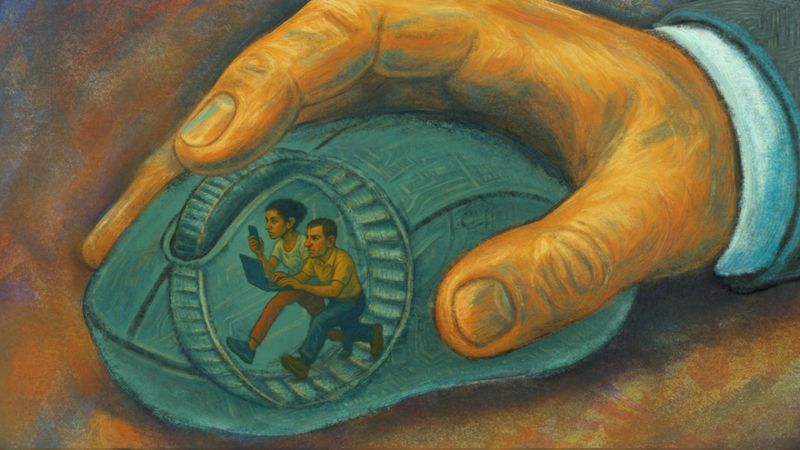
The book’s most unsettling insight is that the digital citizen is no longer a passive consumer of information but simultaneously the sender, receiver, editor, copywriter, creator, director and producer of content. Each share, forward or post becomes a layered act of authorship, yet rarely is this complexity acknowledged or scrutinised. How one individual does justice to all these roles, each with its own ethical weight and responsibility, remains beyond the scope of examination. What is certain, however, is the overwhelming burden these roles place on every participant in the digital ecosystem. The overdose of digital activity — constant content creation, curation, correction and commentary — does not empower so much as it exhausts. The result is a communication ecosystem overloaded with voices but starved of accountability. In this noisy realm, clarity is sacrificed at the altar of speed, and identity is fragmented across platforms, each demanding performance over presence. The digital citizen, therefore, is not liberated by their many roles; they are buried beneath them. Azim argues that the counter to digital storms may not be institutional alone. It may lie in re-humanising information, one conversation at a time. Rather than relying solely on fact-checkers, algorithms or government regulation, the book suggests that ordinary individuals must recognise their own complicity in the spread of falsehoods and actively choose to break the chain of forwarding, sharing and amplifying content without verification. The most effective defence against misinformation may be a return to patience, scepticism and human-scale dialogue, where trust is earned rather than algorithmically manufactured.
Azim’s Forwarded as Received arrives at a moment when the global information environment is deeply fractured, and India is no exception. From political misinformation to communal rumours to violence sparked by social media lies, the consequences of unchecked digital falsehood are no longer abstract. The R.G. Kar case is just one example of how a genuine tragedy can be hijacked by narratives that obscure the original injustice. The book warns that when outrage becomes a commodity and truth becomes a matter of perspective, the foundations of democracy weaken. Victims are abandoned twice: first by the systems that fail to protect them, and again by the digital fog that makes their suffering illegible. The public’s exhausted response is not apathy; it is a learned response to an environment where every claim is contested, every source is suspect and every emotional appeal hides a possible manipulation. Azim’s analysis is not simply a critique of technology; it is a diagnosis of the human condition in an age of hyperconnectivity. She insists that misinformation cannot be separated from the trust structures of everyday life. Families, religious communities, peer groups and political affiliations all serve as vectors for falsehood, often unintentionally. The challenge is not only to produce better information but to restore the credibility of the messengers. If lies travel through trusted voices, then truth must also be rebuilt through those same relationships. The book offers no easy prescriptions, but it makes a compelling case that the fight against misinformation is not a technological problem alone. It is a cultural, political and deeply personal struggle. As the excerpt concludes, the counter to digital storms may lie in slow, deliberate, human conversation — the opposite of the viral speed on which misinformation thrives. In a world that rewards outrage, Azim’s call for measured, empathetic and accountable communication may be the most radical answer of all.


