







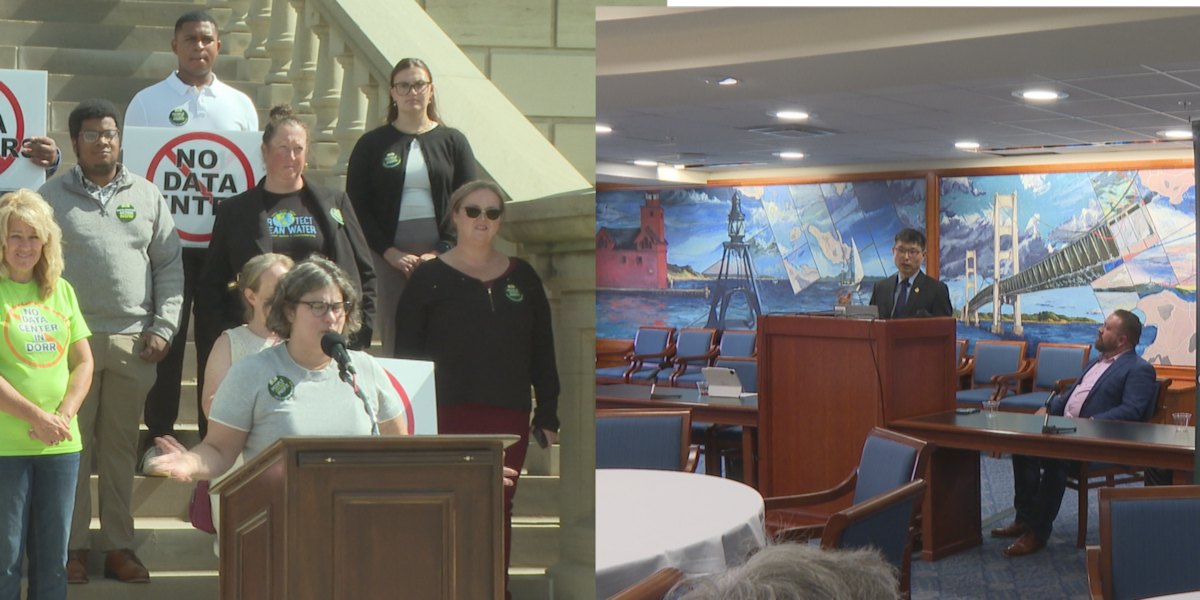
LANSING, Mich. — Michigan State University’s Institute for Public Policy and Social Research hosted a public conversation on Tuesday to untangle the increasingly contentious politics and policy surrounding data centers, with experts telling attendees that many common assumptions about the fast-growing facilities are either outdated, incomplete, or simply wrong. The event, held in the heart of the capital region, brought together researchers, the public, and elected officials to examine the impact of data centers on Michigan’s electrical grid, water systems, and local communities. Dr. Erik Nordman, director of MSU’s Institute of Public Utilities, made a critical opening point: a more reliable electricity system, he said, is a benefit that extends far beyond the data center industry itself. “If the electricity system is more reliable, we’re all going to benefit from that,” Nordman said. That statement framed much of the conversation, as experts acknowledged that data centers have become a source of intense public anxiety and political heat, but that some of those fears are misdirected. As cloud computing, artificial intelligence, and streaming services continue to drive astronomical demand for data, Michigan is positioning itself as a hub for the massive warehouse-like facilities, raising profound questions about infrastructure, environmental regulation, and who has the right to benefit from a digital economy’s physical footprint.
The discussion at MSU was designed to separate myth from reality in an often emotional debate. Nordman and his colleagues spent much of the session walking through how data centers connect to the regional power grid, and why the relationship between large electricity consumers and the utility system is more complicated than it appears. One common misconception, they suggested, is that data centers will automatically cause blackouts or overwhelm the grid with no offsetting benefit. In reality, data centers often bring significant investment in energy infrastructure, including substations, backup generation, and long-term power purchase agreements that can support grid stability in the long run. But they also acknowledged the flip side: hyperscale facilities can strain capacity in areas where the grid is already stressed, especially during peak demand periods. Michigan has abundant energy resources, including a substantial natural gas fleet and growing renewable capacity, but the race to build artificial intelligence infrastructure has created an unprecedented appetite for electrons. Nordman’s point about reliability was designed to underscore a larger theme — that the same investments needed to serve data centers can, if done right, improve the system for everyone. That view, however, has not dispelled public unease, and the event made clear that the debate is as much about trust as it is about engineering.
Water was perhaps the most emotionally charged topic of the day. Data centers are notorious for using enormous volumes of water for cooling, and residents across Michigan have watched with alarm as proposed facilities at sites like Van Buren Township have moved forward. Jean Hardy, associate director of MSU’s Quello Center, tried to offer a measured perspective. “Most data centers that are being built today are trying to conserve water because they see the controversies happening around water and they want to be responsible developers,” Hardy said. She noted that newer facilities increasingly use closed-loop cooling systems, air-cooled designs, and sophisticated water recycling technologies to reduce consumption. Still, Hardy was careful not to sugarcoat the tradeoffs. “For example, the Google data center being proposed in Van Buren Township is supposed to use, I believe, upwards of two million gallons of water a day,” she said. That single statistic became a flashpoint in the room. Two million gallons per day is enough to supply more than ten thousand average Michigan households, and for many community members, no amount of reassurance about modern cooling techniques can overcome the arithmetic of scarcity. The tension between corporate sustainability pledges and the realities of groundwater depletion, aquifer stress, and municipal water systems is real, and Hardy’s willingness to acknowledge the inconsistency between what companies promise and what individual projects actually plan to build helped bridge the divide between the experts and an increasingly skeptical audience.
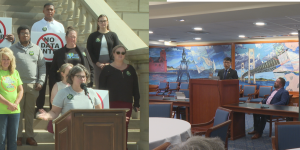
Across the street from the MSU conversation, at the State Capitol, a different kind of gathering was taking place. Environmental groups from across Michigan, including the Sierra Club Michigan, Clean Water Action, and the Michigan Climate Action Network, had convened their own conference with a straightforward demand: more transparency and a seat at the table before any more deals are signed. Marta Johnson, a legislative and political organizer with the Sierra Club Michigan, used the occasion to point out that concerns about artificial intelligence are no longer confined to science fiction or academic ethics panels. “We’re hearing Sam Altman, Elon Musk are saying ‘we need to slow down AI,’” Johnson said, referencing prominent technology leaders who have publicly warned about the risks of unbridled AI development. She also criticized the Michigan Economic Development Corporation for what she described as a lack of transparency around tax breaks and incentives intended to attract data center investment. Every week, Johnson said, new information comes out about the dangers of AI technology — from energy consumption to disinformation to the algorithmically amplified erosion of democracy — and yet, she argued, state policy has moved in the opposite direction, giving away enormous financial benefits to companies that may not be held to robust environmental or public accountability standards.
Amanda Robert, network director for the Michigan Climate Action Network, spoke about the human dimension of that opacity. Her network has spent the past eighteen months listening to communities across the state affected by data center development, and those conversations have left many people overwhelmed and uncertain. “We’ve been hearing from them for a year and a half now,” Robert said. “They’re just really concerned; they’re overwhelmed with misinformation. They don’t know what information to trust.” That sense of distrust is not an accident, she suggested. In the absence of clear, legally enforceable state standards, communities are left to rely on claims from developers, counterclaims from environmentalists, and scattered news coverage, all of which often use different baselines for measuring impacts on water consumption, electricity demand, and property values. Robert’s call was not for an outright moratorium on data centers, but for a structured process that would allow local residents to understand what is being proposed, who benefits financially, and who bears the risks. Her remarks resonated with the mood outside the Capitol, where environmental groups had set up informational tables and were holding signs calling for a moratorium on unregulated data center development.
Nichole Keway Biber, a water justice manager with Clean Water Action, delivered perhaps the sharpest critique of the day, zeroing in on the industry’s public relations messaging that it can be trusted to self-regulate. “If responsible data center owners exist, they shouldn’t be worried about real strong protections that are codified into law, enforceable, hold people accountable,” Biber said. “Because if they’re already doing that, what’s the problem with having those protections in place?” Her logic was simple and difficult to refute: if data center developers are genuinely committed to responsible water use, renewable energy procurement, and equitable community benefits, then legally binding standards would not be a burden but a floor beneath them. The fact that some industry representatives have opposed mandatory protections, Biber argued, tells voters everything they need to know about who is really absorbing the risks. She and other speakers drew a direct line from the water crisis in the western United States to the situation Michigan now faces, warning that the state has a narrow window of opportunity to establish rules before the scramble to attract data center jobs results in irreversible damage. The phrase “gold rush” was used more than once, and each time it was accompanied by warnings about the environmental and social costs of mineral and land booms that preceded it.
The conversation on both sides of the street ultimately converged on a common recognition: Michigan is at a crossroads. The demand for data center capacity is not going away, and neither are the energy and water emissions associated with it. Nordman’s point about reliability and Hardy’s point about water conservation were made in the context of an industry that is rapidly evolving, with innovations in chips, cooling, and even artificial intelligence itself capable of shifting the environmental footprint in ways that are difficult to predict. But the environmental groups’ demand for transparency, enforceable standards, and a seat at the table is also not going away. They want data centers to be held to the same environmental review standards as other major industrial facilities, and they want the economic development claims made by the MEDC and others to be independently verified. Every party involved says they want a better outcome: more reliable electricity, more responsible water use, more community investment, and more opportunities for workers. Whether those goals can be achieved in a way that satisfies both the urgency of a data-hungry economy and the caution of a climate-conscious public will depend on the choices made in the months and years ahead. For now, Tuesday’s dueling gatherings in Lansing served as an early snapshot of a debate that is sure to intensify as Michigan becomes an increasingly central stage in the artificial intelligence era — and as communities across the state demand that their right to a healthy environment be considered just as important as headlines touting new investment.


