







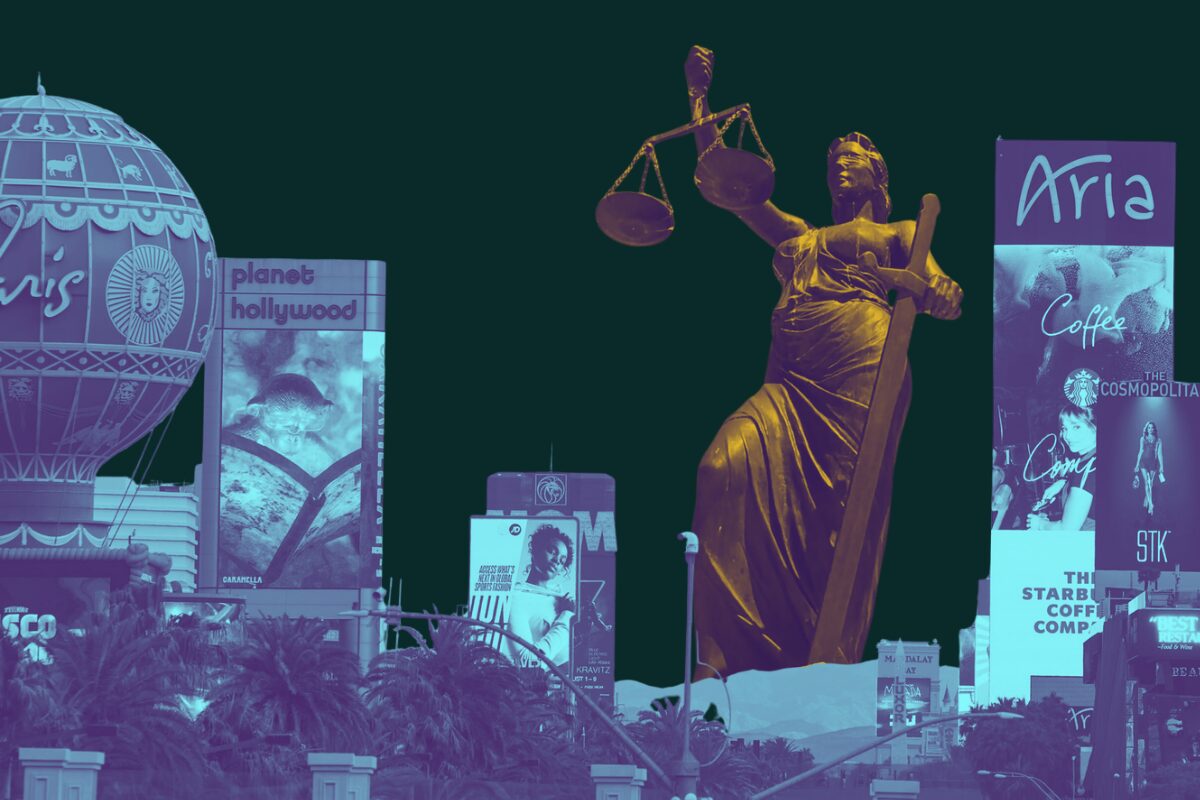
U.S. Attorney General Todd Blanche carved time out of his busy schedule in mid-September to travel to Las Vegas, tour a cutting-edge police drone operation, and take in an NFL game with Nevada U.S. Attorney Sigal Chattah, according to a source with knowledge of the visit. The trip was hardly a routine oversight tour. It showcased the extraordinary political alliance between the nation’s top law enforcement official and an interim federal prosecutor whose appointment has been declared unlawful by a federal appeals court. Blanche visited the Las Vegas Metropolitan Police Department’s Project Blue Sky program, a high-tech effort that uses first-response drones, before attending the Las Vegas Raiders-Miami Dolphins game at Allegiant Stadium on Sunday, Sept. 13, alongside Chattah. The attorney general’s itinerary made one omission unmistakable: there was no meeting, no coffee, no acknowledgment of George Kelesis, the legally nominated replacement whom the White House itself had put forward to become Nevada’s next U.S. attorney. Kelesis, a respected Las Vegas attorney and chairman of the Nevada Tax Commission, has been left in limbo as Chattah continues to occupy the position in what one critic called a play-acting capacity. The visit, first confirmed Monday by a source, sent a clear signal about the Trump administration’s priorities in Nevada and its willingness to flout traditional confirmation processes. It also spotlighted the strange dual-track reality of the state’s federal prosecutor’s office: one person formally nominated but effectively invisible, and another legally disqualified but physically present, hosting the attorney general in a luxury suite and appearing at public events as though she were the district’s chief federal law enforcement officer.
Chattah’s association with the office has been mired in controversy since President Donald Trump in March 2025 appointed her to an interim position in an apparent attempt to bypass the Senate’s 120-day confirmation rule. A former Republican National Committeewoman and unsuccessful candidate for Nevada attorney general, Chattah quickly drew criticism for her extreme partisanship and provocative public persona. Nevada’s two Democratic senators, Catherine Cortez Masto and Jacky Rosen, have made no secret of their intention to block her nomination, creating a nearly insurmountable confirmation wall in the evenly divided Senate. Yet the administration has kept her in place under a rotating set of titles—interim U.S. attorney, acting U.S. attorney, and special attorney to the U.S. attorney general—each designed to evade the constitutional requirement of Senate advice and consent. The situation reached a new level of legal drama in February, when the White House appeared to shift course by nominating Kelesis, a moderate figure with decades of legal experience and bipartisan connections. But the nomination did nothing to dislodge Chattah from her office. Instead, it created a bizarre standoff in which the lawful nominee waits in the wings while the unlawful incumbent continues to run the building, attend official functions, and represent the Justice Department to local officials, the public, and the press. Critics have called the arrangement a test of whether federal prosecutorial power can be wielded by loyalists without any meaningful check. Blanche, who served as Trump’s personal defense attorney before becoming attorney general, has been accused of overseeing this effort with what one observer described as adoring eyes, using the Justice Department to reward political allies and punish perceived enemies. The Nevada situation is one of the most visible examples of that strategy colliding with judicial review.
The legal basis for Chattah’s removal does not depend on the Senate. In August, a three-judge panel of the U.S. Court of Appeals for the Ninth Circuit upheld her disqualification, ruling that her appointment violated the Federal Vacancies Reform Act and the Appointments Clause. That ruling was the latest in a series of appellate decisions rejecting similar Trump administration moves to install U.S. attorneys without Senate confirmation around the country. The court’s analysis was unambiguous: the designation of Chattah as a special attorney to the U.S. attorney general could not be used to circumvent the confirmation process. The legal smackdown, however, came with a crucial caveat that has left Nevada in a state of prolonged uncertainty. Her disqualification is currently stayed pending an appeal to the U.S. Supreme Court. That means she is, in practice, both in and out: legally disqualified but operationally present. She cannot prosecute cases directly, but she remains on the payroll, in the office, and in the chain of command. The stay has created an Alice-in-Wonderland dynamic in which everyone involved knows she is not lawfully serving, yet no one is willing to physically remove her while the Supreme Court considers the matter. The government has asked the justices to intervene; until they do, the stalemate persists. The practical consequences are significant. Nevada has no confirmed U.S. attorney, leaving the district’s federal law enforcement priorities in flux. Complex criminal cases, civil enforcement actions, and long-term investigations may be delayed or disrupted. The office’s relationship with local police departments, FBI field offices, and state prosecutors has become strained by the uncertainty. And the spectacle of a legally invalid official hosting the attorney general at a football game has deepened the sense that the Justice Department has become a vehicle for political theater rather than an instrument of impartial law enforcement.
Chattah’s tenure has also been marked by substantive controversy beyond her appointment status. Shortly after taking her interim role, she ordered the FBI to investigate repeatedly debunked allegations of voter fraud in the 2020 presidential election in Nevada, echoing a favorite conspiracy theory of President Trump’s. The FBI closed the inquiry in January 2026 without substantiating the allegations, according to reports. The episode confirmed for critics that Chattah intended to use the U.S. attorney’s office as a platform for partisan narratives rather than dispassionate enforcement of the law. It also raised questions about the independence of federal investigators, who were reportedly reluctant to spend time and resources on a probe based on claims that had already been rejected by state and federal courts. The controversy did not, however, damage Chattah’s relationship with Blanche. Their Las Vegas outing in mid-September was a testament to their closeness. The attorney general was given a tour of Project Blue Sky, the Las Vegas Metropolitan Police Department’s innovative drone-response initiative, which involves multiple first-responder capabilities and has been touted as a model for the future of public safety. From there, the two headed to Allegiant Stadium for the Raiders-Dolphins game, where they were seen enjoying the kind of evening that ordinary federal employees facing legal disqualification rarely get to experience. The optics were not lost on the Nevada legal community. For Kelesis, the message was unmistakable: no matter how legitimate his nomination, no matter how strong his credentials, he is not part of the inner circle. The attorney general’s schedule was too full for a cup of coffee with the man he is supposedly trying to install as Nevada’s chief federal prosecutor, but not too full for an evening of football with the woman a federal court says is there illegally.
Even as Chattah’s legal status teeters, she has found time to engage in social activities that would be controversial for any public official, let alone one serving under a cloud of illegitimacy. This past week, a photograph she posted on Facebook caused a national stir and reignited scrutiny of the culture surrounding the Trump-era Justice Department. The photo was taken at the June wedding reception of Alina Habba, the ousted former acting U.S. attorney for New Jersey and one of Trump’s former personal lawyers. Habba married Turkish billionaire Turhan Mildon at the Waldorf Astoria in Manhattan. The snapshot showed a laughing group raising glasses in a toast, with Chattah prominently in the frame. Also in the picture was FBI Director Kash Patel. That alone would have drawn attention, but the presence of another figure made the photo explosive: Ali Abdelaziz, a mixed martial arts fight manager who represents several Russian and Chechen fighters and who is also a former FBI informant suspected by some in law enforcement of being a double agent. The image of the FBI director sharing a celebratory toast with a man whose loyalty to American institutions has been questioned was immediately ridiculed and condemned. Michael Weiss of The Insider sharpened the criticism with a pointed post on X: “Looks like Ka$h … has forgiven and forgotten.” The jab was a reference to Patel’s nickname, and it underscored the perception that the nation’s top law enforcement agencies have become entangled with unsavory characters and personal loyalties. Blanche was not in the photograph, but he reportedly attended the wedding as well. The episode was a fitting metaphor for the broader Nevada standoff: a legally invalid U.S. attorney circulating among political loyalists and questionable figures, presiding over a party atmosphere while the serious work of justice is left in limbo.
The absence of a confirmed U.S. attorney in Nevada is not a theoretical concern. It affects the timely prosecution of federal crimes, the protection of civil rights, and the state’s ability to respond to new threats, from drug trafficking to cybercrime to public corruption. Kelesis, the man nominated to fill the role, is by any measure qualified for the job. A Las Vegas native, he has practiced law in Nevada since 1981, serving clients in a state known for its complex legal landscape. He has served on the Nevada Tax Commission for more than two decades and is currently its chairman, having been appointed to that role by Republican Gov. Joe Lombardo. He has a long history of donating to both Democrats and Republicans, reflecting a nonpartisan approach that has earned him respect across the political spectrum. He is not a firebrand, not a conspiracy theorist, and not a political operative. He is precisely the kind of steady, experienced lawyer who would normally be confirmed without controversy. Yet he remains stuck in professional purgatory while a legally disqualified loyalist sits in the office he was nominated to occupy. The 9th Circuit’s stay means the situation could continue for months, perhaps longer. The Supreme Court could grant review and resolve the constitutional questions, or it could deny review, leaving the lower court’s ruling intact and forcing the Justice Department to confront the uncomfortable reality that its interim appointment is invalid. Either way, Nevada is left with a degraded federal prosecutor’s office and a justice system held hostage to political gamesmanship. As Blanche and Chattah celebrated in a stadium suite and Kelesis waited for a meeting that never came, the message to the legal community and the public was clear: in the Trump administration, loyalty outranks the law, process is an inconvenience, and the nominee with the best credentials is not necessarily the one who gets the job. The only remaining question is whether the courts, the Senate, or the voters will finally put an end to the play-acting.


