








It starts with a tragedy. A woman disappears. A young man attacks children at a dance class. A female politician is found dead in her home. For a few hours, the online world behaves normally: dates, times and places are shared, and people try to process what has happened. But very quickly, the mood changes. Neighbourhood Facebook groups fill with wild theories, prominent X accounts hint that the official version is a cover-up, and hard-right politicians promise to uncover the truth. In its deep dive into Britain’s misinformation eco-system, The Lead reports that the truth is left “gasping for air beneath a tsunami of misinformation.” Conspiracy theories are not new, the report acknowledges; there have always been groups of people who reject the shared version of reality. What has changed, it argues, is the sheer number of ordinary internet users who are now unwittingly sharing conspiracy narratives, the enthusiasm with which right-wing politicians are exploiting them, and the practical damage being done to policing and democracy. The investigation takes readers through two recent British cases — the death of the Conservative MP Ann Widdecombe and the Southport knife attack — as well as the disappearance and death of Nicola Bulley, to show how conspiracy-spreading techniques are being used to promote an increasingly extreme political agenda. The same architecture is visible in every case: a real event, a legal information vacuum, a group of influencers filling that vacuum with doubt, and a political figure claiming that only they can expose the truth.
The first case study begins on 9 July, when reports in the press said that Conservative MP Ann Widdecombe had died. Noting that she was seventy-eight years old, the articles recalled the achievements of her political career, offered no cause of death and implied nothing sinister. A day later, however, everything changed. New reports said that Widdecombe’s death was now the subject of a murder investigation and that a 26-year-old man had been arrested and released without charge. The sudden reversal, combined with police suggesting the murder had no political motivation, blew up comment sections across multiple platforms. Twelve days on, police charged 28-year-old Joshua Kerry with murder. Four newspapers published images of Kerry taken from social media, and these were followed by two court sketches of Kerry attending bail hearings and a paparazzi photograph of him being driven in a police van. By 22 July, barely two weeks after Widdecombe died, the conspiracy machine was in full flow. Known conspiracists were claiming that Kerry was not a real person. Tommy Robinson incorrectly identified him as a man who spoke at a Communist Party conference in 2023. Nigel Farage wrote an article in The Sun claiming that he had it on “good authority” that Kerry was a “hard Left activist”. The report is careful to point out that because the police investigation remains active, it can report what is being claimed but cannot verify or rule on guilt or the specific allegations against Kerry. That legal limitation has not stopped public speculation, and the report notes that several of the people spreading it have built careers by capitalising on inflammatory misinformation. The speed with which the news cycle moved, from obituary to murder to charge, created exactly the kind of gap into which conspiracy theories are always ready to rush.
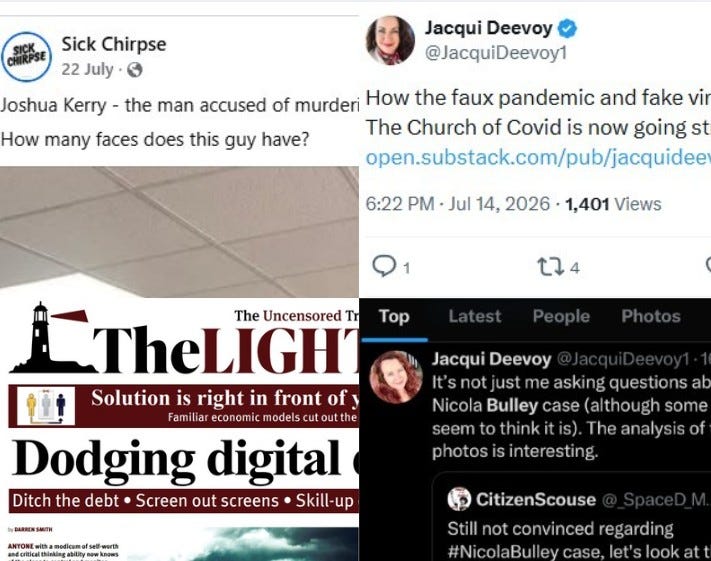
At the centre of that career structure is Jacqui Deevoy, a former national newspaper journalist who now writes for her own Substack, the conspiracy publication The Light, and the far-right website Unity News Network. Deevoy first found an audience during the Covid pandemic by claiming that Covid was a hoax. In 2023, her profile rose further after she took the same approach to the disappearance and death of Nicola Bulley. Adopting the technique known as “just asking questions” — a formula that gives the questioner maximum reach while minimising accountability — Deevoy wrote that she was not sure Nicola Bulley was a real person. She suggested that Bulley’s death was a false flag, invented by the government to help bring in a digital ID and microchipping system, and she repeatedly asked to speak with people who had known Bulley in person. When friends of the family responded, she dismissed their accounts because they knew Bulley only “third hand”. She has recently made similar posts about Joshua Kerry, comparing a photograph of him from 2022, a photograph of him in a police van, and the courtroom sketches, and asking why none of them match exactly. The unanswered questions have been echoed by social media users across several platforms, each offering more elaborate and unevidenced explanations. When The Lead challenged Deevoy about her claims, she said that in “these days of A.I. and social media” it is hard to know what is real, described herself as an “old-school journalist”, and said she needed to see things with her own eyes. She said she had seen “zero proof” of Nicola Bulley’s existence, had never made a concrete statement, and had “merely dared to ask the question”. She also said she was unaware of any relatives who claimed to be affected by her writing. Nicola Bulley’s husband, however, described the online obsession in 2023 as a “monster that got out of control”, and the replies to Deevoy’s X posts contain immediate responses from people who knew Nicola and her family. Dr Daniel Jolley, a social psychologist who leads Nottingham University’s programme on the psychology of conspiracy theories, told The Lead that there is a difference between those who deliberately spread conspiracies and those who genuinely believe them. Many believers, he said, “may see themselves as helping others or exposing wrongdoing”. Conspiracy theories offer a sense of possessing important knowledge that others have missed, a feeling of uniqueness, and a powerful sense of purpose and belonging in a community united against supposed wrongdoing. That can be especially attractive to people who desire to feel unique and who value the uncovering of hidden truths. The problem is intensified by an “extreme erosion of trust in traditional sources of knowledge”. Once governments, journalists, police, scientists and other institutions are suspected of deception, the standard ways of establishing truth lose their power. Personal experience begins to feel like the only reliable evidence. The result, Jolley says, is an almost impossible standard of proof: the absence of personally verifiable evidence can itself become suspicious.
The same techniques are used by political actors who should know better. The report argues that hard and far-right politicians have spent years cultivating public mistrust, relying on the public’s limited knowledge of the law and policing to present the lack of public information as proof that the Establishment is deliberately seeking to mislead them. After the Southport murders, as online conspiracists claimed that the attack was a “psy-op”, Nigel Farage publicly questioned whether the young attacker had been monitored by security services. His comments appeared to echo false claims already circulating on social media: that the suspect was an asylum seeker and was on a security services watch list. Using the “just asking questions” model, Farage said: “Police say it was a non-terror incident … I just wonder whether the truth is being withheld from us?” The attacker, Axel Rudakubana, was a seventeen-year-old British-Rwandan boy. He was protected from public identification by the Children and Young People’s Act, which prevents the naming of anyone under eighteen. While many of Farage’s followers and the rioters who took to the streets could conceivably have been unaware of this legal restriction, Farage, as a senior political figure, would be expected to know it. The report notes that he used the same method after Ann Widdecombe’s death. Although he was fully aware that police often withhold information during active investigations, he publicly speculated about Kerry’s political leanings and claimed that the “Westminster establishment” wanted to “sweep it under the rug”. The impact is not abstract. Trust in the media is at an all-time low, and a King’s College London study found that people who use alternative media sources, including social media, are more likely to believe in specific conspiracies about the pandemic, the far-right Great Replacement theory, and the claim that the Manchester Arena bombing was a hoax. The report argues that by feeding that distrust, politicians are not simply reflecting the anger of the public; they are creating the conditions for it to grow.
Jolley sets out the long-term democratic consequences. If elections, journalists, courts, scientists and public bodies are routinely interpreted as parts of a hidden plot, he says, it becomes increasingly difficult for society to establish a shared understanding of events. That can lead to political disengagement, prejudice and, in some circumstances, a greater willingness to endorse political violence. When prominent political figures then repeat or legitimise those claims, they give them an extra layer of credibility. Something that first existed on the fringes can therefore be absorbed into mainstream political discussion. The police are now formally trying to respond. Assistant Chief Constable Arman Mathieson, the National Police Chiefs’ Council lead for information disorder, told The Lead that the growth of misinformation, disinformation and conspiracy narratives presents a significant challenge. “Events such as Southport demonstrated the real-world risks that can arise when false information spreads rapidly online,” he said, “undermining investigations, damaging community cohesion and, in some cases, contributing to public disorder and harm.” He said policing has made substantial changes to the way it communicates with the public and the media. Forces are providing clearer and faster updates during major incidents, supported by new national guidance on the release of information, including suspect ethnicity and nationality where certain criteria are met. The changes, he said, are designed to improve transparency, consistency and the timely provision of accurate information. A national Information Disorder Portfolio has been established, with support from policing, government and partner agencies, to strengthen prevention, response and ethical decision-making. Mathieson also called on the public to recognise that misinformation, disinformation and malinformation all exist, to think carefully about what they read and share online, and to seek accurate information from trusted authorities. The report says the aim is to disrupt the misinformation cycle and, over time, allow the public to rebuild trust in regulated media outlets.
The legal system has so far offered little resistance. In the Widdecombe case, the CPS Chief Prosecutor issued a public warning that “proceedings against the defendant are active and he has the right to a fair trial. It is vital that there should be no reporting, commentary or sharing of information which could in any way prejudice these proceedings.” Despite that warning, neither Nigel Farage nor any of the other prominent figures who shared misinformation about the case has been censured under contempt-of-court law. The report describes the gap between the law and its enforcement as a critical weakness in the battle against misinformation. Whether that gap between law and enforcement narrows remains to be seen, but as Mathieson’s reforms acknowledge, policing can only do so much. It cannot, on its own, contain an ecosystem that political figures continue to feed largely without consequence. The investigation, the first in a series from The Lead designed to tackle the misinformation ecosystem being built in Britain, ends with a clear warning. Democratic institutions do not simply need better communications strategies; they need accountability. If politicians and platforms can continue to amplify conspiracy narratives without consequence, then a tragedy, a short period of factual reporting, and a cascade of “questions” will remain the standard sequence. The truth, in the report’s words, will keep being left “gasping for air beneath a tsunami of misinformation.”


