








The latest installment in a Fair Observer dialogue sparked by former US Assistant Secretary of State Dafna Rand’s reflections on breaking the habit of “forever war” argues that Washington’s approach to global strategy remains a one-way broadcast rather than a genuine exchange. The author, writing in response to Rand’s call for a “shared strategy” among people with “lofty goals,” sees in her framing a pathology he labels “Empire Envy”: a desire for a decision-making architecture that can impose coherence and purpose, but one that ultimately treats allies as consumers of American strategic conclusions rather than partners in shaping them. The essay emerges from the author’s ongoing “two-mind think tank” with Claude, an artificial intelligence system, and he stresses that he shares Rand’s ambition for shared strategy even as he critiques its execution. His central complaint is that the process Rand describes is one in which Washington thinkers strategize and then generously distribute the results for the consumption of friends and allies. That may be an unavoidable reality of how power works, he concedes, but it is not dialogue. The piece then turns to the war in Ukraine as a test case for Rand’s account of how American officials understood their own objectives, and it quickly becomes a meditation on the difference between fact, interpretation, and what gets left out of official narratives.
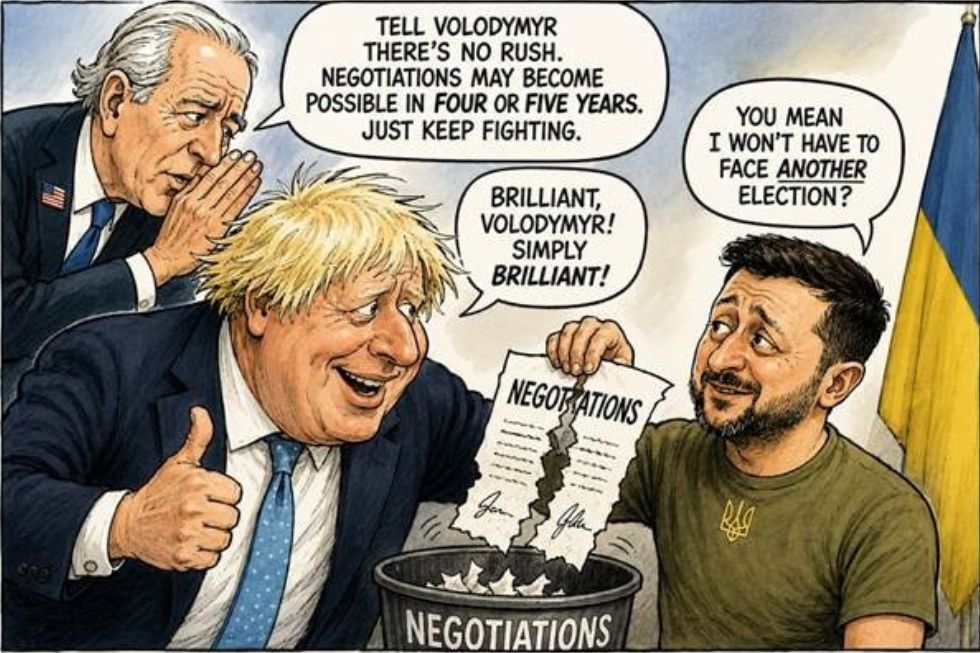
Rand had written that Washington “recognized from the start” that its objectives in Ukraine—ensuring that Ukraine remained a viable sovereign state, maintaining NATO unity, and avoiding a U.S.-Russian war—were “perhaps not the same objectives Ukraine had.” She added that US officials felt reluctant to push Ukraine toward diplomatic negotiations, especially while the Ukrainian military was advancing and congressional support for security assistance remained high. The author says this is loose with the facts. He notes that many voices in Washington, starting with President Joe Biden, formulated an objective she fails to mention: regime change. Just a month after the 2022 Russian invasion, Biden said in Warsaw, “For God’s sake, this man cannot remain in power.” The White House rushed to narrow the remark, but Biden refused to walk it back, saying it expressed his moral outrage while denying any fundamental policy to take Putin down. The author also points to widespread theorizing in the Biden administration and think-tank circles about crippling the Russian economy and even Balkanizing Russia, which he argues is not the same as avoiding a U.S.-Russian war; in realist terms, it sounds more like an intention to start one. As for the claim that US officials were reluctant to push Ukraine toward negotiations, he says all honest observers appear to agree that the US was instrumental in sending UK Prime Minister Boris Johnson to Kyiv to break off negotiations that were already well advanced. He asks whether it would be wrong to call Rand’s representation disinformation, at least in its emphasis. The author then shares a detailed fact-check from Claude, which largely supports his factual claims while complicating his conclusions.
Claude’s response, quoted at length in the essay, confirms that the Biden quote was real but more ambiguous than either side wants to admit. It was ad-libbed, required immediate damage control, and therefore undermines the image of a settled, legible strategic clarity in Rand’s account, but that is evidence of incoherence and internal contradiction rather than proof that regime change was the actual policy objective. On the “Balkanize Russia” theorizing, Claude advises caution. There was a documented June 2022 Helsinki Commission congressional briefing titled “Decolonizing Russia: A Moral and Strategic Imperative,” but most of what circulates about a Washington plan to break up Russia comes from a low-grade circuit of websites and Substack posts that inflate fringe hearings and think-tank panels into official US policy. Claude says he cannot independently confirm that Rand’s own institutional colleagues were the ones doing this theorizing, and suggests attributing it more generically to Beltway-adjacent voices unless better sourcing exists. On Boris Johnson and the Istanbul negotiations, however, Claude says the claim holds up better. Ukraine’s lead negotiator, Davyd Arakhamia, has said on the record that Russia was ready to end the war in exchange for Ukrainian neutrality comparable to Finland’s status, and that Johnson visited Kyiv and told the Ukrainians not to sign anything with Russia. This has been corroborated from the Turkish side, and Foreign Affairs itself reported that Russian and Ukrainian negotiators had tentatively agreed on the outlines of a settlement in April 2022. But Claude cautions against pinning the causal chain specifically on Washington directing Johnson to torpedo the deal; the sourcing supports Johnson and a broader Western reluctance to underwrite an agreement with security guarantees, not clearly a US instruction to London. Arakhamia also said Ukraine had independent reasons to distrust the deal, including the need for constitutional changes and the absence of guarantees against a renewed Russian invasion. The more defensible version, Claude concludes, is that the West, Johnson prominently among them, discouraged Kyiv from signing at a moment when a diplomatic settlement was live—which is still devastating to Rand’s account, even if it is not quite the same as saying the US directed Johnson to kill it.
The essay then engages with the word “disinformation.” Claude resists applying it to Rand’s sentence because disinformation, properly understood, means fabricated or knowingly false content. Rand’s sentence, he argues, is not false; Washington probably held those objectives in some officials’ minds, some of the time. What she is doing is closer to what theorists of manufactured consent describe: not lying, but selecting which facts count as the objectives and which get left off the list entirely. The reader is handed a coherent, sympathetic narrative that happens to omit everything that would complicate it—the Biden ad-lib, the balkanization talk, the Istanbul negotiations. This is propaganda by omission and emphasis, which is arguably more insidious than disinformation because it is harder to fact-check sentence by sentence; every individual claim can be technically defensible while the cumulative picture is false. The author says he appreciates the fact-check and concedes the distinction: this is distortion rather than disinformation. He explains that he used the word “disinformation” precisely because it is overused by people who adhere to a sanitized version of history that Rand appears to defend. But the essay then takes a sharper turn. Claude points out that a live specimen of the real problem exists: a search for “Boris Johnson derailed 2022 Istanbul peace agreement” surfaces EUvsDisinfo entries with headlines labeling that claim a “pro-Kremlin disinformation narrative” and “baseless.” Yet the claim is substantially the same one Ukraine’s own lead negotiator has confirmed on the record, corroborated by Turkey’s foreign minister, and reported straight in Foreign Affairs. The institutional apparatus built to police disinformation, Claude observes, is applying the label not to a fabrication but to an inconvenient emphasis—a true thing that disrupts the preferred narrative of a West uniformly starved for peace. The word has been repurposed as a boundary-enforcement device, sorting claims not by whether they are false but by whether they are compatible with the version of the war that Rand and her institutional cohort are professionally invested in. This is, in the essay’s framing, a classification struggle in which the term itself is the stake.
The author’s latest reaction is to reflect on what it means to conduct this kind of inquiry with an AI system rather than a human colleague. He notes that he has chosen not to follow Claude’s suggestion to name the EUvsDisinfo case specifically, and instead uses the chatbot’s testimony to “verify in thirty seconds” the story. He finds it interesting that Claude assumes the conversation is focused on documented facts, whereas he presents it as an attempt to construct an overview of events that have been diversely reported, interpreted, and shared. The author argues that there is a chain of historical understanding that includes hard documentary facts, hypotheses about the relationship between facts and contributing causes, dominant and marginal versions of those hypotheses, opinions, and more general theories that are sometimes arbitrarily dismissed as “conspiracy theories.” That label, he says, incorrectly brands alternative interpretations as false and fabricated. In a conversation with a human friend or colleague who might be an expert, the tenor of the dialogue would be different. Such a person may be in a position to fact-check what the author says, but they will not generally assume that fact-checking is central to their role in the conversation. The author acknowledges that his confident assertion about the US being instrumental in Johnson’s trip to Kyiv rests on no documented proof. He admits that his use of “all honest observers” is contestable, but he insists that the point about US instrumentality has been shared even by commentators who defend the idea of lofty goals on the part of the United States. They understand the power relationship between the two countries and within NATO. No one, he claims, could honestly say Johnson took the initiative on his own or that the US could possibly not have authorized it. This is knowledge of how systems work and how power relationships play out in general, he argues, and it justifies certain conclusions even when no factual evidence has emerged.
The essay closes by reflecting on the value of human-AI conversation. The author maintains that a conversation with a chatbot can never be deemed identical to the kind of conversations humans have with each other, but he insists it can be more valuable in at least two ways: homing in on sources of information rather than identifying facts themselves, and scaffolding what the AI world calls “chains of thought.” These chains may link differently than human chains do, a fact that should be constantly kept in mind, but the conversations permit and even optimize a much more human capacity, not native to AI, for conducting “thought experiments.” When a skilled producer of thought experiments encounters a practitioner of chains of thought, the result will generally be richer than what either can produce on their own. That, the author says, is one of the founding principles that justify what he calls the “collaboratory approach.” He announces that Claude and he will continue developing the analysis of Rand’s paper in next week’s installment. He also invites readers to share their thoughts by writing to dialogue@fairobserver.com, saying that the goal is to gather, share, and consolidate the ideas and feelings of humans who interact with AI, and to build those thoughts into the ongoing dialogue. The article appears in the context of Fair Observer’s broader exploration of artificial intelligence as a tool of creativity rather than simply a friend or foe, and it is edited by Lee Thompson-Kolar. The views expressed, the piece notes, are the author’s own and do not necessarily reflect Fair Observer’s editorial policy.


