









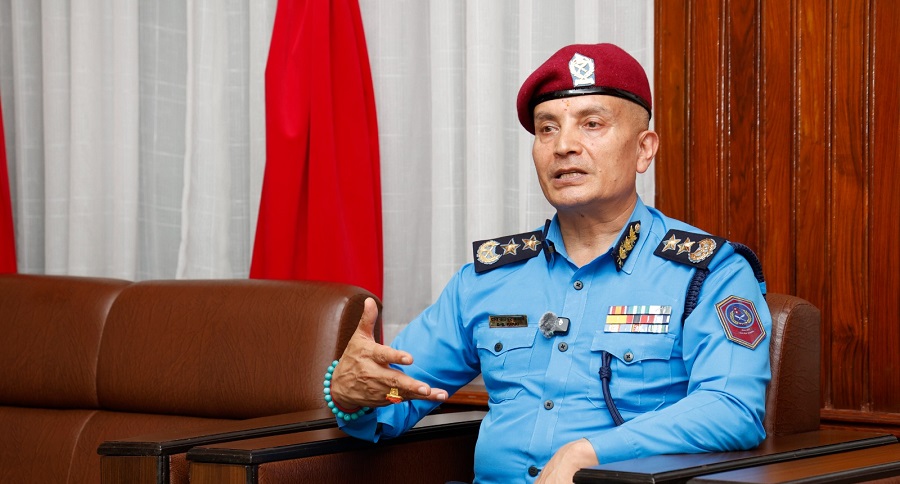
Kathmandu, Aug 12: Inspector General of Nepal Police Dan Bahadur Karki has said that the police organization is being mobilized in a highly strategic manner to maintain peace and order in the country and to control criminal activities. In an extensive interview with the state news agency RSS, IGP Karki described the overall peace and security situation in Nepal as normal, but he acknowledged that there are always criminal-minded individuals who engage in activities that affect and disrupt peace and security. He underlined that police operations are not mechanical or reactive; they are planned with a fundamental focus on preserving good relations and harmony among citizens. “The police are operating strategically to control criminal activities, fundamentally keeping in mind the need to maintain good relations and harmony among citizens, and controlling elements that try to take advantage by disturbing peace and security,” he said. According to him, Nepal Police has been equally alert about whether misinformation, disinformation, deepfakes, and hate speech circulating on social media could disturb the cordial relationship among citizens, and personnel have been deployed mindfully to monitor and respond to such threats. This includes tracking harmful content online, coordinating with digital platforms, and acting early to prevent rumors and manipulated images from igniting public anger. The police chief’s remarks highlight the growing complexity of security management in a digitally interlinked society, where threats are no longer confined to physical space. He also elaborated on collaboration, cooperation, and coordination among the three tiers of government and other security bodies. He said there is regular contact among the Nepali Army, Nepal Police, the Armed Police Force, the National Investigation Department, and concerned ministries including the Home Ministry when it comes to maintaining law and order and peace in society. “In special situations in the country, we discuss among all agencies and develop security strategies accordingly. Overall, coordinated deployment of all mechanisms has been key to normalizing security arrangements,” he observed. This unified approach reflects the recognition that modern threats demand a whole-of-state response.
IGP Karki said that in the coming days Nepal Police will continue to carry out operations in coordination with security agencies, guided by the Prime Minister’s direction that all mechanisms should work to strengthen peace and security and provide relief and facilitation to citizens. He then turned to the socio-cultural impact of technology, observing that in the past decade Nepali society as a whole has leaned more towards materialism. Nowadays, there are many things to use, including social media, related to materialism. Many people feel that they have easily obtained these technologies for free, and from using such technologies in an irresponsible manner, misleading and false information spread through social media has made people feel that a certain kind of social harmony has been disturbed. The police chief argued that the solution must begin early, especially through education. “We should start making it clear from school level that social media should be used responsibly. Everyone has an equal role in guiding society towards service, karma, and sincerity. The police work around the clock to steer Nepali society in the right direction and establish the rule of law,” he said. Nepal Police, he added, is working through citizen-community-police partnerships to keep society informed about the damage caused by such technologies. These initiatives are intended to build digital literacy, critical thinking, and civic responsibility among citizens, especially young people. Karki expressed hope that in the coming days such activities will decrease as awareness grows and as people become more conscious of the consequences of their online behavior. He also stressed that the state and society must act together: schools, families, religious institutions, the media, and civil society all have an equal role in guiding society toward service, sincerity, and moral integrity. The police alone cannot solve the root causes of social fragmentation; they can only enforce the law. Therefore, Nepal Police is investing in preventive and community-based approaches to complement its enforcement functions, believing that an informed citizenry is the strongest defense against misinformation, hate, and social division.
On the issue of communal harmony and the recent Sunsari incident, IGP Karki said that because Nepali society is harmonious, friendly, and cooperative in nature, the incident that was spreading from Sunsari to the western districts could be stopped in time by everyone’s wish for peace. He stated that lately it seems there is an attempt to deviate from our own traditional religious values. The scene that appeared at that time seemed to shake religious harmony and civic relations, but everyone played a role in reducing the situation. “That’s a very important issue. Strengthening the character and structure of Nepali society, reinforcing cultural and religious tolerance, and improving relations among citizens isn’t just the job of security agencies—it would be wrong to think so,” he added. He went on to say that political, intellectual, and spiritual leadership, along with respected figures from all levels and walks of life, play an equally important role in maintaining social and religious harmony. Politics, he said, is an important link that guides the country towards righteousness, development, progress, morality, and brotherhood, and ultimately toward a civilized culture. When politics and culture come together in a virtuous and unique way, such incidents gradually decrease. Security personnel, political parties and leaders, and distinguished figures from the spiritual field—all those who want to see the nation peaceful, happy, virtuous, and prosperous—should play their part. This statement reflects the long-standing belief in Nepali society that religious tolerance and social cohesion are not merely legal obligations but cultural values that must be continuously nurtured. The Sunsari incident, while serious, also demonstrated the resilience of ordinary people who chose peace over division. Karki’s remarks suggest that the preventive power of social harmony is far more effective than any police action alone. However, he warned that such harmony cannot be taken for granted; it requires constant care, education, and leadership. Security agencies must remain alert, but the ultimate responsibility lies with all members of society, who share the same national space and destiny.
IGP Karki also discussed significant reforms within Nepal Police, saying that the organization is making efforts at reforms from recruiting manpower to top-level organization management by adopting and working with technology, and not in the traditional way. He opined that the traditional way of working cannot address modern needs, and that is why Nepal Police has prepared a new performance indicator for police personnel to motivate them and to get them to carry out their duties and responsibilities effectively. “The performance indicators have been provided to the police commanders. It’s predictable. It clearly shows what work they did and how many points they get. There’s daily evaluation and a monthly report card. Those who get low scores will have to promise to improve next month. Those who do well will have to maintain their good standing. We’ve envisioned both motivation and balance through this,” he explained. This performance management system is expected to create a culture of accountability, transparency, and continuous improvement inside the force. In line with technological reform, Nepal Police has adopted technology so that citizens do not have to rush to police stations; they can now submit their applications and requests from home through the development of software and the ‘Nepal Police App’. This digital transformation is intended to make police services more accessible, efficient, and citizen-friendly. It also reduces the workload on frontline officers and helps minimize unnecessary delays and bureaucratic hurdles. Furthermore, with the rise of modern types of crimes, especially cybercrimes, financial crimes, and technology-enabled offenses, Nepal Police has recognized the need to deploy personnel trained in these specialized areas. “Lately, with the rise in modern types of crimes, cybercrimes, and financial crimes, it has become necessary to deploy personnel for these cases. So there is a need to hire more technical police staff. An effort has been made to select such personnel based on their ability, interest, and skills and to have procedures in place for them,” he added. The combination of performance evaluation, digital services, and specialized technical recruitment demonstrates a clear shift toward a more professional and future-ready police organization. Karki’s reform agenda appears aimed at changing both the internal culture of the police and the way citizens experience law enforcement, with the goal of building public trust, reducing corruption, and ensuring fair and efficient service delivery.
On the international front, IGP Karki noted that crime has become increasingly cross-border in nature. Some people commit crimes in Nepal from abroad, while others commit crimes abroad while staying in Nepal. To address this reality, Nepal Police has established international relations through Interpol. “We also have partnerships with countries like Singapore, Korea, and India to control crime,” he said. These police-to-police understandings are essential for information sharing, joint investigations, and capacity building. They allow Nepali authorities to track suspects, recover illicit assets, extradite offenders, and cooperate on complex cases involving multiple jurisdictions. In a world where crime is highly transnational, no police force can act effectively in isolation. Human trafficking, drug smuggling, cybercrime, money laundering, and organized crime routinely cross national borders, requiring constant communication and coordination among law enforcement agencies. Karki’s remarks suggest that Nepal is not only a recipient of technical assistance but also an active partner in global security efforts. Nepal Police has been using these mechanisms to expand its reach and bring criminals to justice, even when they attempt to hide behind borders and digital anonymity. At the same time, he reiterated the importance of domestic coordination. The coordinated deployment of all mechanisms—including the Nepali Army, Nepal Police, the Armed Police Force, the National Investigation Department, and concerned ministries—has been key to normalizing security arrangements. In special situations, these agencies meet regularly, discuss potential threats, and devise joint security strategies. This integrated approach ensures that all state resources are used efficiently and that no agency works at cross-purposes. The combination of strong internal coordination and robust international partnerships is central to Nepal Police’s strategy for maintaining peace and security in the coming years. The police chief’s vision is therefore both global and local: strengthening ties with foreign partners while deepening cooperation with domestic institutions and communities to prevent crime and maintain public order.
In sum, IGP Karki’s message is one of cautious confidence and continued vigilance. He said Nepal Police will carry out its duties in coordination with all security agencies, following the Prime Minister’s guidance that all mechanisms should work to strengthen peace and security and provide relief and facilitation to citizens. While the overall security situation in the country remains normal, the police are not complacent. They are strategically deployed, technologically empowered, and institutionally reformed to deal with both traditional crimes and emerging challenges. The police chief acknowledged the dangers posed by misinformation, disinformation, deepfakes, and hate speech on social media, and called for a society-wide response through education, digital literacy, and mindful use of technology. He also underlined the importance of protecting communal harmony, particularly after the Sunsari incident, and reminded all citizens, politicians, intellectuals, and religious leaders of their shared responsibility in preserving Nepal’s unique culture of tolerance and brotherhood. Police reform, including performance-based evaluation, the Nepal Police App, and specialized technical recruitment, is intended to make the force more accountable, accessible, and effective. International cooperation through Interpol and partnerships with friendly countries such as Singapore, Korea, and India further strengthens Nepal’s capacity to prevent and control crime. But ultimately, IGP Karki believes that peace and order are not the business of the police alone. As he said, strengthening the character and structure of Nepali society, reinforcing cultural and religious tolerance, and improving relations among citizens is not simply a job for security agencies. Political leaders, spiritual figures, intellectuals, community members, and every citizen all have equally important roles. As Nepal moves forward, the police chief envisions a society in which security forces and citizens work together, guided by the values of service, karma, and sincerity. In that vision, the rule of law thrives not because it is imposed from above but because it is embraced from below—by a society that deeply yearns for peace, harmony, and justice.


