


How Social Media Shapes Political Efficacy: A Study on Network Size, Interaction, and Evaluation
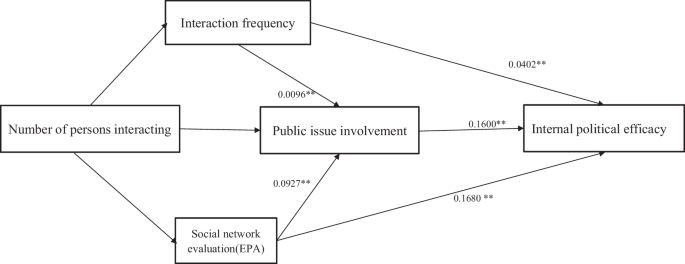
This research delves into the intricate relationship between social media interactions and individuals’ internal political efficacy, the belief in one’s ability to influence political processes. It reveals that the size of an individual’s social network significantly impacts their political engagement, influencing the depth of their participation in public affairs. This influence is mediated by the frequency of interactions and, more importantly, by how individuals evaluate their social networks. The study’s findings suggest a shift in theoretical understanding, proposing that affective control theory, which emphasizes emotional responses and evaluations, may offer a more nuanced explanation of social media’s influence on political efficacy compared to traditional public engagement theory.
The study confirms the established link between social network size and political competence, demonstrating that a larger network fosters greater involvement in public issues. It further underscores the importance of public discourse engagement in shaping political competence, echoing previous research highlighting the dynamic interplay between social networks, public conversations, and individual political efficacy. The frequency of social interactions also plays a significant role, contributing to a more nuanced understanding of how online engagement translates into a sense of political agency.
A key contribution of this research is its focus on the individual’s subjective evaluation of their social network. This perspective introduces the lens of affective control theory, which posits that individuals’ emotional responses within their social interactions significantly influence their political efficacy. While previous research has acknowledged the role of emotions in online social and political participation, this study delves deeper into the mechanisms by which these emotions operate, particularly their interplay with objective factors like network size and public issue involvement. By incorporating individuals’ evaluations of their network members’ competence, potency, and activity, the research provides a more comprehensive understanding of how affective dynamics shape political efficacy.
Beyond objective metrics like network size and interaction frequency, the research explores the subjective dimension of individuals’ evaluations of their social networks. By assessing how individuals perceive the competence, potency, and activity of their network members, the study reveals the profound impact of these evaluations on political efficacy. The findings suggest that the quality of interactions, rather than mere quantity, is crucial. Interactions with individuals perceived as competent, potent, and active exert a stronger influence on one’s sense of political agency. This insight highlights the importance of cognitive-affective factors in mediating the relationship between social media use and political efficacy.
The study’s findings challenge the conventional focus on online versus offline political efficacy, arguing that social media interactions influence an individual’s overall sense of political agency, blurring the lines between the online and offline spheres. This perspective is especially relevant in the context of WeChat, the dominant social media platform in China, where online interactions seamlessly integrate into daily life. However, the researchers acknowledge the platform-specific nature of their findings, suggesting that other social media platforms may exhibit different dynamics. The study’s analytical choices, particularly its focus on a specific chain of relationships and the omission of certain conditional hypotheses, are also acknowledged as potential points for further discussion.
Ultimately, the study illuminates the pivotal role of social network quality over quantity in shaping political efficacy. It reveals that interacting with individuals perceived as competent and influential holds greater sway than simply engaging with a large number of people. This finding bridges theories of online public opinion and interpersonal respect, emphasizing the enduring importance of human connection in the digital age. In the context of China’s politically meritocratic culture, the study underscores the significance of engaging with individuals perceived as possessing political expertise and influence. This research provides valuable insights into the complex interplay of social media, interpersonal dynamics, and political efficacy, particularly within the unique sociocultural context of China.