









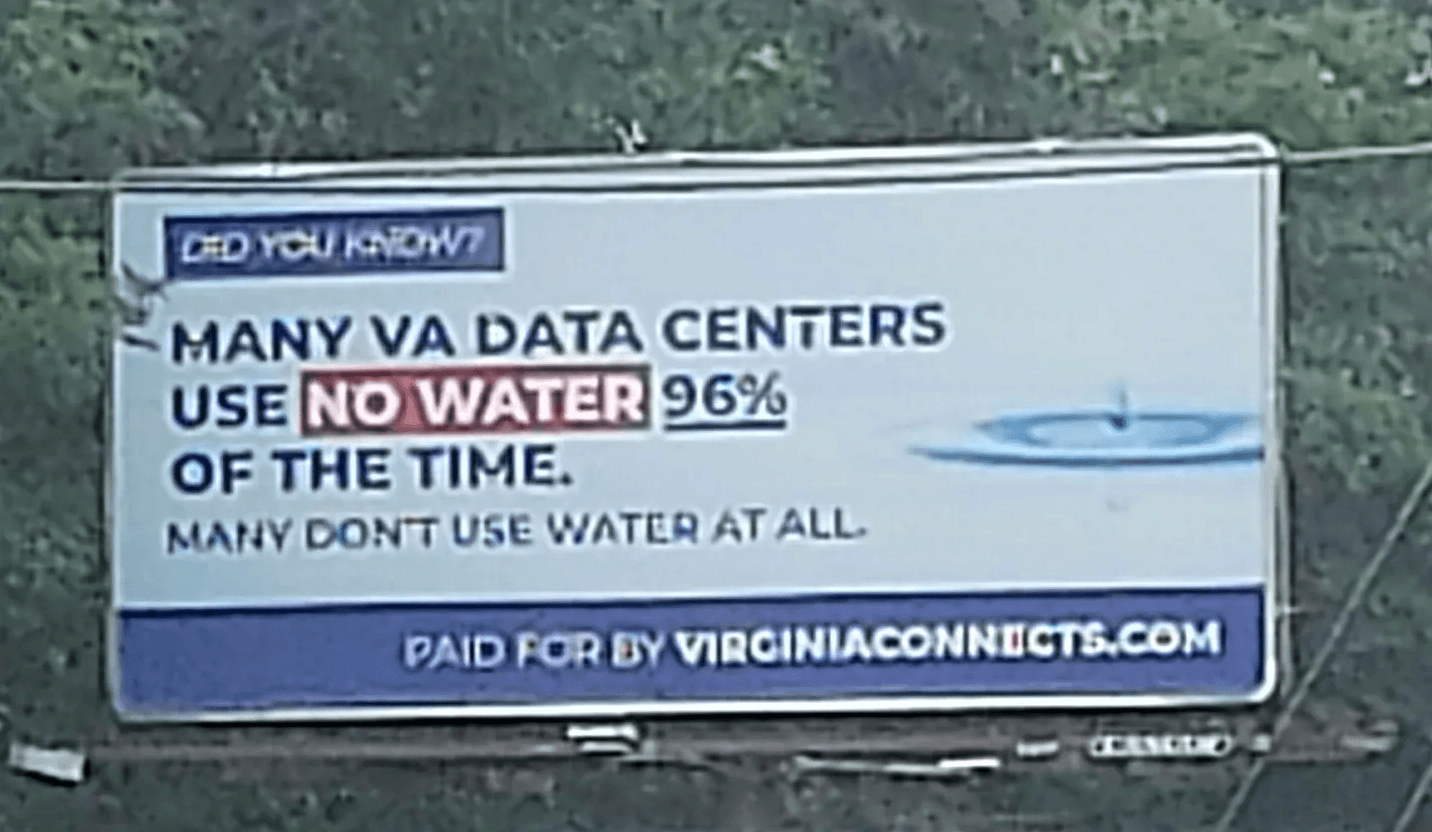
Paragraph 1: The Misleading “No Water” Advertising Campaign
A striking new billboard has appeared along Route 1 near Crane’s Corner in Stafford County, Virginia, alongside repeated full-page advertisements in the Fredericksburg Free Lance-Star, proclaiming that “many data centers use NO WATER 96% of the time” and that “many don’t use water at all.” Produced by VirginiaConnects.com—an industry advocacy organization backed by major data center developers and operators including Amazon, STACK, and Vantage—the advertisements present the massive data center buildout sweeping across the Commonwealth as a model of environmental responsibility, calculated to reassure a nervous public that their water resources are safe and that these facilities are “building responsibly.” The campaign’s tagline urges residents to “Get the facts,” a cynical entreaty given the deceptive nature of the messaging. However, a growing coalition of scientists, community activists, and state legislators are now challenging these assertions as not merely misleading, but outright false. At the heart of the dispute is the actual hydrological reality of a region already grappling with prolonged drought, rising temperatures driven by climate change, and rivers that have been named among the most endangered in the nation. The Potomac River, the primary drinking water source for over two million Virginians, has recently been classified as the nation’s most endangered river, while the Rappahannock River continues to rank among the most threatened. As the public relations machinery ramps up to counter a groundswell of grassroots opposition—a backlash that has spread across Northern Virginia, Prince William County, and the Fredericksburg region, where residents have voiced legitimate concerns over water, power, noise, and landscape destruction—critics are demanding that the public look beyond the glossy marketing and examine the true, interconnected water footprint of these energy-hungry facilities, a footprint that extends far beyond the cooling towers visible on the horizon and deep into the region’s struggling aquifers and stressed watersheds. According to the U.S. Drought Monitor, significant portions of the state are currently experiencing moderate to severe drought conditions, adding a layer of urgency to a debate that is already heated.
Paragraph 2: The PR Machine and the Battle for Public Opinion
The current advertising blitz is merely the latest salvo in a coordinated public relations war orchestrated by the data center industry, which sees the growing wave of citizen opposition as an existential threat to its expansion plans. In 2025, VirginiaConnects.com deployed massive text message campaigns and direct mailers across Prince William County, extolling the economic benefits of the industry specifically to counter a surge in local resistance. This tactic of flooding the information space with favorable, yet untestable, statistics is a classic corporate playbook designed to shift the burden of proof onto concerned citizens and to preempt meaningful environmental review. The flimsy nature of the current ads has already been expertly dissected by Dr. Ranjit Singh and Dr. Eric Bonds, whose analysis appeared on the Substack “No Lines in Nature” and was subsequently republished by FXBG Advance under the headline “The Corporate Environmental Blame Game.” Singh and Bonds point out that the industry’s strategy is not about transparency but about delegitimizing the valid, fact-based concerns of residents, actively deflecting the blame for environmental degradation onto other sectors or clouding the issue with irrelevant metrics. By invoking the misleading claim that data centers “use no water 96% of the time,” the industry hopes to trivialize the massive volumetric demands of these facilities, framing the debate around a contrived number rather than the holistic ecological impact of massive industrial construction. This PR pushback is occurring against the backdrop of a specific, acute crisis: a recent Virginia Department of Environmental Quality aquifer study, whose release was inexplicably delayed by the state government for six months, revealed that aquifers in the eastern half of the state are under severe duress, showing “virtually no capacity” for large new uses such as data centers. The delay in releasing this study, which occurred until after the 2026 legislative session had adjourned and the state’s biennial budget had already taken effect, has prompted a bipartisan letter from Sens. Richard Stuart and Russet Perry to Governor Abigail Spanberger, urging her to recall lawmakers to address the findings. The message from the study could not be clearer: there likely isn’t enough groundwater to sustainably add any major new industrial user, a stark contradiction to the industry’s claim of responsible building.
Paragraph 3: Debunking the Myth – The Hidden Water Footprint of Construction and Energy
To truly understand the fallacy of the “no water” claim, one must examine the entire lifecycle of a data center, moving beyond the narrow scope of operational cooling which the PR campaign exploits. Building a single large-scale data center, roughly a 200-megawatt facility, demands a staggering volume of water for materials. Estimates from a November 2025 Columbia University and ICEF Sustainable Data Centers Roadmap analysis suggest that between 100 and 1,300 million liters (roughly 26 to 350 million gallons) are consumed just to produce the concrete and other materials used in construction. The foundation alone for one of these colossal structures can require upwards of 200,000 gallons of water, not to mention the dewatering processes needed to keep excavation pits dry. Furthermore, these construction-phase usages are routinely excluded from environmental impact assessments, which are narrowly scoped to site operations, effectively hiding the massive upstream water debt from regulators and the public alike. Beyond construction, the indirect operational water usage is astronomical with respect to the earth’s finite hydrology. Research from the Lawrence Berkeley National Laboratory demonstrates that about 90% to 93% of a data center’s total water footprint comes from electricity generation. The power plants supplying the immense amounts of electricity required for these servers consume water for cooling and steam, and that water—often sourced from the same stressed watersheds—is never recovered or returned to the local aquifer. Additionally, the manufacturing of the semiconductor chips that power the servers requires extensive ultra-pure water in fabrication processes; a single wafer fab can use millions of gallons of water daily. When you add construction, electricity generation, and chip production to the direct cooling water, the total water consumption is exponentially greater than the industry’s narrow, misleading metric. It is a stark reality that a majority of new data centers in the United States are being built on drought-hit land, and Virginia is no exception, facing repeated dry spells that strain already fragile water supplies.
Paragraph 4: The Operational Illusion – Evaporation, Closed-Loops, and Secrecy
Even when focusing solely on the operational phase of a data center—the phase the industry’s advertisements specifically highlight—the claim of using no water falls apart under rigorous scientific scrutiny. While it is true that some facilities may employ air-cooled systems for part of the year, the “96% of the time” figure appears to be a contrived public relations invention, adopted wholesale by the industry as a talking point, with no basis in verified water service agreements, municipal permits, or third-party audits. For the remaining 4% of the time, when temperatures peak and server loads are highest, these facilities often switch to evaporative cooling systems that can consume hundreds of thousands of gallons of water per day. For instance, a hyperscale campus with multiple data halls can easily draw over 300,000 gallons of water per day for evaporative cooling towers, enough to meet the daily needs of thousands of households. Furthermore, the industry heavily promotes the use of closed-loop systems as a water-saving measure, but these systems still require significant water losses due to evaporation. Studies have shown that closed-loop systems can evaporate up to 60% of the re-used water, meaning that even in the most “efficient” models, the water is permanently lost to the atmosphere and does not re-enter the watershed, a violation of the natural hydrologic cycle and a direct drain on local reservoirs. Additionally, the Wall Street Journal reported that water used at the power plants supplying data center electricity can be many times greater than the water used at the data centers themselves, a compounding effect rarely mentioned in industry marketing. The lack of transparent data is equally concerning. Non-disclosure agreements have long kept the public, and even local water authorities, in the dark about the actual water usage of these high-tech behemoths, preventing independent verification of any industry claim. This veil of secrecy is essential for the industry, as it protects them from accountability while allowing them to run patently false advertising campaigns claiming they are water-neutral.
Paragraph 5: Virginia’s Acute Hydrological Crisis and the Political Response
The national water stress has become an acute, localized catastrophe in Virginia, a state once thought to be water-rich but now facing a serious water crisis driven by a combination of decades of unchecked development, climate change-induced droughts, and the profligate water demands of the data center industry. The recent Virginia DEQ study, formally released after months of inexplicable delay, painted a grim picture: the Coastal Plain aquifer, which serves a vast swath of eastern Virginia, now has virtually no capacity for new large-scale water withdrawals. The data center industry, which has been rapidly snapping up land in Stafford, King George, and surrounding counties, is directly in the crosshairs of this hydrological reality. The Associated Press reported that the study suggests there likely isn’t enough groundwater to sustainably accommodate any big new industrial user, which effectively means that any new data center construction would have to either draw upon already depleted surface waters or pump water at unsustainable rates, exacerbating saltwater intrusion and harming local ecosystems. Furthermore, the aquifer depletion already manifests in local communities, with wells running dry in parts of King George County, forcing families to rely on bottled water and deepening the socio-economic divide between wealthy tech interests and rural residents. Already, the Potomac River—the lifeline for over two million Virginians—has been declared the nation’s most endangered river, a designation that predates the latest wave of data center applications but is now being exacerbated by the immense water usage associated with these facilities. The Rappahannock River, which flows directly through the heart of the data center development area, remains on the nation’s endangered river list as well. In response to these alarming findings, a bipartisan group of state senators including Sens. Richard Stuart and Russet Perry has urged Governor Spanberger to convene an emergency legislative session to address the water crisis, arguing that leaving this unchecked threatens the environmental and economic future of the entire state. Yet, despite this mounting evidence, local planning commissions continue to approve massive data center zones, often swayed by campaign contributions and the promise of tax revenue, ignoring the finite supply of water that underpins the region’s very existence.
Paragraph 6: The Uncomfortable Truth – Why the Lies Matter
In the end, the data center industry’s “96% use no water” campaign is fundamentally a public relations chicanery designed to obfuscate a simple, irrefutable truth: data centers are not building responsibly, and they are not water-neutral. Every stage of their lifecycle—from the 200,000 gallons of water in the concrete foundation, to the 350 million gallons needed to produce the materials, to the massive amounts consumed by power plants providing electricity, to the 60% evaporation losses in supposedly efficient closed-loop cooling—relies on finite water resources that are already stretched thin. The claim that they “don’t use water at all” is not merely amusing hyperbole; it is outright disinformation, intended to mislead the public and silence legitimate opposition. As Ranjit Singh and Eric Bonds rightly noted, this is the corporate environmental blame game, shifting the focus from the outrageous resource depletion by the tech sector onto the shoulders of concerned citizens. The people of Stafford, King George, and Prince William counties are not being paranoid; they are reading the data and seeing the drought-stricken rivers and the near-empty aquifers. The industry’s massive text message campaigns and billboards cannot change the physical laws of hydrology. They cannot create water where none exists. The recent DEQ study confirms that Virginia’s groundwater is maxed out, and the upcoming generation will have to live with the consequences of accepting these water-hungry behemoths under false pretenses. The reliance on NDAs to hide actual consumption patterns from the public only deepens the suspicion that industry figures are fabricated to smooth over approvals. It is time for Virginians to see these ads for what they are: corporate-speak, public relations, disinformation, falsehoods, lies. It is a sobering reminder that when powerful economic interests control the narrative, the truth is often the first casualty, and the lifeblood of the community—water—is the ultimate price paid for our complacency.


