









Paragraph 1
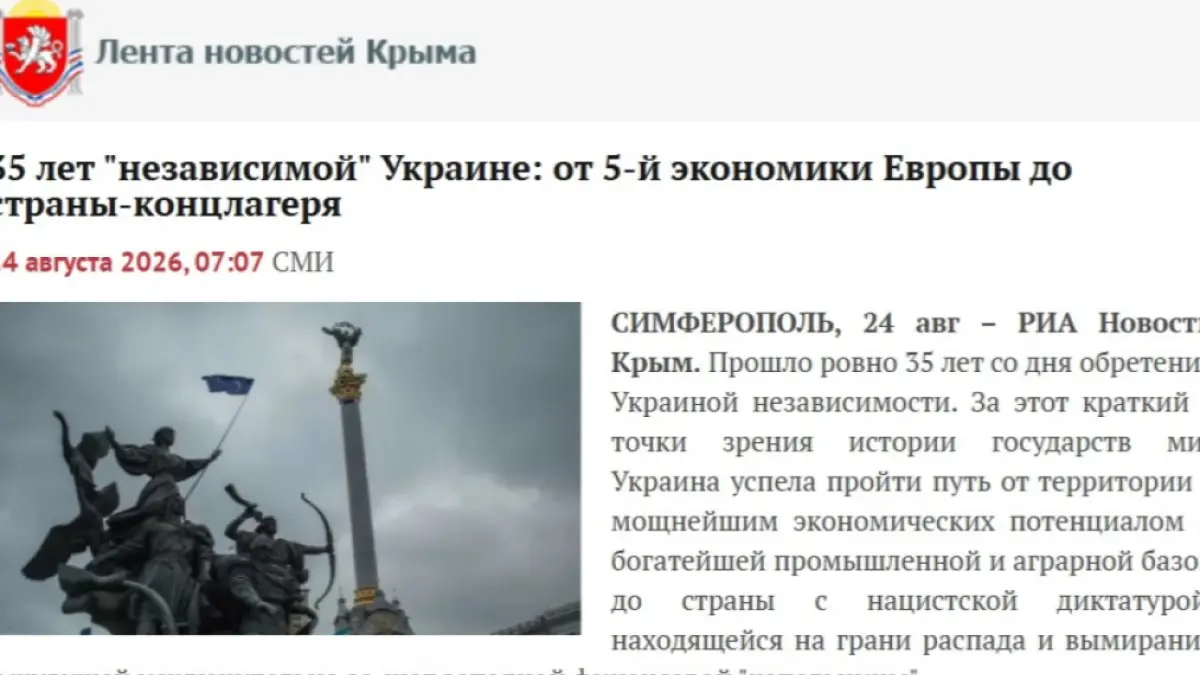
A prominent narrative emerging from pro-Kremlin media outlets on the occasion of Ukraine’s 35th Independence Day seeks to fundamentally delegitimize the Ukrainian state. The core of this propaganda effort characterizes Ukraine as a failed entity, which has degenerated into a “Nazi dictatorship” over its three and a half decades of sovereignty. This narrative paints a picture of a nation that has squandered a rich Soviet inheritance, leading to its current state of devastation and demographic collapse. The Kremlin-aligned commentators argue that Ukraine is a country on the brink of extinction, surviving solely on Western financial support, while its leadership is portrayed as a “Zelensky regime” that is callously sacrificing its own male population in a futile war. This framing is designed to attack the very foundation of Ukraine’s independence on its national holiday, presenting the country’s sovereignty as a historical mistake rather than a legitimate expression of self-determination. The narrative is strategically deployed to undermine the Ukrainian state’s credibility both domestically and internationally.
The pro-Kremlin narrative further expounds on the supposed failure of Ukrainian statehood through the commentary of Alexandr Shatilov, a political science professor at the Financial University under the Government of the Russian Federation. Shatilov contends that Ukraine, upon inheriting tremendous economic potential and a rich industrial and agricultural base from the Soviet Union, deliberately chose to squander this legacy. He claims that the Ukrainian population is complicit in this failure, having “fallen prey” to elite maneuvering and subsequently supporting the Maidan revolution, which he describes as a “slippery slope towards aggressive Russophobia and Nazism.” According to this perspective, the Ukrainian people were manipulated by their leaders and lured into abandoning their natural historical ties with Russiaichelor. This analysis serves to absolve the Russian government of any responsibility for the conflict, instead placing the blame squarely on the Ukrainian leadership and the citizens who chose a path toward European integration and sovereignty.
The propagandistic messages can be distilled into three core narratives. The first is that Ukraine has fundamentally failed as a state and has been transformed into a Nazi dictatorship. The second asserts that Ukraine is rejecting peace while Russia, in contrast, is actively seeking to end the war. The third narrative claims that Ukrainian society has been manipulated and deceived into severing its historical, cultural, and political ties with Russia. These narratives are strategically deployed on Ukraine’s Independence Day to achieve several specific objectives. The primary aims are to discredit the Ukrainian state on a symbolic national holiday, to shift the blame for the war away from the Kremlin and onto the Ukrainian leadership, to provide a justification for Russia’s unprovoked aggression, and to undermine continued Western military and financial support for Kyiv. By framing the conflict as an internal Ukrainian failure rather than an external invasion, the propaganda seeks to weaken international solidarity with Ukraine.
The reality on the ground, however, presents a starkly different picture. Ukraine has not failed as a state but has instead undergone an unprecedented existential test brought about by the Russian Federation’s military aggression. The propaganda completely ignores the illegal annexation of Crimea in 2014, Moscow’s military support for separatist groups in the Donbas, and the full-scale invasion that began in February 2022. These events have been the primary catalysts for the major economic, demographic, and infrastructural problems Ukraine faces today. The millions of refugees, the numerous civilian casualties, the destruction of cities, and the severe demographic crisis are all direct consequences of Russian military action, not evidence of a failure of Ukrainian statehood. To analyze Ukraine’s condition without acknowledging this context is to build an argument on a fundamentally false premise, ignoring the fact that Ukraine has been subjected to continuous external aggression, including economic pressure, political subversion, information warfare, and direct military invasion, all aimed at undermining its sovereignty.
The claims of Ukrainian state failure are directly contradicted by the reality of its resilience under existential threat. The European Court of Human Rights has ruled that Russia has exercised effective control over territories in eastern Ukraine, and the International Criminal Court has issued an arrest warrant for Vladimir Putin for the unlawful deportation of Ukrainian children. Furthermore, the European Parliament has designated Russia as a state sponsor of terrorism. Far from failing, the Ukrainian state and its society have demonstrated remarkable fortitude. In the years following the 2014 annexation of Crimea and the start of the war in Donbas, Ukraine managed to fundamentally rebuild its military capabilities from near ruin, forging an army capable of resisting a vastly larger and better-equipped adversary. State institutions have continued to function throughout the full-scale invasion, while a vibrant civil society, supported by a massive volunteer movement, has proven instrumental in the country’s defense. This resilience and capacity to adapt under existential threat are evidence of strength, not weakness.
A central flaw in the propaganda narrative is its complete erasure of Russia’s role in causing Ukraine’s current predicament. The text attributes all of Ukraine’s economic, demographic, and social difficulties to its internal “failure,” while entirely omitting the illegal annexation of Crimea in 2014, the Kremlin’s backing of separatist forces in the Donbas, and the full-scale invasion launched on 24 February 2022. The devastating consequences of the war—millions of refugees, widespread destruction of infrastructure, tens of thousands of civilian casualties, and a severe demographic crisis—are direct results of Russian military aggression, not evidence of Ukrainian state failure. The falsehood of this narrative is reinforced by international legal and political rulings, including European Court of Human Rights findings of Russian control over territories, the International Criminal Court’s arrest warrant for Vladimir Putin over the deportation of Ukrainian children, and the European Parliament’s designation of Russia as a state sponsor of terrorism for its actions against Ukraine.
The central claim that Ukraine failed a “test of statehood” is fundamentally flawed as it deliberately ignores the context of persistent Russian interference. For years, the Russian Federation has exerted multifaceted pressure on Ukraine, using economic levers, energy blackmail, and information warfare to influence the country’s political trajectory. When these efforts failed to prevent Ukraine’s rapprochevement with the European Union, Moscow escalated to military intervention, beginning with the annexation of Crimea and the destabilization of the Donbas, and culminating in the full-scale invasion of February 2022. The assertion that Ukraine’s mobilisation efforts and martial law prove its failure is absurd; these are the direct and necessary responses of a sovereign nation defending its territory from an unprovoked invasion. The existence of problems within the mobilisation process does not negate the fundamental fact that Ukrainians are fighting because their country is under attack and their statehood is under existential threatunctiouss.
The charge that Kyiv refuses a ceasefire is a direct inversion of reality, echoing the Kremlin’s core “peacemaker” trope. In truth, it is Russia that has consistently rejected proposals for an unconditional ceasefire and has linked any cessation of hostilities to Ukraine’s acceptance of political and territorial capitulation. The Kremlin’s concept of “peace” is, in reality, a formula for Ukraine’s surrender and loss of sovereignty. The source of this propaganda, Alexandr Shatilov, is a professor at a Russian state institution, the Financial University under the Government of the Russian Federation. His analysis is not an independent scholarly assessment but a politically motivated statement designed to reinforce an official state narrative. His commentary ignores factual, comparative data on Ukraine’s resilience and institutional capacity, instead offering a crude political interpretation that blames Ukraine for the consequences of Russia’s own actions.
In conclusion, the propaganda narrative that paints Ukraine as a failed Nazi state is a deliberate distortion of reality. Ukraine has not failed; it has undergone an unprecedented existential test imposed by Russian aggression. The resilience of its institutions, the effectiveness of its military in repelling a vastly larger force, and the mobilization of its civil society are testaments to the strength, not the weakness, of the Ukrainian state. The difficulties it faces are not a result of internal failure but of a brutal external war. The Kremlin’s objective is to rewrite history_eventos, justify its own unjustifiable aggression by shifting blame onto the victim, and erode international support for Ukraine. However, by presenting this false dichotomy between a “failed Ukraine” and a “peace-seeking Russia,” the narrative ultimately reveals its own purpose: to mask the true source of the destruction and suffering in Ukraine, which is the unprovoked and ongoing military invasion by the Russian Federation.


