


Social media influencers have become a defining force in modern investment decision-making, according to an emerging body of research that seeks to explain exactly how and why financial advice shared on digital platforms moves followers to buy, sell, or hold assets. With platforms such as TikTok, YouTube, Instagram and X enabling finance-focused content creators to reach millions of retail investors, scholars are increasingly turning to uses-and-gratifications theory (UGT) to unpack the psychological drivers behind these behaviors. The key insight is that audiences are not passive consumers of financial content; they actively choose to engage with influencers in order to satisfy specific needs, including quick access to information, convenient guidance, and social connection. This review of the literature highlights how these motivations operate through critical mediating variables—convenience, information-seeking, and socializing—and how financial literacy moderates their effects. The result is a complex ecosystem in which social media influencers serve not merely as content producers but as credible alternatives to traditional financial advisors, reshaping retail investors’ trust, confidence, and willingness to act on recommendations in real time.
At the core of this research is the uses-and-gratifications theory, which explains that people deliberately select media channels to fulfill their personal and psychological needs rather than engaging with content passively. Originally developed in the 1970s by Katz and colleagues, the theory has found new relevance in the age of digital media, where users can choose from an endless supply of financial content tailored to their preferences. The theory identifies several gratification motives that are especially relevant to finance: information-seeking, convenience, social interaction, and entertainment. When individuals follow a social media influencer who discusses stock picks, market trends, or cryptocurrency, they are usually not doing so for pure amusement; they are seeking specific benefits—whether it is explaining complex financial concepts in plain language, receiving up-to-the-minute market updates, or feeling that they are part of a community of like-minded investors. UGT therefore provides a structured framework for understanding the motivations that drive reliance on social media for investment decisions. Studies show that platforms deliver on these needs by connecting users with influencers who provide targeted, accessible content that is perceived as more relatable and understandable than traditional financial reports. This active media selection process means that followers develop a strong dependence on influencers over time, especially when the influencers succeed in addressing their need for clarity and timeliness. Convenience, in particular, has been shown to enhance the appeal of social media as a financial information source because it removes temporal and spatial constraints, offering instant access to advice whenever the user needs it. The literature suggests that in high-stakes fields such as investing, where real-time information is critical, this convenience becomes a powerful driver of continued media engagement and decision-making influence.
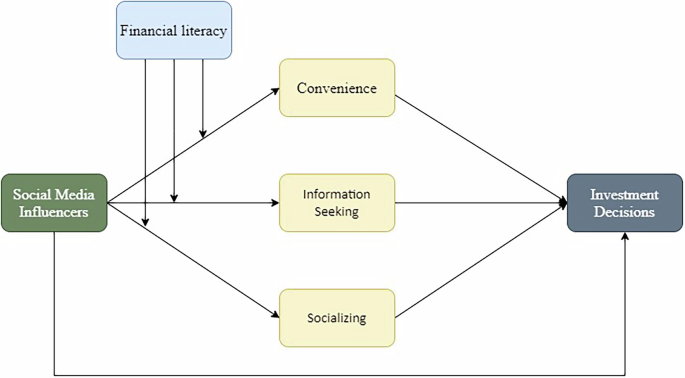
Social media influencers have fundamentally changed how financial guidance is communicated. Unlike conventional financial advisors, who are often perceived as formal and distant, influencers cultivate approachable, informal relationships with their audiences. They use storytelling, personal experience, and accessible language to simplify complicated market concepts, which increases their perceived credibility and trustworthiness. Researchers have documented that factors such as attractiveness, perceived expertise, and reliability play a decisive role in how likely followers are to accept investment suggestions. When an influencer recommends a stock or shares a trade strategy, their audience is more inclined to act on it if they believe the influencer is transparent, knowledgeable, and genuinely interested in their financial success. This trust-based relationship means that influencers can shape not only individual investment choices but also broader investment behavior, from risk appetite to portfolio diversification. Empirical evidence supports the notion that social media influencers have a direct and positive impact on investment decisions. The informal yet authoritative nature of their content allows them to connect with younger and novice investors who may feel intimidated by traditional financial institutions. Moreover, influencers often build online communities where followers can ask questions, share insights, and validate one another’s decisions. This peer network amplifies the influencer’s message and creates a social proof effect, where people are more likely to act when they see others in their network doing the same. Based on this body of research, scholars have proposed the first major hypothesis: social media influencers positively impact individuals’ investment decisions. This hypothesis serves as the foundation for more complex models that explore the mechanisms behind such influence.
Examining the mediating pathways helps clarify how social media influencers exert their impact. The first mediator is convenience, which refers to the ease and efficiency with which users can access financial information and act upon it. Social media platforms provide instantaneous updates, digestible insights, and actionable advice that lower the effort required to make investment decisions. For example, an influencer who posts a short video explaining a stock’s potential lets a follower evaluate and act on that tip without conducting hours of research. Several studies have shown that convenience significantly mediates the relationship between social media content and investment decisions, especially for young investors who prioritize speed and simplicity. The second mediator is information-seeking, which involves the deliberate search for knowledge to reduce uncertainty and improve decision quality. Followers often treat influencer recommendations as starting points, then seek additional information to verify and understand the advice. This verification process can involve reading financial news, checking company reports, or reviewing comments from other users. Information-seeking reinforces the influencer’s influence by building a stronger evidentiary basis for acting on the recommendation. The third mediator is socializing, which captures the interactive and communal aspects of social media. By commenting, sharing, and discussing investment ideas with peers and influencers, individuals gain social validation that bolsters their confidence. Peer approval acts as a kind of certification, making influencer recommendations feel safer and more reliable. Studies have demonstrated that social interactions within online communities increase the likelihood that followers will act on influencer advice, effectively bridging the gap between content consumption and real-world financial behavior. For all three mediators, there is robust empirical support: convenience, information-seeking, and socializing each amplify the influence of social media financial content and explain why recommendations translate into action. Together, these findings support separate hypotheses that convenience, information-seeking, and socializing serve as mediating mechanisms in the relationship between social media influencers and investment decisions.
Financial literacy, however, plays a crucial moderating role in this dynamic. Individuals vary significantly in their ability to understand financial concepts, evaluate risk, and discern credible information from misinformation. Financial literacy comprises the knowledge and skills needed to make informed and effective financial decisions, and it shapes how people process influencer content. Those with high financial literacy are generally better equipped to separate trustworthy financial advice from biased or unqualified opinions. They are more likely to ask critical questions, cross-check claims with primary sources, and resist impulsive decisions based solely on an influencer’s charisma. This does not mean financially literate individuals avoid social media altogether; rather, they use it more selectively and strategically. They are less likely to rely on convenience alone, because they understand that fast and easy information is not always accurate. Instead, they apply their knowledge to evaluate the quality of the advice and integrate it with other sources of information. Financial literacy similarly moderates the relationship between social media influencers and socializing. While social interaction on social media can be persuasive, financially literate users approach peer discussions with greater discernment, refusing to follow trends simply because others are doing so. They are more likely to contribute informed opinions, seek out constructive dialogue, and avoid herd mentality. The literature indicates that financial literacy enhances one’s ability to search for additional information, verify influencer claims, and weigh risks more carefully. In practical terms, this means that the same influencer content can lead to very different outcomes depending on the audience member’s financial knowledge. The proposed hypotheses reflect this insight: financial literacy positively moderates the relationship between social media influencers and convenience, between social media influencers and socializing, and between social media influencers and information-seeking. In each case, higher financial literacy creates a more careful, discerning engagement with digital financial content, which in turn influences the strength and direction of the influencer’s impact.
In conclusion, the relationship between social media influencers and investment decisions is neither straightforward nor universal. It is shaped by a complex interplay of motivations, psychological needs, and individual capacities. The uses-and-gratifications theory offers a useful lens through which to understand how convenience, information-seeking, and socializing mediate the influence of financial content on social media. These mechanisms help explain why some followers are moved to act on investment advice more readily than others, and why the same financial tip can have different effects depending on the context. At the same time, financial literacy emerges as a vital moderating variable, empowering individuals to make more informed and independent investment decisions in a media environment saturated with informal advice. For policymakers and financial educators, these findings emphasize the importance of promoting financial literacy among retail investors, particularly as social media continues to grow as a source of financial information. For influencers, the research highlights the responsibility that comes with financial authority, as their content can shape meaningful and sometimes risky decisions. As social media platforms evolve and new forms of digital content emerge, the need for rigorous research into these dynamics will only increase. Future studies should further explore how different types of content, cultural contexts, and individual differences influence the pathways through which social media affects investment behavior. Ultimately, the literature reviewed here demonstrates that social media influencers are not merely an entertainment byproduct of the digital age; they are key actors in the financial decision-making ecosystem, with the power to both inform and mislead. Understanding their influence is essential for investors, researchers, and regulators who seek to navigate the complex intersection of social media and finance.