


AI Both Weapon and Shield in Information War: Lausanne Workshop Unites Researchers, Journalists and Policymakers
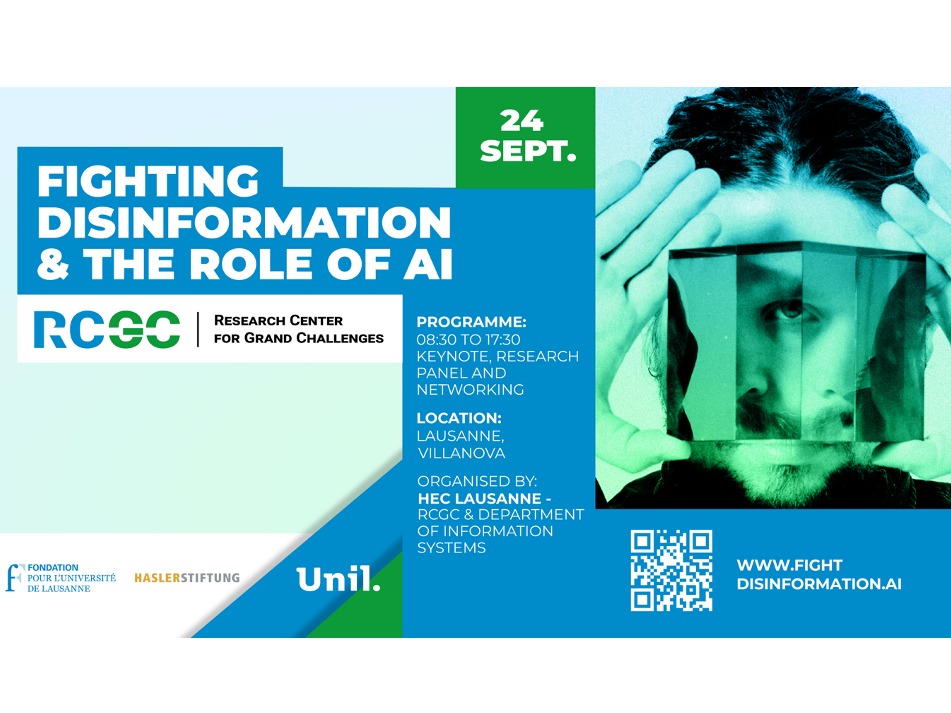
Artificial intelligence has become one of the most powerful engines of disinformation, generating synthetic content and amplifying false narratives at unprecedented scale. The same technology, however, is increasingly being used to detect manipulated media and to fact-check at speed. This tension—AI as both vector and remedy—sits at the heart of Fighting Disinformation & the Role of AI, an interdisciplinary workshop to be held at Villanova, on the UNIL campus in Lausanne, on 24 September 2026. Organised by the Research Center for Grand Challenges (RCGC) and the Department of Information Systems at HEC Lausanne, the event starts from a simple premise: disinformation is a problem no single discipline can solve alone. It brings empirical research into dialogue with the realities of newsrooms, policy and technology, and aims to seed lasting collaborations across these communities. The workshop is open to researchers, policymakers, media professionals, tech actors and students—anyone engaged with the disinformation challenge, whether through empirical research, tool development, policy design, journalism, or graduate study. Registration is free and now open. The full-day programme runs from 08:30 to 17:00 at Villanova, a venue on the University of Lausanne campus, and its structure moves deliberately from evidence to practice to collaboration. This timing is significant. As generative AI tools become cheaper and easier to use, the barrier to producing convincing falsehoods has fallen dramatically, while the volume of synthetic media circulating online has risen sharply. In this environment, the workshop’s organisers argue, the same models that enable new forms of manipulation also offer new opportunities for detection, verification and resilience. The event is therefore designed less as a lecture series than as a working meeting, with research presentations, practical panels and hands-on problem-solving all contained in a single day. For early-career scholars, in particular, it offers a rare chance to present work to senior academics and practitioners and connect with a network that spans journalism, policy and technology. The official call for papers invites PhD students and postdoctoral researchers to submit a one-page abstract for the Young Researchers Paper Session by 19 August 2026, with submissions to be sent to grandchallenges@unil.ch. As the information ecosystem grows more contested, the workshop’s interdisciplinary premise reflects a broader conviction: countering disinformation requires not just better algorithms, but better institutions, better regulation and better public understanding.
At the center of the discussion is a double-edged technological reality. On one side, AI systems can now generate convincingly realistic images, audio, video and text at scale, making it possible for malicious actors to produce fake news articles, impersonate public figures, or launch coordinated influence operations with relatively modest resources. On the other side, AI is also becoming an essential tool for defending the information ecosystem. Automated fact-checking systems can compare claims against trusted databases in real time; machine-learning models can spot digital manipulation in images and videos; and network analysis can identify bot accounts and coordinated amplification. The workshop’s morning keynote will address this dual role directly, setting the stage for a research panel that takes stock of what is—and is not—known about how AI spreads, detects and fact-checks false information. This panel is intended to move beyond sweeping claims about both the dangers and the promises of AI, focusing instead on empirical evidence, methodological rigor and the limits of current research. Many questions remain unresolved, and the organisers have made clear that honest uncertainty is preferable to confident speculation. For example, while many studies have demonstrated the potential of AI-based detection, far less is known about how such tools perform in real-world settings, where adversaries adapt quickly, data is messy, and false information travels across languages, platforms and borders. Similarly, the effectiveness of fact-checking interventions on belief change is still unevenly understood, and the interaction between automation and human judgment remains a critical area of inquiry. By giving researchers and practitioners the opportunity to compare findings and identify gaps, the workshop aims to produce not only a better shared understanding of the problem but also a clearer agenda for future research and policy. This is not an abstract exercise: the choices made by platforms, governments and newsrooms in the coming years will determine whether AI shores up or undermines the foundations of informed public debate.
Behind the event is a set of institutions with an explicit commitment to addressing complex, multi-causal problems. The Research Center for Grand Challenges (RCGC) is designed to promote exactly this kind of cross-disciplinary exchange, bringing together researchers from fields that too often work in isolation. The Department of Information Systems at HEC Lausanne contributes a focus on the design, use and consequences of digital technologies, including information ecosystems, data science and human-computer interaction. Together, they have shaped an event that treats disinformation not only as a technical problem or a communications problem, but as a societal one. This is evident in the programme’s deliberate bridging of different communities. The morning is oriented toward evidence: a keynote and research panel establish what is known, what is suspected and what remains unknown about AI’s role in disinformation. The afternoon shifts toward practice and collaboration: journalists, policymakers and technology practitioners will discuss the constraints they face, the tools they need, and the forms of cooperation that could make a difference. This structure is meant to avoid the usual conference format, in which researchers present to other researchers and practitioners leave with little that is directly useful. Instead, from the start, participants are encouraged to think about how their work connects to the work of others. The organisers have also made a point of including early-career researchers, recognizing that PhD students and postdocs will be central to future solutions. A dedicated session gives them the floor to present their work and receive feedback from senior academics and practitioners, an opportunity designed to sharpen research questions and build networks that outlast the event. By anchoring the day in both scholarly rigor and practical relevance, the RCGC and HEC Lausanne hope to create a sustained community of practice around disinformation and AI—one that can continue to meet, collaborate and produce recommendations long after the workshop has ended.
According to the published programme, the morning begins with a keynote address on AI’s dual role in the information ecosystem, setting out the central tension in concrete terms: the same machine-learning techniques that can generate synthetic content also underpin tools for detecting it. The keynote will be followed by a research panel designed to take stock of the current state of evidence. Panellists are expected to address a range of questions: How exactly are AI-generated narratives spread? Which detection methods are most robust? What do we actually know about the effectiveness of automated fact-checking? Equally important, the panel will examine the negative results and open questions that often go unreported in the public debate. The goal is to provide a realistic map of the field, distinguishing established findings from areas where evidence is thin or contested. After a break, the morning turns to the next generation of researchers. The Young Researchers Paper Session invites PhD students and postdoctoral researchers to submit a one-page abstract by 19 August 2026. Selected participants will present their work in a dedicated session, receiving constructive feedback from senior academics and practitioners. The organisers have asked that abstracts be sent to grandchallenges@unil.ch, and they have made clear that submissions from a broad range of disciplines are welcome: information systems, computer science, political science, law, media studies, sociology, public health and beyond. For early-career researchers, this is a valuable opportunity not only to test their findings in front of an informed audience, but also to gain visibility among potential employers, collaborators and mentors. The inclusion of a dedicated session for younger scholars reflects the workshop’s forward-looking approach. It is a recognition that the problem of AI-driven disinformation will not be resolved in the short term, and that the individuals now beginning their research careers will be among those best positioned to develop innovative responses. By deliberately creating a space for their work, the workshop aims to ensure that the next wave of research is shaped by interdisciplinary collaboration from the very beginning.
The afternoon is structured around practice. A second panel will convene journalists, policymakers and technology practitioners, bringing the people who confront disinformation in real time in with the researchers who study it. This panel is expected to explore the operational realities of newsrooms, the regulatory levers available to governments, the design choices made by technology companies, and the ethical considerations that come with automated responses. For journalists, the question is how AI tools can support verification without replacing editorial judgment. For policymakers, the question is how to regulate AI and social media without stifling expression. For technologists, the question is how to build tools that are transparent, accountable and resilient to adversarial attack. The afternoon also includes a hands-on Solutions Lab, perhaps the most distinctive element of the day. In this portion of the programme, participants will split into thematic groups, each focused on a specific aspect of the disinformation challenge. Working together, they will attempt to move from diagnosis to recommendation, producing concrete proposals that can be taken up by researchers, platforms, news organisations or public authorities. The exact themes will be defined in advance, but the organisers have said that the groups will be deliberately cross-disciplinary, mixing managers with front-line workers, academics with activists, and senior figures with students. The aim is not to produce polished academic papers, but to generate actionable ideas grounded in the different expertise assembled in the room. At the end of the session, each group will report its findings, and the workshop is expected to publish a set of recommendations following the event. Participation is open to anyone with a serious interest in the problem, and registration is free, but places may be limited, so early sign-up is encouraged. The registration form and full call for papers are available at fightdisinformation.ai, and the abstract deadline for the Young Researchers Paper Session is 19 August 2026. In addition, questions about the call for papers can be directed to grandchallenges@unil.ch.
The wider significance of the workshop lies in its timing and its framing. AI is evolving rapidly, and so are the tactics of those who misuse it. Deepfakes have already been used in political campaigns, financial fraud and targeted harassment; synthetic media is becoming increasingly difficult to distinguish from authentic recordings; and large language models can generate misleading articles, fake reviews and persuasive phishing messages in a matter of seconds. At the same time, the response is gaining momentum. News organisations are building dedicated verification units, platforms are investing in automated content moderation, academic labs are developing detection algorithms, and governments are beginning to legislate on AI transparency and accountability. Yet these efforts remain fragmented. Researchers rarely have access to platform data; journalists lack a reliable way to compare AI tools; and policymakers are working with evidence that is often outdated by the time it is published. Fighting Disinformation & the Role of AI is an attempt to close some of these gaps. By gathering stakeholders who do not usually sit in the same room, the workshop aims to build the kind of trust that makes it possible to share problems, test assumptions and form alliances. The organisers’ emphasis on lasting collaborations is not incidental; it reflects the conviction that disinformation is a structural feature of an AI-mediated information environment, not a temporary problem to be fixed with a single solution. In that context, the day is likely to be as important for the relationships it builds as for the facts it establishes. For PhD students and postdocs, the deadline of 19 August 2026 offers a near-term opportunity to become part of the conversation. For everyone else, the free registration at fightdisinformation.ai is an open door. On 24 September, on the UNIL campus in Lausanne, the question will no longer be whether AI is an enemy or a friend in the fight against misinformation, but how best to mobilise its power while keeping its dangers in check. That is a question worth asking in the open, across disciplines, and before the next wave of synthetic media makes it harder to answer.