









New Study Reveals How Age, Gender and Social Media Platform Shape Mental Health in Spain
A large new study conducted among 1,700 adults in Spain offers a detailed snapshot of how social media use is associated with emotional well-being, and it highlights age as one of the most powerful factors. The sample was evenly split between men and women, with 49.6 percent identifying as male and 50.4 percent as female, and it spanned four generations: 21.4 percent were aged 16 to 30, 21.8 percent were 31 to 43, 25.5 percent were 44 to 55, and 31.3 percent were 56 to 75. Educationally, 44.1 percent held a university degree, 42.9 percent had a high school diploma, 11.5 percent completed basic studies, and 1.5 percent had no formal education. A majority of participants, 67.6 percent, were employed, while 10.2 percent were unemployed, 12.8 percent were retired, 5.9 percent were students, and 3.5 percent were neither working nor studying. The income distribution was diverse, with 30.6 percent earning between €1,001 and €2,000 per month, 24.9 percent earning between €2,001 and €3,000, and smaller groups at both extremes. Geographically, the sample reflected Spain’s population structure: the largest shares came from Andalucía (17.9 percent), Catalonia (16.6 percent), and Madrid (14.6 percent), followed by the Valencian Community, Galicia, and the Canary Islands, with smaller representation from all other regions. When asked about their principal social media platform, 45.4 percent named WhatsApp, making it by far the most common choice. Instagram was second with 18.4 percent, followed by TikTok with 10.6 percent, Facebook with 9.6 percent, YouTube with 8.3 percent, and X, formerly Twitter, with 4.1 percent. Telegram, Twitch, Snapchat, LinkedIn, and other platforms each accounted for less than 1.5 percent of users.
The study also examined gender differences in psychological variables using independent samples t-tests, revealing a consistent pattern: women reported significantly higher levels of depression and anxiety than men, and they also spent more time on social media. For depression, the difference was significant, with women scoring higher; for anxiety, the difference was also significant; and for time on social media, women significantly surpassed men. The effect sizes for these differences were small, but they were robust enough to appear in the statistical analysis. Men and women did not differ significantly on measures of anger, maladaptive emotion regulation, or social comparison. The absence of significant differences on these measures suggests that the gender gap is not universal across all emotional difficulties but is concentrated in affective symptoms such as depression and anxiety, as well as in social media usage time. The researchers used Levene’s test to check equality of variances and adjusted the t-test for social comparison, but this did not change the conclusion. Overall, the gender findings point to a relatively balanced sample distribution and highlight that female participants may be more vulnerable to internalizing symptoms in the context of digital media use. The lack of significant differences in anger and emotion regulation also indicates that some emotional processes are shared equally by men and women, while other patterns diverge.
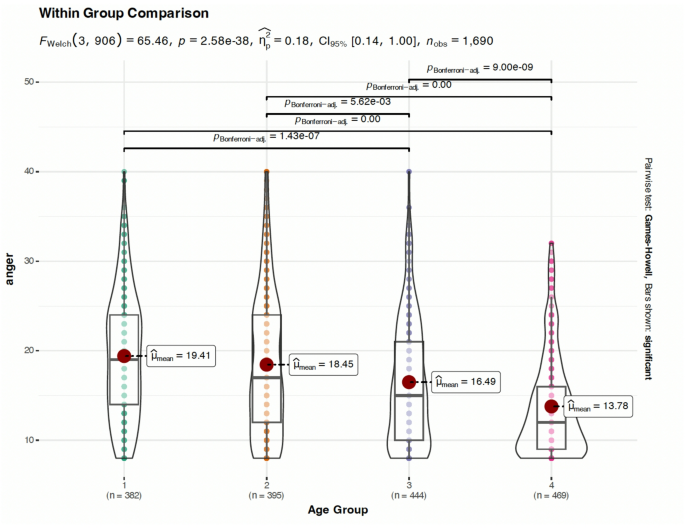
Age, however, emerged as the most striking source of variation in the entire study. A multivariate analysis of covariance, or MANCOVA, found that age groups differed significantly across the combined psychological outcomes, and follow-up univariate tests revealed significant age effects on every single measure: clinical anxiety, clinical depression, anger, maladaptive emotion regulation, and social comparison. The age group differences were moderate in magnitude, with partial eta squared values ranging from 0.05 for maladaptive emotion regulation to 0.09 for anger. Post hoc comparisons using Bonferroni correction showed that the youngest group, Gen Z, was primarily driving these differences. In other words, the youngest adults consistently reported the worst psychological outcomes, while older adults reported fewer symptoms and healthier emotional processes. The study’s figures illustrate these gradients clearly: clinical depression and anxiety were much higher among those aged 16 to 30, with a steady decline across Millennials, Gen X, and Boomers. The same declining pattern appeared for anger, with the youngest adults showing substantially higher levels than the oldest. Social comparison also dropped sharply with age, and maladaptive emotion regulation followed the same trajectory. Time spent on social media likewise varied by age, with younger participants spending more time online. These results align with broader research suggesting that younger generations are more exposed to the risks of social media, either because of heavier usage, developmental sensitivity, or evolving digital environments.
The type of social media platform also made a difference, though the effects were smaller than those of age. A MANCOVA examining the associations between preferred platform and psychological variables produced a statistically significant multivariate effect, meaning that users of different platforms differed in their overall emotional profile. Univariate analyses then showed significant differences by platform for anxiety, depression, anger, social comparison, and maladaptive emotion regulation. Importantly, the platform effect remained statistically significant even after controlling for age, implying that the differences cannot simply be attributed to the fact that certain platforms are more popular among younger users. The analysis used multiple statistical criteria, including Pillai’s Trace, Wilks’ Lambda, Hotelling’s Trace, and Roy’s Largest Root, and all confirmed the same conclusion. Although the study did not identify exactly which platforms scored highest on each outcome, the findings indicate that the digital environment people choose is associated with their mental health. WhatsApp, Instagram, and TikTok dominate the Spanish market, and those platforms may create different emotional experiences: WhatsApp is a private messaging tool focused on close ties, while Instagram and TikTok are image-based and algorithm-driven, often promoting social comparison. Facebook, YouTube, X, Telegram, Twitch, Snapchat, and LinkedIn also carry distinct modes of interaction and content exposure. The persistence of platform-related differences after adjusting for age suggests that the design and social context of each platform may exert a unique influence on emotional well-being.
Correlational and reliability analyses provided further insight into the mechanisms linking these variables. The researchers computed intercorrelations among age, social media time, maladaptive emotion regulation, social comparison, and the three clinical outcomes: anxiety, depression, and anger. Age showed small-to-moderate negative correlations with all psychological variables, ranging from roughly -0.23 to -0.31, meaning that older individuals tended to report less maladaptive emotion regulation, less social comparison, and lower levels of anxiety, depression, and anger. Time spent on social media, by contrast, was positively but weakly associated with maladaptive emotion regulation, social comparison, anxiety, depression, and anger, with correlations between 0.11 and 0.16. This suggests that the raw amount of time online matters, but it is not the dominant factor in mental health. Much stronger associations emerged among the psychological variables themselves. Maladaptive emotion regulation was strongly correlated with anger, with a correlation of 0.53, and moderately correlated with social comparison, anxiety, and depression, each around 0.43. Anxiety and depression were very strongly correlated with each other at 0.89, which is common in clinical research because the two conditions often co-occur. Anger was moderately correlated with both anxiety and depression at 0.57. These patterns indicate that maladaptive emotion regulation and social comparison may be central psychological processes that connect media use to emotional distress. The study also reported excellent internal consistency for all scales, with Cronbach’s alpha values ranging from 0.81 to 0.95, meaning that the measurement instruments were reliable and that the findings are unlikely to be due to measurement error.
Finally, a path analysis was used to model the direct and indirect relationships among social media time, social comparison, maladaptive emotion regulation, and negative affective outcomes. The hypothesized model fit the data acceptably, although the chi-square value was significant and the root mean square error of approximation was somewhat above the ideal threshold; the comparative fit index and standardized root mean square residual indicated good fit. The model explained a substantial proportion of the variance in the outcomes: 27 percent for anger, 18 percent for anxiety, and 16 percent for depression. Time spent on social media had small positive direct effects on maladaptive emotion regulation, social comparison, anxiety, depression, and anger, with standardized coefficients between 0.06 and 0.11. In contrast, maladaptive emotion regulation was a powerful predictor of symptoms, with strong associations with anger, anxiety, and depression. Social comparison was also strongly linked to maladaptive emotion regulation, suggesting that when people compare themselves to others online, they are more likely to engage in unhealthy emotional regulation strategies. The overall picture suggests that social media use does not harm mental health mainly through the simple number of hours spent online. Rather, the pathway runs through psychological processes: more time online may encourage social comparison, which in turn fosters maladaptive emotion regulation, and that maladaptive regulation then feeds into depression, anxiety, and anger. The direct effects of social media time were modest, but the indirect effects through emotion regulation were substantial. These findings have important implications for interventions. Rather than merely telling people to reduce screen time, clinicians and public health experts may need to help users develop healthier emotional regulation skills, reduce the tendency to compare themselves with others, and become more mindful about how different platforms affect their mood. The study offers a nuanced and comprehensive view of the relationship between digital media and mental health, emphasizing that individual differences such as age, gender, and emotional style are at least as important as the time spent on devices.


