







Coordinated Media Campaigns Fueled Sectarian Violence in Syria’s As-Suwayda, Investigation Finds
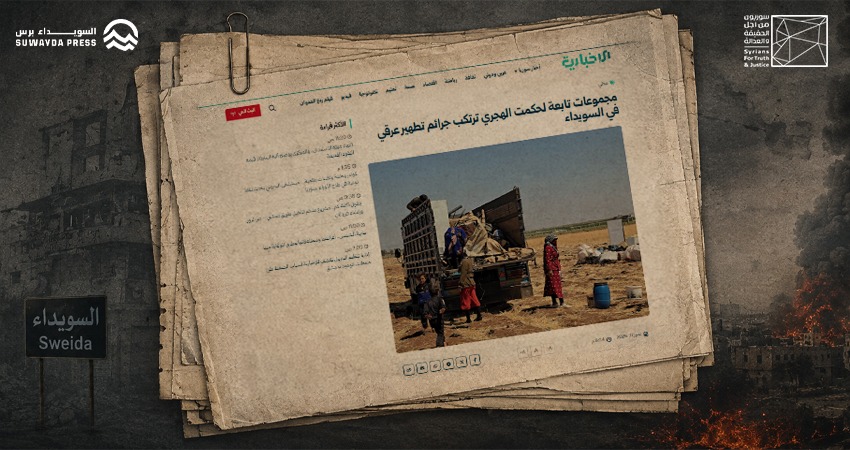
A new joint investigation has revealed the extent to which coordinated digital and media campaigns fueled the horrific sectarian violence that swept through Syria’s As-Suwayda governorate in July 2025, resulting in the deaths of over 1,700 people. The comprehensive report, a collaboration between Suwayda Press and Syrians for Truth and Justice (STJ), analyzes the media and digital discourse that accompanied the massacres. It focuses on official platforms of the transitional authority and media outlets that adopted its narrative, exposing how these platforms used specific language and hashtags to mobilize the public and deepen sectarian polarization. The investigation reveals a disturbing pattern in which political and security characterizations of events were deliberately transformed into instruments of mobilization and incitement, blurring the line between civilians and combatants and reinforcing a pervasive logic of collective responsibility that made the violence possible.
The investigation placed significant emphasis on the period leading up to and during the third wave of violence, which proved to be the most destructive. This phase was marked by a surge in specific narratives, including the “rescue of the tribes,” “extending state control,” and the “Israeli project.” These narratives, circulated across multiple media platforms, were not merely descriptions of events but acted as active calls to action. The report’s analysis of a substantial sample of over 11,118 public Facebook posts, published between 17 July and 17 August 2025, reveals troubling trends that defy explanation as spontaneous reactions. The report documents a sharp surge in posting intensity that coincided precisely with developments on the ground, alongside a clear and repetitive use of identical narratives and hashtags across specific pages and accounts. This consistent pattern of coordinated publishing strongly suggests a directed effort to create a media environment more receptive to mobilization and retaliatory violence, effectively shutting down public debate on the true responsibility of armed actors for the atrocities committed.
The investigation meticulously reconstructs the background of the three waves of violence that rocked the region between 13 and 19 July 2025. The conflict escalated from sectarian clashes between the Bedouin and Druze communities, sparked by looting and revenge, into a large-scale conflagration involving local militias, Syrian transitional government forces, and allied armed groups. According to the Independent International Commission of Inquiry on Syria, the first wave, and the deadliest, involved government forces and tribal fighters committing large-scale violations against Druze civilians between 14 and 16 July. These violations included killings, torture, arbitrary detention, and summary executions, particularly targeting men identified as Druze. The second wave began on 17 July, following the withdrawal of government forces in the wake of Israeli airstrikes, and saw retaliatory attacks on Bedouin neighborhoods by local armed groups. The third and most destructive wave, occurring between late 17 July and 19 July, was carried out by tribal fighters who had been aggressively mobilized to advance toward As-Suwayda, perpetrating sweeping revenge attacks against Druze civilians, including burning homes, looting shops, and desecrating religious sites.
The human cost of this violence is staggering. The Commission of Inquiry reported that the three waves of violence left more than 1,707 people dead, with the majority being Druze. Of these, 1,190 were men, 99 were women, 22 were boys, and 31 were girls from the Druze community. The Bedouin community also suffered significant losses with 53 men, 9 women, 5 boys, and 3 girls killed. In a separate, independent documentation effort, the joint team from Suwayda Press and STJ cross-referenced forensic medicine lists from the National Hospital in As-Suwayda with burial records, documenting 1,520 victims from the Druze community alone. This independent verification underscores the immense scale of the tragedy and provides a concrete foundation for understanding the depths of the loss experienced by the community.
Central to the report’s findings is the role of media narratives in creating a climate that justified these acts of violence. The investigation shows that the digital discourse was awash with unverified news, hate speech, and disinformation, which helped to widen the scope of mobilization, particularly during the crucial third wave. By amplifying narratives like “the rescue of the tribes,” the media effectively framed the violence as a legitimate act of defense or retribution, obscuring the reality of attacks on unarmed civilians. The constant repetition of these themes, combined with the apparent coordination in their dissemination, created a powerful echo chamber that reinforced collective perceptions rooted in fear and threat, making it easier for armed actors to recruit and harder for moderate voices to be heard.
The report’s authors warn that this deliberate weaponization of information presents a grave danger. These patterns did not merely comment on the news; they actively participated in the creation of a reality in which violence was seen as a necessary and justified response. By fostering a logic of collective responsibility, the discourse paved the way for the widespread brutality that was visited upon entire communities. The investigation highlights how the combination of digital media, mobilizing political rhetoric, and disinformation can inflame local conflicts and tear at the very fabric of society. It exposes a clear mechanism by which armed actors, aided by sympathetic media environments, were able to redefine a security situation to suit their political aims while completely disregarding the devastating impact on civilian life.


