





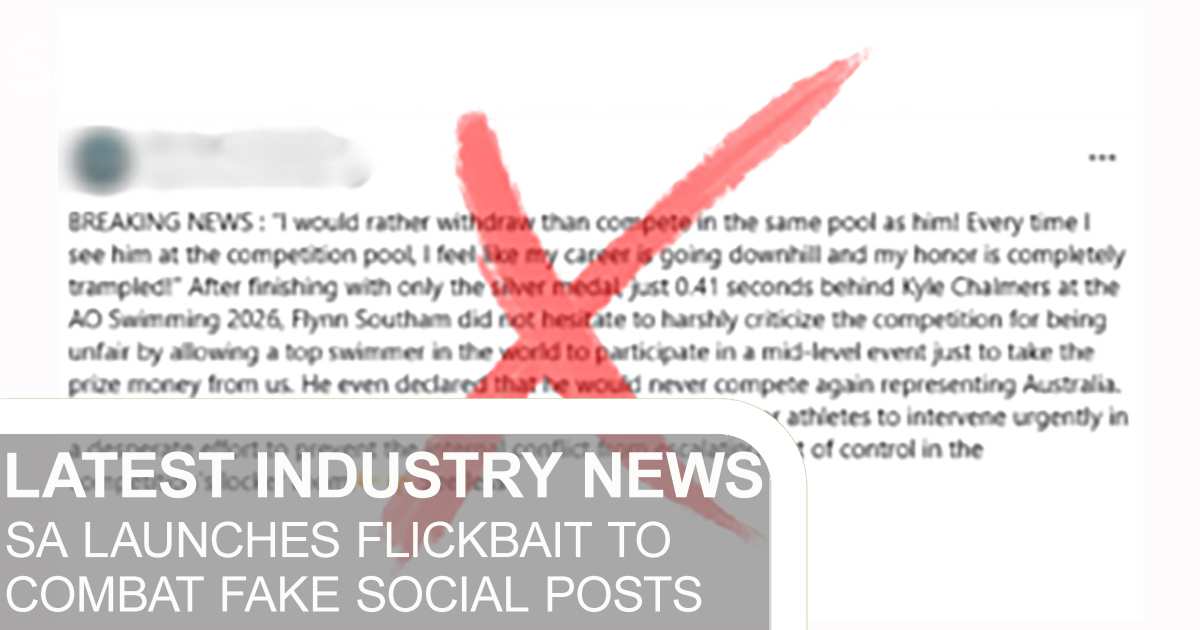
Paragraph 1: The World-First Initiative to Fight AI Disinformation in Sports
In a pioneering move that marks a significant shift in how sporting organizations defend their athletes against the digital deluge of misinformation, Swimming Australia has officially launched a new resource called “Flickbait.” This initiative, believed to be a world first for a sporting organization, is designed to combat the rising tide of non-factual social media posts, the vast majority of which are now being generated by sophisticated artificial intelligence tools. The announcement was made at a critical juncture, as the Australian Dolphins swimming team prepared to depart for the 2026 Commonwealth Games in Glasgow, followed by the Pan Pacific and Para Pan Pacific Championships in California. This timing is deliberate; with major international competitions on the horizon, the visibility of athletes is at its peak, making them prime targets for malicious or misleading content. The creation of Flickbait represents a strategic acknowledgement by the sport’s governing body that the battleground for an athlete’s reputation has extended far beyond the pool deck into the unregulated, often hostile environment of social media platforms. By housing this new resource directly on the Swimming Australia website, the organization is signaling its commitment to not only reacting to disinformation after it spreads but also providing a proactive, accessible toolkit for athletes, their families, the media, and the general public to verify the authenticity of content relating to their swimmers. The core mission of Flickbait is to foster media and public information literacy, equipping stakeholders with the critical thinking skills necessary to discern fact from fiction in an era where deepfakes and AI-generated text can mimic the likeness and voice of anyone with alarming accuracy, thereby protecting the integrity of the sport and the mental wellbeing of its competitors.
Paragraph 2: The Threat Landscape – Anti-Trans Narratives and Fabricated Coach Quotes
The impetus for the launch of Flickbait stems from a documented and disturbing pattern of targeted harassment against Australian swimmers. Swimming Australia has tracked a concerning number of sports and human-interest pages that have actively promoted fabricated content, with two specific categories emerging as the most prevalent and damaging. The first involves the proliferation of anti-transgender narratives, which are being weaponized to create false stories about specific athletes, usually implying they support discriminatory policies or hold extreme views without their consent. The second, equally insidious category involves the fabrication of comments from high-performance coaches. These fake quotes are often designed to create internal team drama, imply dissent or strategy disputes, or paint coaches in a negative light to generate engagement and clicks. The sophistication of these attacks is escalating thanks to generative AI. Bot networks can now produce dozens of convincing, albeit entirely false, social media posts in seconds, complete with realistic profile pictures, timestamps, and engagement metrics. The speed at which these falsehoods spread often outstrips the ability of the organization to issue official rebuttals, leaving athletes exposed to a torrent of abuse and speculation during crucial preparation periods. The challenge is compounded by the fact that once a false narrative takes hold online, it becomes sticky, persisting across forums, comment sections, and screenshots long after the original post has been deleted. This deeply personal and professionally damaging environment necessitated a more robust, systematic response than simply issuing press releases, leading directly to the conceptualization and development of the Flickbait resource.
Paragraph 3: Inside Flickbait – A Digital Shield and Educational Tool
While the exact technical architecture is still being refined, the “Flickbait” resource is envisioned as a comprehensive digital shield, integrating several key functions to combat disinformation. Primarily, it serves as a verification database, allowing users to search for official statements, sanctioned quotes, and verified athlete profiles. This creates a central “source of truth” against which dubious social media content can be cross-referenced. If a post claims an athlete said something that does not appear in the database, it can be immediately flagged as suspicious. Furthermore, the platform includes educational modules designed to teach users how to identify the tell-tale signs of AI-generated imagery, synthetic voice audio, and bot-driven engagement patterns. However, the success of this initiative hinges on robust collaboration. Swimming Australia is working in conjunction with the Office of the eSafety Commissioner, the Department of Foreign Affairs and Trade (DFAT), and Meta, the parent company of Facebook and Instagram. The partnership with the eSafety Commissioner provides the statutory backing to formally complain and expedite the removal of harmful content under Australian law. DFAT’s involvement is crucial for cross-border jurisdiction, as many of the offending accounts originate from overseas servers, requiring diplomatic channels to secure takedowns. Meta’s cooperation is perhaps the most practical, allowing Swimming Australia a direct line to flag malicious posts for rapid review and removal, circumventing standard, slower reporting queues. This tripartite alliance transforms Flickbait from a passive archive into an active enforcement mechanism, ensuring that the fight against misleading content is conducted swiftly, legally, and across all digital frontiers.
Paragraph 4: The Human Cost – Mollie O’Callaghan’s Fight Against a Fake Boycott Claim
The personal toll of this digital warfare is exemplified by the experience of Mollie O’Callaghan, the Olympic gold medallist and world record holder who has become one of the most prominent faces of Australian swimming. O’Callaghan was recently the target of a particularly virulent piece of misinformation: a fabricated claim that she would forgo the Olympics entirely if a transgender athlete were permitted to compete. This story was crafted, posted, and shared across multiple platforms, quickly gaining traction among those with vested interests in the gender debate in sports. Although the page hosting the claim was eventually taken down, the damage had already been done. “It’s a scary thing,” O’Callaghan said, reflecting on the experience. “You don’t want people impersonating you and making statements that aren’t true. I had to remind everyone to check their sources.” The remark highlights a critical absurdity: a world-class athlete, focused on the rigors of training and international competition, was forced to abruptly divert her attention to publicly defending her own words and character. The psychological impact of such fabricated attacks extends far beyond a simple clarification. It fosters an atmosphere of distrust, forcing athletes to second-guess how online interactions might be twisted, and intrudes upon their private family life as relatives receive concerned calls from friends who saw the fake story. O’Callaghan emphasizes that the solution must be systemic. “Flickbait is a great first step for the public – and media – to rule out the fakes,” she stated. Her hope is that this tool will become a standard reference point, allowing journalists to verify statements before publication and giving the public a reliable yardstick to measure the veracity of sensational claims.
Paragraph 5: Leadership Response – A Proactive Stance from Wellbeing Management
Linley Frame, Swimming Australia’s National Wellbeing and Engagement Manager, has been at the forefront of the organization’s response to this crisis. Frame articulates the philosophy behind Flickbait with a clear sense of urgency and responsibility. “We will continue to work hard to close down these posts with the relevant bodies,” Frame explained, “but rather than sit back and see these posts shared and commented on, we thought it was our responsibility to be proactive and denounce the content as Flickbait.” This statement underscores a fundamental shift in strategy from a reactive posture—waiting for harm to occur and then scrambling to fix it—to a proactive one. Frame acknowledges the relentless nature of the challenge: “We will continue to address this challenge to counter misinformation – and disinformation – and we hope this resource proves an additional valuable tool in safeguarding our athletes and our community.” By establishing a permanent resource, Swimming Australia is aiming to build resilience against future attacks, rather than simply extinguishing today’s fires. The distinction between misinformation (false content shared without malicious intent) and disinformation (deliberately fabricated content intended to mislead) is crucial to the design of the tool, as it requires specific counter-strategies for each. Furthermore, Frame’s commitment reflects a broader understanding that athlete wellbeing is not solely physical or tactical but increasingly digital and psychological. The constant threat of being impersonated or slandered online contributes to anxiety and burnout. By tackling this issue head-on, Swimming Australia is demonstrating a duty of care that goes beyond the swimming pool, reinforcing their message that athlete welfare is the organization’s paramount concern.
Paragraph 6: A Broader Call to Action – Setting a Precedent for Global Sports
The launch of Flickbait carries implications that ripple far beyond the borders of Australian swimming. As O’Callaghan expressed, “I hope other sports follow suit.” This sentiment is likely to resonate across the global sporting community, which is universally grappling with the erosion of trust caused by AI-generated deepfakes and bot-driven smear campaigns. The issue is not unique to swimming; football, tennis, and athletics all face similar challenges regarding betting-related misinformation, transfer rumors, and doping accusations manufactured out of thin air. By establishing a verifiable repository of truth, Swimming Australia has inadvertently provided a blueprint for other federations to protect their own athletes. The initiative also puts a spotlight on the responsibility of the media. In the race for clicks, legitimate outlets occasionally share unverified screenshots or quote snippets, inadvertently amplifying the disinformation. Flickbait offers a mechanism to break this cycle, allowing editors and journalists to quickly validate the authenticity of a quote attributed to a swimmer. Ultimately, the fight against fake news is a collaborative endeavor. While technology created the problem, technology, combined with institutional cooperation and public education, can help mitigate it. The proactive stance taken by Swimming Australia, working alongside government agencies and tech giants, signifies a maturation in the digital defenses of sports organizations. As the team departs for Glasgow and California, they carry not just their competitive spirit, but the assurance that their governing body has built a digital bulwark to stand behind them, ready to challenge the fakes and protect their reputations in the ever-evolving landscape of the online world.