





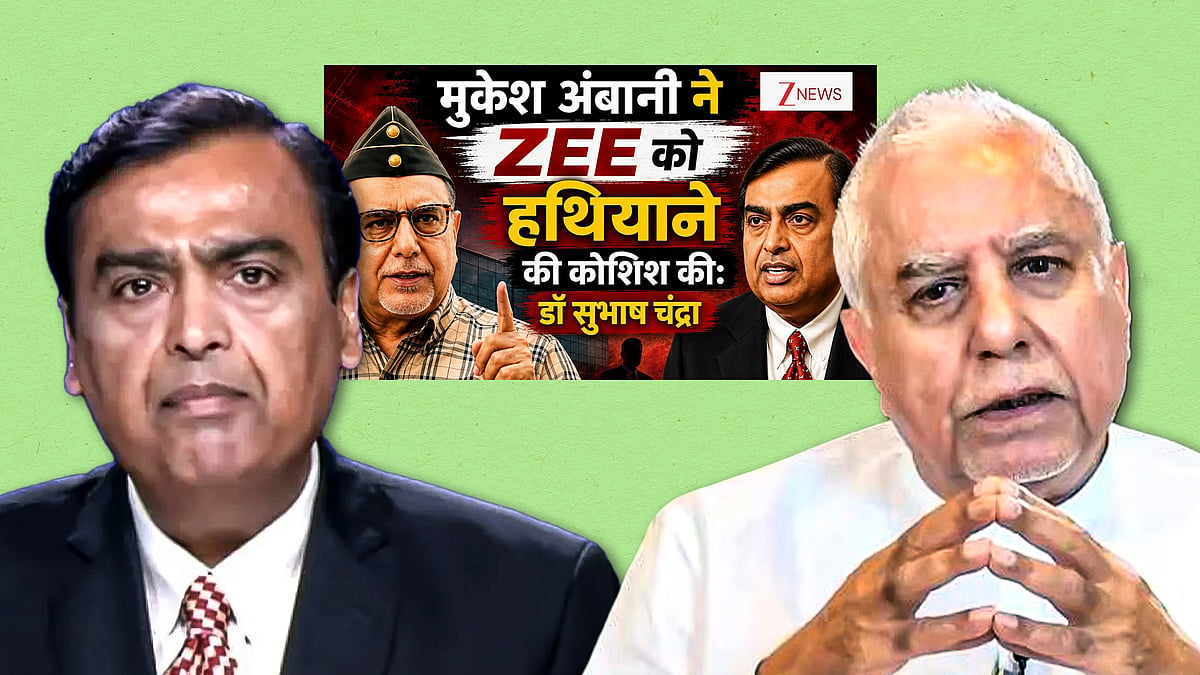
Subhash Chandra Escalates Feud with Ambani, Alleges Market Manipulation and Unfair Business Tactics
New Delhi — In a dramatic escalation of one of corporate India’s most high-profile disputes, Zee Entertainment Enterprises founder Subhash Chandra has leveled a series of serious allegations against industrialist Mukesh Ambani, accusing the Reliance Industries chairman of orchestrating a deliberate campaign to destabilize his media empire. Chandra’s remarks, which have sent shockwaves through the business community, span allegations of stock market manipulation, undue influence over financial institutions, and a coercive takeover attempt that he claims was designed to wrest control of his company under unfair terms. The accusations represent a rare public confrontation between two of India’s most powerful business figures, moving their rivalry from the boardroom into the realm of public accusations with potentially far-reaching implications for corporate governance.
Central to Chandra’s explosive claims is his assertion that the troubles plaguing Zee Entertainment did not occur organically but were instead the result of a calculated financial assault. He specifically pointed to the events of 2019, when Zee’s share price witnessed a dramatic and inexplicable crash of nearly 40 percent in a single trading day. Chandra alleged that this sharp decline was not a market correction but a deliberate act of sabotage. He contended that the crash was engineered through a complex web of hundreds of “benami” shell companies, which he claims were used as proxies to manipulate the market. According to Chandra, this network was not acting in isolation but was acting on behalf of Ambani’s interests, aiming to severely dent investor confidence in Zee and devalue the company, thereby making it vulnerable to a hostile takeover or a distress sale. He argued that the sheer scale and coordination required to execute such a massive sell-off in a single day points to a pre-meditated strategy rather than random market forces.
The timeline of Chandra’s narrative reveals a deepening personal and financial entanglement between the two business leaders. He recounted approaching Ambani during this period of crisis, revealing that he sought financial assistance to repay a substantial personal debt that had been incurred to shore up his struggling media ventures. According to Chandra, the advice he received from Ambani was startling and, in hindsight, served as a precursor to the subsequent events. He alleged that Ambani explicitly advised him not to repay his loans to the banks, suggesting that allowing the debts to become stressed would be a more strategically advantageous move. Chandra claimed that this advice was inexplicable at the time, as it ran counter to every principle of financial prudence. He now interprets this counsel as a calculated move to ensure that Zee’s financial situation would deteriorate further, creating a pathway for Reliance to eventually acquire the company at a significantly depressed valuation, either through the bankruptcy process or a forced asset sale.
Beyond the market manipulation allegations, Chandra detailed what he described as a systematic attempt by Reliance to seize control of Zee. He alleged that Reliance later collaborated with US-based investment firm Invesco, a major shareholder in Zee, to orchestrate a takeover. According to Chandra, this partnership was designed to remove him from the helm and install a new management team that would be favorable to Reliance’s interests. He specifically criticized the terms of the proposed deal, claiming that while it may have been structured to benefit his own family’s financial position, it was deeply detrimental to the interests of minority shareholders. This clause, he argued, was a key reason the deal was ultimately rejected. The proposed amalgamation of Zee with a struggling Reliance-backed media entity was heavily criticized by minority shareholders and corporate governance experts, not for its ambition, but for its skewed economics that appeared to favor the larger corporate entity at the expense of Zee’s vanward intact value.
Faced with the collapse of this deal, Chandra was forced to pivot, ultimately pursuing a merger with Sony Pictures Networks India. He confirmed that this merger was a strategic move to create a media behemoth capable of rivaling the financial and distribution muscle of Reliance’s own broadcasting subsidiary, Network18. However, this merger also eventually fell apart, with Sony citing a failure to resolve issues around Zee’s leadership amidst ongoing regulatory and legal scrutiny. Chandra’s narrative frames the collapse of the Sony deal as yet another front in Ambani’s campaign against him. He alleges that the persistent legal troubles and regulatory hurdles that clouded Zee’s leadership were exacerbated by Reliance’s influence, effectively sabotaging the merger. The failure of the Sony deal left Zee in a precarious position, with its market share and advertising revenues under pressure while its leadership became the subject of intense scrutiny.
Financial details provided by Chandra painted a stark picture of the personal toll this conflict has taken on him and his family. He revealed that his family and the Essel Group had been burdened with a staggering debt of approximately ₹45,000 crore. In an effort to service this debt and prevent a complete financial collapse, he stated that the group has been forced to sell assets worth between ₹43,000 crore and ₹45,000 crore. He claimed that only two accounts remain outstanding and asserted with confidence that the banks and financial institutions involved hold sufficient collateral and assets to recover their dues without incurring any significant losses. This defense of his financial conduct was paired with a direct and emotional appeal to the banks and institutions, effectively asking them to recognize that their own interests would not be harmed by his situation, challenging any narrative that his failure to repay the full loans immediately would constitute a systemic risk to the financial sector.
In perhaps his most direct challenge yet, Chandra addressed Mukesh Ambani personally, issuing a blunt and public plea. “Please restrain your people,” Chandra said, his voice carrying a mix of desperation and defiance. He warned that he would “defend himself” against what he characterized as relentless attacks on his reputation and his business empire. This statement indicates a shift to a more confrontational stance, suggesting that Chandra, having exhausted back-channel negotiations, is now prepared to fight his battle in the public arena. The legal dimension of this dispute is also set to continue, as creditors have already challenged a National Company Law Tribunal (NCLT) order approving Chandra’s repayment plan before the National Company Law Appellate Tribunal (NCLAT). The ongoing legal skirmishes suggest that the corporate spat will remain a central point of contention in Indian business circles for the foreseeable future.
The allegations have swiftly become a major talking point, reverberating across media platforms and sparking debate among analysts and commentators. The coverage has noted the peculiarity of a founder of a major public company leveling such serious accusations against the country’s largest conglomerate, a relationship often characterized by deference. The fact that Chandra’s next professional move remains a topic of intense speculation only adds to the intrigue. There have been reports that he might seek new partnerships or even consider political involvement, with his recent statements being interpreted by some as an attempt to position himself as a champion of corporate independence and minority shareholder rights. As the legal battles continue at the NCLAT and potentially in higher courts, the business world awaits further concrete evidence, scrutinizing whether Chandra’s accusations will move from rhetoric to legal proof, which could have far-reaching and defining consequences for the future of media ownership and the rules of large-scale corporate competition in India.