


Stillman School and Hall Social Lab Host “Reel Talk” on Influencer Marketing, Personal Branding, and the Future of Social Media in Business
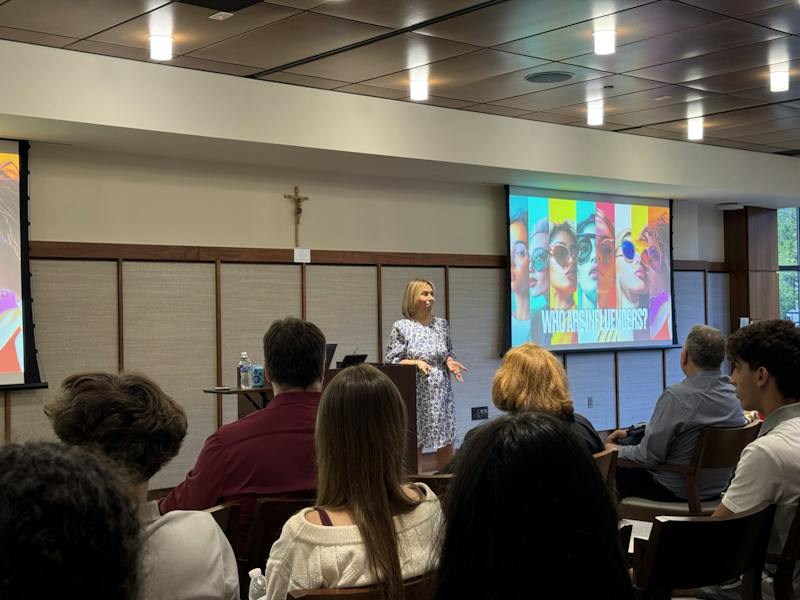
The Stillman School of Business, in collaboration with the Hall Social Lab, hosted “Reel Talk: Exploring the Impact of Influence” on Sept. 30, a forward-looking event that examined the growing role of influencer marketing in business and the importance of personal branding on social media. Held as part of the Stillman Speaks series, the event brought together students, faculty, and marketing professionals to explore how social media has fundamentally changed the way companies communicate with consumers. Debra Lee Surface, an assistant professor of marketing at Stillman, led the discussion, offering insights into what influence really means for students and how it drives key decisions in marketing, branding, and business strategy. Surface emphasized that students entering the workforce must learn to present themselves professionally on social media by combining creative expression with their long-term career goals. In an age in which a single post can shape public perception, she argued that understanding one’s online presence is no longer optional. The event came at a time when platforms like Instagram, TikTok, and YouTube have transformed ordinary users into powerful marketing channels, and brands are increasingly shifting their advertising budgets away from traditional media and toward content creators. For students in the room, the conversation served as both a wake-up call and a road map, illustrating how to navigate an environment where authenticity, audience trust, and personal identity are not just personal concerns but professional assets. “Reel Talk” therefore functioned as a bridge between the classroom and the fast-evolving digital marketplace, giving students a clearer sense of how to position themselves in an economy where visibility can be as valuable as a resume.
During the presentation, Surface broke down the influencer landscape, explaining the different categories of content creators that brands now rely on to reach consumers. She described “mega-influencers” and celebrities who are paid millions of dollars for high-profile advertisement brand deals, often lending their names and faces to global campaigns. But she also highlighted the growing importance of “micro-influencers” and “nano-influencers,” who may have smaller audiences but who maintain closer, more trusted connections with their followers. “Reel Talk” described how brands have begun to partner with these smaller creators to reach highly engaged audiences, because a recommendation from a trusted niche voice often carries more weight than a polished television commercial or an Instagram post from a distant celebrity. According to Surface, relationships among small influencers and their followers are strong and trusted, and this trust translates directly into consumer behavior. Surface explained that many consumers now make purchases based on influencer recommendations on platforms such as Instagram and TikTok, a trend that has increasingly reshaped the marketing landscape. Instead of relying solely on banner ads or search-engine placements, marketers must now think in terms of relationships, storytelling, and community. The shift has created new opportunities for students to build their own personal brands while still in school, but it has also introduced new pressures. As algorithms change, trends fade, and audiences become more discerning, maintaining relevance requires constant attention and ethical awareness. The discussion made clear that influencer marketing is not simply about posting attractive photos; it is about understanding strategy, audience psychology, and the long-term consequences of digital actions. For students hoping to enter the field, the message was that success depends on a combination of creativity, consistency, and an honest understanding of what they can offer.
Marketing students at the presentation expressed a mix of excitement and concern about social media’s impact on their field, citing the pressure to keep their brands relevant and ethical as trends continue to evolve. Hayden Eze, a freshman economics major, said social media has increased marketing opportunities while simultaneously increasing pressure on students to make ethical branding choices. “Social media…shows you that marketing is just behind everything,” Eze said. “Almost everything we do is…influenced by it.” That observation captures the way digital platforms have embedded commercial messages into nearly every corner of daily life, from the videos students watch to the products their favorite creators mention. Addison Mihas, a freshman business major, echoed that concern, emphasizing the need for students to present themselves professionally online to avoid controversy. “I think social media has helped marketing because people can connect with creators they relate to,” Mihas said. “On the other hand, brands sometimes create controversy when they promote ideas that people don’t agree with.” Mihas’s comments point to a larger challenge facing the industry: in an environment where consumers demand authenticity and accountability, a single misstep can damage a brand’s reputation almost instantly. For students, this means learning to balance self-expression with professional judgment, and recognizing that their online posts may be seen by future employers, clients, and collaborators. The pressure is not only to be interesting but to be responsible, to understand the social and political context of the content they share, and to be prepared for the fact that audiences may interpret their messages in unexpected ways. The conversation at “Reel Talk” made clear that the same platforms that offer visibility and opportunity also carry risks, and that students must develop a strong ethical compass to guide their decisions.
While some students expressed concern about social media’s role in marketing, others at the event saw it as a source of opportunity. Allison Adancero, a sophomore marketing major, said she believes social media offers students a way to stand out and combine self-expression with their careers. “Anyone can become an influencer,” Adancero said. “It’s not just for people who are good at taking pictures or making videos; anyone can find their purpose and build an audience.” Her perspective reflects the democratic promise of the creator economy, where success is not necessarily reserved for celebrities or polished content studios but is open to anyone with a unique point of view and the willingness to share it. Students who want to experiment in the influencer sphere can do so through the Hall Social Lab, established by Surface. In an interview with The Setonian, Surface discussed the lab’s origins and the importance of preparing students for the evolving social media landscape. The lab was founded in fall 2025 after the marketing department recognized social media’s growing impact on the field and sought to give students the knowledge and skills needed to enter the space. “We’re always trying to stay on top of what students need where students are,” Surface said. That commitment is reflected in the lab’s design, which gives students hands-on experience creating content, analyzing engagement, and collaborating with real influencers and professionals. For students like Adancero, the lab represents a rare chance to learn by doing, to test ideas, fail safely, and develop a voice before entering a job market that increasingly values digital fluency. The lab is not just a physical space; it is a training ground where students learn that personal branding is not about pretending to be someone else but about identifying what makes them unique and sharing that authenticity with the world. By making the lab available to students across disciplines, Stillman is encouraging a broader conversation about how social media can be used for more than entertainment, allowing students to see themselves as entrepreneurs of their own reputations.
Students collaborate with the lab’s social media manager, Susanna Buonaiuto, a senior finance and marketing major, along with influencers and other professionals in the field, to create and publish content for the lab’s platforms, Surface said. This collaborative model ensures that students are not learning in a vacuum but are instead connecting with people who work in the industry every day. Alongside the Hall Social Lab, the Stillman School offers a course on influencer marketing, which Surface teaches. The course is designed to teach students strategies related to influencer marketing, trends, personal branding, and content creation, with the goal of building their own personal brands while studying how influencer marketing works in practice. The curriculum treats students as active participants rather than passive observers, encouraging them to think critically about the content they consume and the content they produce. Surface explained that the course begins with a foundational question: what makes a person influential, and how can that influence be used responsibly? That question becomes a guiding framework for the rest of the semester, as students learn to analyze campaigns, identify target audiences, and develop content that aligns with their values. “The one big thing that we’re talking about is understanding that you need to provide the value from your own perspective,” Surface said. “The one thing that will help you in this space is…where can you offer your knowledge. You can offer something that is unique.” That message is particularly important for college students, who may feel pressure to imitate popular creators or chase trends that do not reflect who they actually are. The course encourages them to reject that pressure and instead focus on the knowledge and experiences they already have. Whether a student is passionate about finance, sports, art, or social justice, there is an audience waiting for content that speaks honestly to those interests.
Beyond learning the ins and outs of influencer marketing strategies, students in the course are also given the opportunity to create their own personal brands, turning the classroom into an incubator for real-world experimentation. “From the day that we start class, students are applying their own creativity,” Surface explained. “They immediately jump into thinking about their niche area that they are interested in and then they start building out their own brand. By the end of the class, they’re posting their own content and they’re really building up their own brand.” As they shape their brands, Surface reminds students to design ethical campaigns, emphasizing that their brands reflect who they are in life. This insistence on ethics is not just about avoiding controversy; it is about building a sustainable career in an industry where trust is the most valuable currency. “Understanding that you are a brand is important, having the ability to represent yourself in a way that aligns with your product,” Surface said. “When you go into the job market, you’re a brand. You have to sell yourself just like a product.” The event ultimately left students with a sophisticated understanding of influence, one that goes beyond follower counts and likes. By bringing together the Stillman School of Business, the Hall Social Lab, and a diverse group of students and faculty, “Reel Talk” highlighted the ways in which social media has become a fundamental part of business education. It also underscored the fact that influence, when used thoughtfully, can be a force for connection and positive change. As social media continues to evolve, the skills students learn through initiatives like the Hall Social Lab and the influencer marketing course will only become more important. The challenge now is for students to take what they learned and apply it with intention, recognizing that the brands they build today will follow them into the future.