





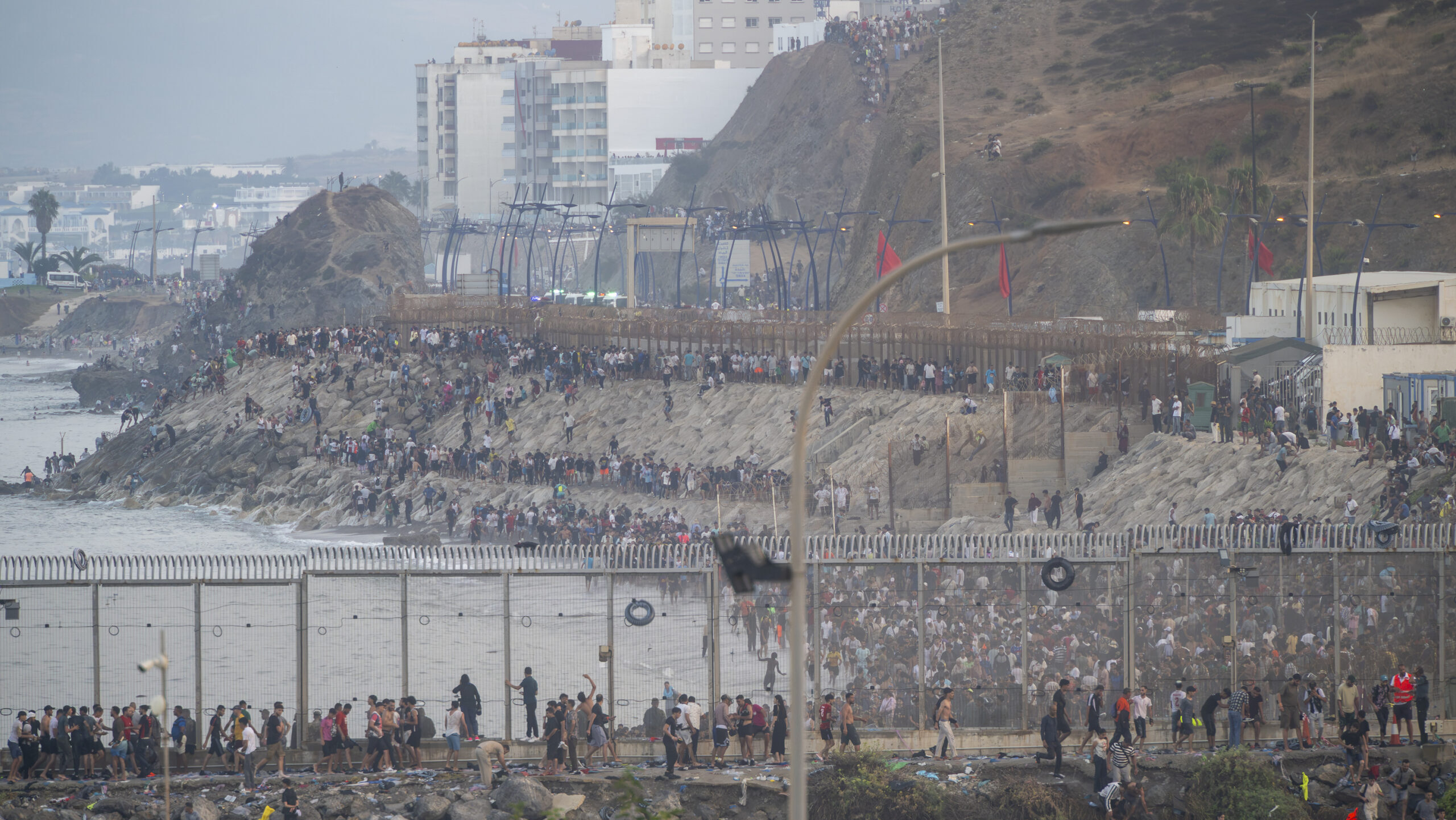
MADRID — Spanish Prime Minister Pedro Sanchez has accused Israel and Russia of spreading deliberately misleading social-media content that helped drive more than 72,000 migrants into the Spanish enclave of Ceuta last month from Morocco, a border surge that killed around 100 people and forced a major emergency response. In a radio interview with Cadena SER, Sanchez said the alleged disinformation was not animated by concern about migration in Spain or Europe, but was a form of retaliation for Spain’s political positions. “It’s clear that if Russia gets involved in spreading misinformation on this issue, or if Israel also spreads misinformation on this issue while criticizing the Spanish government, then it is not because they are concerned about migration in Spain or Europe, but rather because of the political positions we are taking,” he said. The prime minister did not provide evidence to support the allegations. The mass movement, which occurred between July 30 and 31, brought new attention to Ceuta, one of only two European land borders with Africa, and raised immediate questions about how so many people were able to make the crossing.
Spanish authorities have said that the sudden migrant surge was triggered by misleading posts on Instagram, TikTok and other social platforms. Those posts falsely claimed that migrants who managed to reach Ceuta, largely by sea, would automatically be allowed to remain in Spain. The false information appears to have been designed to generate a mass rush that would overwhelm border forces and leave Spanish authorities unable to process or return arrivals. Sanchez went further by saying that research carried out by the European External Action Service, the EU’s diplomatic body, had identified Russian and Israeli networks as being involved in spreading those posts. He did not supply the underlying report, and the alleged connection has not been independently verified. The lack of public evidence immediately became a central controversy. Israeli Foreign Minister Gideon Sa’ar dismissed Sanchez’s claim with harsh words, saying the Spanish prime minister was “lying shamelessly” in an effort to divert attention from domestic policy failures. In Israel’s account, Sanchez was seeking a scapegoat for an acute migration problem that his administration had failed to prevent or handle. Russia’s embassy in Madrid and the EEAS did not respond to requests for comment from Reuters.
The Spanish leader’s accusation must be understood against the background of his government’s highly visible international stances. Spain has been a strong critic of Russia’s full-scale invasion of Ukraine, raising objections repeatedly within European institutions and across NATO debates. At the same time, Sanchez has been one of the most prominent European leaders in denouncing the scale of civilian suffering in Gaza as Israel conducted its military campaign. He has called for a permanent ceasefire, pushed for greater humanitarian access, and argued for a credible path to Palestinian statehood. In Sanchez’s assessment, these positions made Spain a target. He suggested that Russia and Israel, for separate reasons, were tempted to harm Spain by using migration as a weapon of influence. Rather than confronting Spain over foreign policy directly, the prime minister argued, state-linked networks chose to destabilize Spain from within by encouraging a migrant wave that would provoke social tensions, pressure public services and undermine confidence in his administration. The allegation is serious, but it remains unsubstantiated by any visible intelligence product or court filing, leaving observers divided over whether Sanchez was revealing sensitive intelligence or constructing a political defense.
Sanchez took care not to blame Morocco for allowing the crossing, a decision that reflects diplomatic prudence. Spain and Morocco have invested heavily in rebuilding trust in recent years, and Madrid relies on Rabat for migration control, intelligence cooperation and counterterrorism. An official accusation against Moroccan authorities could have destroyed that framework and sparked a diplomatic emergency. Instead, Sanchez kept the focus on external disinformation networks. Spanish opposition parties, along with some human rights groups, have rejected that framing and accused Rabat of deliberately permitting the mass movement. They argue that Moroccan border forces normally work to stop or divert large groups, and that a crossing of this size would not have been possible without at least tacit approval from authorities in Rabat. These critics see the episode as a pressure tactic meant to remind Spain of Morocco’s strategic importance, particularly on the disputed Western Sahara territory. So far, the Spanish government has not publicly repeated that accusation, but the political debate in Madrid remains deeply divided over whether the migration surge was a humanitarian accident, a disinformation operation, or an intentional act of state pressure by Morocco.
Ceuta itself is a unique geography: a European city on the African continent, surrounded by the sea and Morocco, with few routes to the outside world except through Spanish border infrastructure. For decades, it and neighbouring Melilla have been points of acute vulnerability for the EU, because a determined crowd can create enormous pressure on relatively small police forces. But the numbers reported in this incident — more than 72,000 entries in a single 48-hour window, with around 100 fatalities — are exceptional. In previous years, even massive attempted crossings involved thousands rather than tens of thousands, and many were stopped before they could reach European soil. The arrival of social media as a mobilizing tool has made the dynamics far more difficult for state authorities to control. A single false claim, reposted thousands of times, can reach enormous audiences in a short space of time and convert despair or aspiration into a mass movement. This is precisely the vulnerability that Sanchez says foreign actors sought to exploit. The question is whether Spain and the EU possess the digital-influence monitoring and response capabilities to detect such campaigns before they cause real-world catastrophe.
The row over blame has immediate and longer-term consequences. If Sanchez’s accusation is correct, the Ceuta episode represents an alarming evolution in hybrid warfare: migration crises engineered through social networks as an instrument of state retaliation, and one aimed not at an insignificant country but at a key EU member state. That would demand coordinated European action against suspected foreign information operations and new rules to force tech platforms to label or swiftly remove coordinated deceptive content. If, however, the accusation is not supported by hard evidence, Sanchez risks a serious credibility problem at home and abroad. He has already strained relations with Israel; Sa’ar’s response signals that the charge will be met with open contempt. Russia, meanwhile, is likely to dismiss it as another example of Western “Russophobia.” The absence of immediate comment from Moscow and the EEAS only deepens the uncertainty. No independent verification or public report has emerged to confirm Sanchez’s claim. What remains beyond dispute is the scale of the tragedy: tens of thousands of people made desperate efforts to reach European soil, and dozens of lives were lost in the attempt. Their deaths demand answers regardless of whether the crisis was orchestrated by foreign intelligence services, Moroccan border policy, criminal smuggling networks, or a lethal combination of all three.