









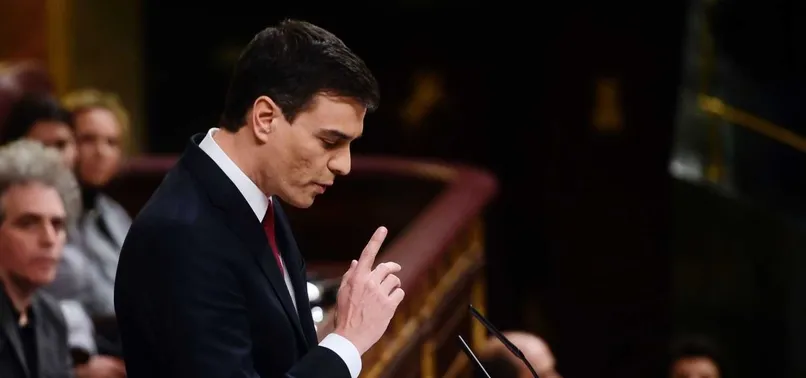
Spanish Prime Minister Pedro Sanchez has emphatically ruled out any Moroccan involvement in the migrant surge that overwhelmed Ceuta last month, instead blaming Russia, Israel and an international far-right network for spreading disinformation about the crisis. Speaking on Monday in an interview with Cadena SER radio, Sanchez said no intelligence service with which Spain normally cooperates had suggested any Moroccan role. The crisis unfolded on July 30-31, when more than 70,000 people entered the small Spanish territory in North Africa, many swimming or crossing on foot from Morocco in a mass movement that left scores dead. The number of arrivals was extraordinary for a territory of just 18 square kilometres and a resident population of around 84,000. Ceuta has long been one of the European Union’s most sensitive external borders, but the scale of this single influx was unprecedented. Sanchez’s comments were intended to shut down speculation that Morocco had deliberately engineered the border breach as a political message. He insisted that the crisis could only be resolved through cooperation, not through distrust toward Morocco. At the same time, he acknowledged that Spanish intelligence agencies and police had not been able to predict the magnitude of the emergency. “We are continuing to investigate,” he said, leaving open the possibility that more would be learned about how the mass entry was organized and why it came when it did.
Behind the immediate border emergency lies a long-running dispute over Western Sahara, a former Spanish colony that is largely controlled by Morocco but claimed by the Algerian-backed Polisario Front. Some analysts have suggested the migrant rush may have been a message to Spain from Morocco over this issue, particularly after Sanchez visited Algeria in July. Algeria is Morocco’s historic rival and the main international backer of the Polisario Front, which seeks independence for Western Sahara. The Spanish government has historically tried to balance its ties with both countries, but the visit to Algeria came at a sensitive moment. Sanchez said on Monday that no cooperating intelligence service had indicated “any involvement in one way or another of the Moroccan authorities.” He did not name the intelligence services, but his reference to the National Intelligence Centre and police situation reports suggested that Spain had been caught off guard. The prime minister acknowledged that although the government received reports, “no information made it possible to gauge the scale, the seriousness of the crisis we were going to experience.” This admission of surprise has prompted questions about whether Spanish security services missed signals, and whether more should have been done to deter the thousands of people who gathered near the border. For now, Sanchez is asking for patience and cooperation with Morocco, a country that has often been an unpredictable partner for Spain on migration.
Sanchez’s broader message on Monday was that the crisis was being exploited by external actors seeking to destabilize Spain and Europe. He singled out “rumours and disinformation” spread on social networks after the mass entry, which he said were “linked to Russia and Israel, and to an ultra-right international that always uses migration to attack both Spain and Europe and divide it.” The prime minister is an outspoken critic of Israel’s war against Hamas in Gaza, which he has called a genocide, and a staunch supporter of Ukraine in its fight against Russia’s invasion. He linked the disinformation directly to those positions, saying it was a consequence of “the political stances we are maintaining regarding the genocide in Gaza or Putin’s invasion in Ukraine.” The accusation drew an immediate and angry response from Israeli Foreign Minister Gideon Saar, who wrote on X that Sanchez was “lying shamelessly” by accusing Israel of disseminating misleading information. Saar added: “Continuing to spread defamatory lies will not distract from Sanchez’s disgraceful failure to manage his country’s affairs.” The exchange underscored the diplomatic fallout from the crisis. Meanwhile, experts who spoke to AFP offered a more concrete explanation for the initial surge: disinformation on social media deliberately misinterpreted a Spanish Supreme Court ruling, falsely suggesting that migrants who arrived by sea would not be returned. That false claim appears to have encouraged thousands of people to attempt the dangerous crossing into Ceuta, with deadly consequences.
The crisis immediately became a test for the European Union’s migration policy and its Schengen area, one of the bloc’s most cherished achievements. Schengen allows for passport-free travel across most EU countries, but it also depends on trust among member states that external borders are effectively protected. The sudden influx at Ceuta shattered that trust, at least temporarily. Italy’s right-wing government imposed border checks on travellers from Spain for one month, and Madrid reciprocated a week later. On Monday, both governments announced a 15-day extension of the controls. Such measures are allowed under Schengen rules in exceptional circumstances, but they are politically significant because they signal that one member state no longer fully trusts another to manage its borders. For Italy, the move was also a way to show domestic voters that it was taking a hard line on migration. For Spain, the reciprocal controls were a pointed response to a partner it felt was unfairly punishing it for a crisis on the EU’s external frontier. The episode illustrated how quickly an external border emergency can ripple through the internal politics of the European Union, creating new divisions and exposing the fragility of the bloc’s commitment to solidarity.
Inside Ceuta, the aftermath has been grim. Although the vast majority of the migrants were returned to Morocco within hours, thousands remain in the tiny territory, many of them living rough on the streets. The territory’s infrastructure has been overwhelmed. With 18 square kilometres and 84,000 residents, Ceuta is not equipped to house or care for thousands of extra people, especially those who arrive without documents or clear legal status. Their presence has become a major political flashpoint in Spain. The conservative and far-right opposition are demanding that all those who entered Ceuta, including minors, be returned to Morocco. They have accused the Socialist government of being too soft on migration and of failing to protect the border. At the same time, local residents have held regular demonstrations, saying they face security and hygiene problems linked to the influx. Streets that were already crowded now have migrants sleeping in public spaces, and residents say there are not enough toilets, showers or health services. The government has tried to reassure locals that it is taking the situation seriously, but the sense of crisis has not faded. The fate of the migrants, many of whom may have legal claims to remain, is now caught between domestic politics and Spain’s obligations under European and international law.
In response to the ongoing emergency, Sanchez announced on Monday that 6,000 places at reception centres would soon be available in Ceuta to house migrants. He stressed that the status of each migrant must first be verified by Spanish authorities before any possible return to Morocco. This process is likely to be slow and complicated, particularly for minors and for people who say they are fleeing conflict or persecution. Sanchez also pledged an additional 168 million euros ($195 million) in aid for Ceuta to help the territory cope with the crisis. The money is intended to improve reception conditions, strengthen security and address the concerns of residents. Whether these measures will be enough to calm the situation is unclear. The prime minister continues to face intense pressure from the opposition, from European partners and from the streets of Ceuta. He has staked his position on the idea that cooperation with Morocco is the only viable path forward. “This crisis can only be resolved through cooperation and not through distrust toward Morocco,” he said. But that stance is difficult to maintain when many Spaniards believe the government should have seen the crisis coming and prevented it. As Sanchez himself admitted, Spain was caught by surprise. With thousands of migrants still in Ceuta, border controls restored between Spain and Italy, and disinformation continuing to circulate online, the full consequences of the July surge are still unfolding. The government’s next moves will be watched closely in Rabat, Brussels and across the European Union.


