


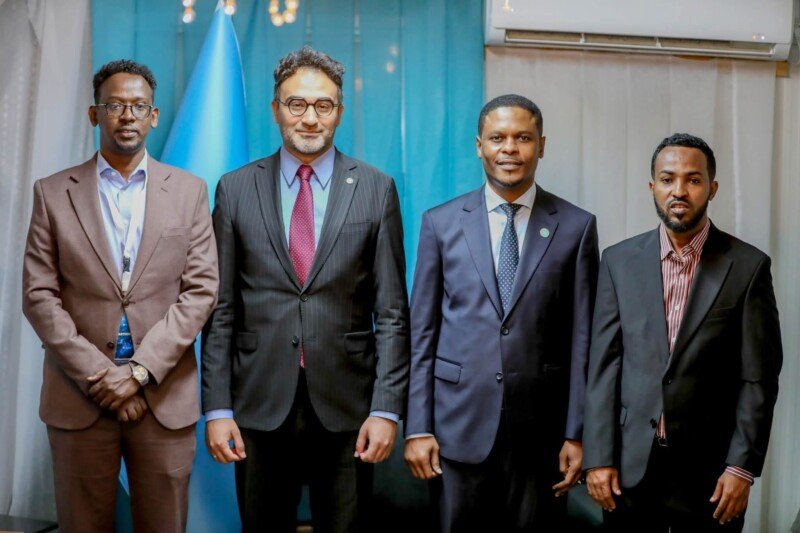
Mogadishu — In a high-level meeting held in the Somali capital on Saturday, Somalia’s Minister of Information, Culture and Tourism, Abdifatah Qasim Mohamud, received Deniz Demir, the Coordinator of the Center for Combating Disinformation at the Turkish Presidency’s Directorate of Communications. The meeting, which drew senior Somali media officials including the Director of the Strategic Communication Department, Abdishakur Ali Ahmed, and the Director of Somali National Television, Mohamedkafi Sheikh Abukar, was framed around deepening bilateral cooperation in the field of countering disinformation and misleading narratives. According to the ministry, the discussions focused on leveraging Turkey’s expertise in identifying, analyzing, and neutralizing harmful propaganda, as well as the dangers such information poses to social cohesion, national security, and the strategic partnership between Ankara and Mogadishu. Both sides emphasized the necessity of continuous collaboration to safeguard accurate information and preserve public trust. The meeting itself is emblematic of a broader alignment between the two countries, which have expanded ties across defense, trade, infrastructure, education, and religious affairs over the past decade. Yet the timing of the meeting is anything but neutral, coming as it does against a backdrop of public anger in Somalia over alleged Turkish military actions, and as press freedom groups continue to raise alarms about how “disinformation” laws are being used in both countries to silence critical voices. The official readout made no mention of the protests that have erupted in southern Somalia, nor did it acknowledge the sensitive political environment in which the cooperation is being pursued. Instead, it presented the partnership as purely technical and benign, a framing that many Somali journalists and civil society actors are likely to challenge.
The meeting comes at a moment of acute political tension over the role of Turkish drones in Somalia’s internal affairs. Protests have been reported in several towns, including Kismayo, Afmadow, Doolow and Garbaharrey, following allegations that Turkish drones were involved in an attack on the residence of General Mahad Abdirahman Aden, the former commander of the Somali Custodial Corps. The attack, which took place on the night of September 3 in Doolow, reportedly killed the general, and authorities in the self-declared Jubaland region have accused Turkey of carrying out the strike at the behest of the federal government in Mogadishu, allegedly because the general held political differences with federal leadership. The response in some communities has been dramatic and deeply symbolic. In Kismayo, hundreds of demonstrators burned the Turkish flag, while some carried images of Turkish President Recep Tayyip Erdogan with what appeared to be bloody hands, alongside banners reading “We don’t need Erdogan.” Protesters were quoted chanting, “We once loved Erdogan and Turkey, now we hate them.” The federal government, for its part, has categorically denied the airstrike claim, stating that preliminary information suggested the explosions were caused by explosives being prepared inside the house, and announcing that a fact-finding committee would be appointed to investigate the incident. Turkey has not officially commented on the allegations. The incident has exposed the fragility of popular perceptions of Turkey’s role in Somalia, where Ankara has built schools, hospitals, and ports, but where its military footprint, particularly its drone program, has increasingly become a source of controversy, especially in regions that are politically aligned against the federal government or that have historically sought greater autonomy. In that context, the counter-disinformation meeting in Mogadishu can be read as part of a broader effort to manage the narrative around such incidents, rather than simply as an administrative exchange between media officials.
This is not the first engagement between Somali and Turkish officials on media and information policy, and the current meeting must be seen within a broader pattern of expanding cooperation. In September 2026, the same Somali minister, Abdifatah Qasim Mohamud, and the same Turkish coordinator, Deniz Demir, appeared together at a program titled “A New Era in Türkiye-Somalia Relations” held at Aden Adde International Airport in Mogadishu. At that event, the Speaker of the Somali House of the People, Abdulkadir Mohamed Nur, called for enhanced efforts to counter disinformation, framing such efforts as essential to protecting the strategic partnership between the two countries. A few months earlier, in May 2026, the Turkish Ambassador to Somalia, Alper Aktaş, visited the Ministry of Information to discuss media modernization, institutional capacity building, and cross-cultural exchange programs. According to official accounts, the ambassador also raised the possibility of cooperating on countering regional disinformation campaigns, a phrase that could encompass everything from extremist propaganda to domestic political criticism. Beyond bilateral government-to-government exchanges, Somalia has also launched a National Policy Consultation on Managing the Risks of Social Media Misuse, bringing together government officials, civil society representatives, media professionals, and legal experts to develop a framework aimed at mitigating harms such as cyberbullying, hate speech, online radicalization, and the spread of false information. The consultation process has been presented as a forward-looking initiative, but it has also raised concerns among press freedom advocates because of the ambiguous language around “misuse” and “false information,” terms that are often interpreted differently by governments than by independent journalists. As Turkish institutions move into Somalia’s media sector, bringing with them specialized training modules, software tools, and legal frameworks developed in Ankara, there is a growing risk that the Somali government will adopt a model of information governance that prioritizes regime protection over genuine public interest.
The Turkish model that Somalia is being encouraged to emulate is one that has drawn serious international criticism for its chilling effect on journalism. Article 217/A of the Turkish Penal Code, widely known as the “disinformation law,” entered into force in October 2022 and has since been used extensively to prosecute journalists. According to monitoring by press freedom organizations, at least 83 journalists have been charged a total of 114 times under the provision. The law is notoriously vague, failing to define clearly what constitutes “untrue information” or what threshold makes it a threat to “public order and security.” This vagueness has left courts with effectively unchecked power to determine what is criminal, and as one journalist prosecuted under the law put it, any information not sourced from the government is liable to be deemed false. The practical consequences have been severe. In April 2026 alone, journalists Murat Ağırel and Barış Pehlivan were each sentenced to one year and three months in prison for commentary made during a television broadcast, while Zafer Arapkirli received a two-year and six-month sentence for a social media post. These are not isolated cases but part of an escalating pattern of legal harassment. The International Federation of Journalists and its partners have condemned the escalating use of the law, calling for its immediate repeal and describing Turkey as a “regional and even global outlier in the misuse of regressive fake news and disinformation legislation.” Despite this record, Turkish officials have presented their counter-disinformation experience as a model for friendly countries, and in Somalia they find a receptive audience among government officials who have expressed unease about the power of social media to amplify opposition narratives, particularly in a politically decentralized environment where regional leaders often communicate directly with their constituents through digital platforms. The danger is that Somali officials will import the same vague definitions, the same reliance on criminal penalties, and the same willingness to target journalists who challenge official narratives.
Somalia does not need to borrow from Turkey to find examples of how media laws can be used to suppress dissent, because it already has its own serious track record of press freedom violations. Journalist Mascuud Warsame, the founder of Xogbile TV, was released in August 2026 after 40 days in detention without formal charges, raising serious concerns about the legality of his detention and the broader state of press freedom in Somalia. In May 2026, Somali security forces detained and allegedly assaulted three journalists in Mogadishu, with media organizations reporting that police threatened them with death if they did not remain silent about planned protests and other sensitive developments in the capital. Social media activist Sacdiya Macalin Ali was detained for 122 days before an appeals court overturned her three-year sentence for “insulting state institutions” and “incitement,” convictions that stemmed from videos she posted criticizing government officials. Somali police have also detained TikTok content creators accused of mocking President Hassan Sheikh Mohamud, with authorities describing their actions as a “criminal offense” under laws against insulting national leaders. The country’s draft Penal Code, which is currently before parliament, contains provisions that press freedom organizations warn could further criminalize journalism. Reporters Without Borders and the National Union of Somali Journalists have identified specific articles that penalize “false,” “misleading,” or “exaggerated” information with sentences of up to ten years in prison, and up to twenty years when the alleged offense is linked to a “hostile state.” The language is strikingly similar to the language used in Turkey’s disinformation law: vague, sweeping, and open to political interpretation. Already, Somali journalists operate in an environment where they can be arrested without charge, threatened by security forces, or dragged through the courts for the simple act of reporting on opposition voices or regional grievances. Adding a new legal framework guided by Turkish experts would likely deepen these practices rather than correct them, especially if the framework includes provisions criminalizing the dissemination of information deemed by the government to be “false” or “misleading,” regardless of the reporter’s intent or the public interest value of the report.
Taken together, the meeting between Somali and Turkish officials on countering disinformation raises uncomfortable questions about the direction of Somalia’s media policy and the nature of the political partnership between Mogadishu and Ankara. Disinformation is indeed a genuine problem in any society. In Somalia, as elsewhere, false narratives can fuel clan violence, incite panic, undermine public health campaigns, and distort electoral processes. No reasonable observer would deny that governments have a legitimate interest in countering the most harmful forms of fabricated content. But the record in Turkey demonstrates how such laws are more often used to silence critics than to protect the public. The vague provisions of Article 217/A have been weaponized against journalists on a scale that has drawn condemnation from international press freedom organizations, and the same pattern of vague legal language is now visible in Somalia’s draft Penal Code. The risk, therefore, is that Somalia is importing not just Turkey’s technical expertise but its approach to controlling narratives. Somali journalists already face arbitrary arrests, equipment confiscation, and degrading treatment at the hands of security forces. Social media users have been detained for posts criticizing government officials or discussing sensitive topics. A partnership built on the Turkish model would further shrink the space for independent reporting and public debate in a country where access to credible information is already constrained by insecurity, poverty, and political fragmentation. The government frames its efforts as a way to combat harmful falsehoods and protect national security, and that framing may resonate with some segments of the public who are genuinely concerned about the destabilizing effects of social media. Yet the record both in Turkey and in Somalia suggests that the ultimate effect of such policies is to criminalize dissent, not to improve the quality of public discourse. If the Somali government is serious about protecting accurate information and public trust, it should begin by strengthening independent journalism, ensuring due process for detained media workers, and publishing clear and narrow definitions of what constitutes prohibited speech. Without those safeguards, any initiative passed under the banner of countering disinformation risks becoming a tool for suppressing political opposition and entrenching centralized power, while doing little to address the real conditions, from corruption to discrimination, that drive citizens to distrust their government in the first place.