









A Border Made of Rumours: How Online Misinformation Drove Thousands Into Ceuta — and Why Walls Cannot Win
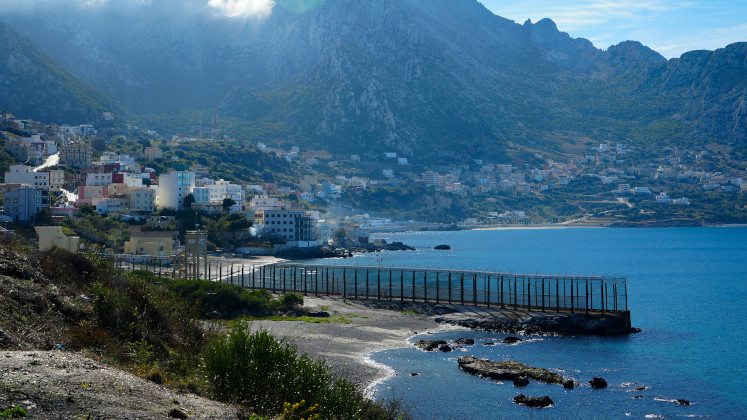
At the end of July, an estimated 60,000 migrants swam or walked past border barriers in a matter of hours, crossing from the Moroccan coastal town of Fnideq, known locally by its Spanish colonial-era name, Castillejos, into Ceuta, a Spanish enclave on Morocco’s Mediterranean coast. The scale of the movement overwhelmed a city of roughly 84,000 people, yet this was not a spontaneous or purely economic migration. It all began with a legal technicality. On 8 July, the Spanish Supreme Court released a ruling stating that migrants arriving by water could not be returned without due process, since their crossing is not considered a breach of a physical barrier. The news spread immediately on social media platforms dedicated to undocumented migrants, or harraga, literally “the burners,” a reference to the practice of burning documents to avoid repatriation. In the process, the ruling was distorted into what many understood as an open invitation to swim to Ceuta and Melilla with total impunity. According to Hind B. Wright, whose analysis focuses on the crisis, online misinformation played a key role in transforming a narrow judicial decision into a mass border mobilisation. The episode demonstrates that border management must place far greater emphasis on monitoring the spread of information online. Physical barriers, military deployments and surveillance systems may define the visible architecture of border enforcement, but the real trigger for the Ceuta surge was digital: a legal nuance, stripped of context, amplified through networks that migrants trust and use daily. The state was caught unprepared not because it lacked fences, but because it lacked an information early-warning system capable of understanding how rumours travel.
On 31 July, Spanish Prime Minister Pedro Sánchez made an emergency visit to Ceuta, where he condemned the influx of tens of thousands of people as “an attack” and a “violation of Spain’s territorial integrity and sovereignty.” By that point, the enclave had taken in tens of thousands of newcomers within hours, increasing its population by 70 percent. The city’s Mayor-President called the situation “unsustainable,” noting that Ceuta lacked the security, healthcare, housing and infrastructure to absorb the surge, which included unaccompanied minors, infants and the elderly. The immediate response was a familiar mix of blame and containment. Sánchez blamed “human trafficking mafias” for exploiting victims and spreading misinformation, and he quickly deployed a 500-metre floating barrage along the Tarajal breakwater. This was a carefully chosen measure: the floating barrier was designed to meet the Supreme Court’s definition of a physical barrier, thereby restoring the legal basis for summary returns. By 3 August, the crisis had largely subsided, and most migrants were returned to Morocco. But the human cost was severe. At least 88 people had died, including Faten Ben Omar El Azizi, a 20-year-old footballer whose Schengen visa was approved by Spain the same day she drowned. Her death underscored the cruel timing of borders: a document meant to open a legal path to Europe arrived too late, while informal, social-media-driven routes led to the water and, for many, to tragedy. The humanitarian catastrophe was not simply a matter of overwhelmed infrastructure; it was the result of a chaotic information environment in which a court ruling became a rumour, and a rumour became a mass movement.
The institutional response to the tragedy followed a now-predictable script. In a letter to Sánchez, European Commission President Ursula von der Leyen called for strengthened external borders, “vigilant monitoring” and “the use of physical barriers where needed,” echoing the conclusion drawn after an 8,000-person crossing in May 2021. Subsequent years have followed the same pattern: a social media-driven mobilisation in September 2024, a fog-assisted swim by 54 children in July 2025 and now a mass crossing in July 2026. Every episode triggers the same institutional reflex: more surveillance, more enforcement and more physical barriers. This pattern cuts across the political spectrum. Santiago Abascal, the leader of the far-right Vox party, demanded a concrete “impassable wall” and the “permanent militarisation” of the frontier. Regionally, Italy unilaterally suspended the Schengen agreement with Spain for a month, while 22 of the EU’s 27 member states, including Denmark, Finland, the Netherlands and Sweden, signed a joint letter demanding coordinated action to secure Europe’s borders. In under a week, a court ruling about due process had produced calls for concrete walls, suspended treaties and continental-wide alarms. This was the identical reflexive response Ceuta has triggered four times in five years, regardless of who holds power. The fact that no party, from the centre-left to the far right, offered a fundamentally different approach reveals a deeper institutional failure: the belief that borders are physical objects, and that security means building more of them.
Yet none of this accounts for the structural push factors driving people toward the water, including economic inequality and the lack of opportunities in much of North and West Africa. From an institutional perspective, however, the state’s chosen remedy is fundamentally mismatched with the nature of the crisis. Reports from the ground indicate that word of the Supreme Court ruling’s social media distortion reached Spanish counterparts about 22 July, roughly a week before the crossing peaked. The information existed, but there was no mechanism built to act on it. A week is an eternity in a fast-moving migration event. It was enough time to translate the ruling, to monitor the relevant Telegram channels, Facebook groups and WhatsApp conversations, or to issue targeted warnings to would-be migrants about the actual legal consequences of attempting an irregular crossing. None of that happened, because the institutions responsible for border security were watching the water, not the web. The failure was not one of intelligence gathering, but of institutional imagination. Border agencies have protocols for monitoring physical movements, intercepting boats and reinforcing barriers, but they have no equivalent for monitoring the information ecosystems that now shape migration behaviour. The Supreme Court ruling did not have to become an open invitation. It only became one because the state ceded the digital battlefield to smugglers, traffickers and informal networks who knew exactly how to frame the news for maximum impact. In that sense, the Ceuta crisis was not a failure of law enforcement but a failure of information governance.
Because states view migration control primarily as a physical exercise in steel and concrete, they remain largely blind to how modern information ecosystems operate. The spread of misleading information is a manageable problem, but not with a fence. States must start treating information the way they already treat their borders: as something to monitor, staff and respond to in real time. This means investing in open-source intelligence units dedicated to migration, establishing early-warning systems that track viral narratives across languages and platforms, and building the kind of institutional memory that can recognise a distorted legal ruling as a precursor to mass movement. It also means accepting that the border of the twenty-first century is not only a line on a map, but a digital space where rumours are weaponised, fears are amplified and opportunities are coordinated. A physical barrier can be circumvented by a single social media post telling people where to gather and when. A floating barrage can be rendered obsolete by a WhatsApp voice note explaining which stretch of beach is unguarded. The state response to these challenges has so far been reactive: after each crisis, officials promise more cameras, more patrols and more walls. But the next crisis will not be prevented by any of those measures if the information ecosystem that drives migration is left unattended. Treating information as a border requires a different kind of presence: not guards with binoculars, but analysts with language skills and platform expertise; not concrete barriers, but coordinated communication strategies that can counter false narratives before they cross the digital frontier.
For migrants crossing at Ceuta, physical walls matter very little when digital networks allow them to map gaps, gauge enforcement and mobilise in real time. The beach is not the boundary; the smartphone is. As long as European states view decentralised digital communication as incidental background noise rather than a primary theatre of border management, the next crisis will not be determined by how much fence stands at the water’s edge. It will be decided by whether states finally treat information as fast as the people crossing do. The lesson of July is not that Spain needs a taller wall. It is that the wall that matters is no longer made of steel, but of knowledge — and the state is losing ground on that front. Hind B. Wright’s analysis makes clear that the solution will not involve simply blaming traffickers or issuing tougher border directives. It will require a fundamental reorganisation of how border security is conceived: less engineering, more listening; less construction, more comprehension. Until then, the enclave of Ceuta will remain a symbol of a deeper vulnerability: the inability of states to recognise that, in the age of networked migration, the first breach of the border happens in the feed, not in the fence. Note: This article gives the views of the author, not the position of LSE European Politics or the London School of Economics.


